Tutorial: assessing convergence of nonlinear solvers

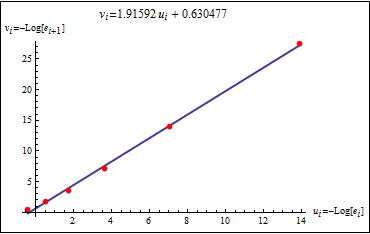
Given software that finds a value of x that makes f(x)=0 , how do you infer the rate of convergence of the algorithm embedded in the software?  The answer is to do some tests for which you know the answer.  Shown below are convergence plots of the error \left(e_i = |x_i-x^\text{exact}|\right) for three solver methods applied to find a zero of the function f(x)=(x-1.5)(x-2.3) . In all cases, the first guess is taken so that the root x=1.5 is found by the solvers. The errors at each iteration are used to generate points on a convergence plot as indicated.  The slope of the plot is the rate of convergence. The zip file, 5newtonIterationErrorConvergenceAnalysis.zip, contains the Mathematica commands (.pdf and .nb) used to conduct this study.

(a) Classical Newton-Raphson

Convergence plot for classical Newton-Raphson iterations at the Utah Computational Solid Mechanics Lab

Classical Newton-Raphson iteration, here applied to find the zero of the function (x-1.5)(x-2.3) using a starting guess of x=0, has approximately second-order convergence (slope of the line).


(b) Modified Newton-Raphson:

Modified Newton-Raphson Convergence Plot at the Utah Computational Solid Mechanics Lab

The modified Newton-Raphson method, which uses the function slope at the first iteration for all subsequent iterations, has approximately first-order convergence and thus requires more iterations (more red dots).

(c) Secant solver:

Secant solver convergence analysis at the University of Utah Computational Solid Mechanics Lab

Convergence for a secant solver, in which the function slope is approximated by the secant connecting two first guesses (x=0 and x=0.5), showing a convergence rate (slope of this line) somewhere between 1st-order and 2nd-order


The zip file, 5newtonIterationErrorConvergenceAnalysis.zip, contains the Mathematica commands (.pdf and .nb) used to conduct this study.

Exciting time for materials research in Utah


Congratulations to the University of Utah Materials Science researchers and collaborators in Physics and Electrical Engineering for their new $21.5M center of excellence aimed at fundamental research in the areas of organic spintronics (for advanced data storage) and plasmonic metamaterials (for improved microscope resolution and for increased data transfer speeds).  For more information, see http://unews.utah.edu/news_releases/21-5-million-for-materials-research.

Conference Poster: Hertzian contact theory applied to edge-loaded ceramic-on-ceramic hip bearings: analysis and validation.

Sanders, A. P., and R. M. Brannon. (2010) “Hertzian contact theory applied to edge-loaded ceramic-on-ceramic hip bearings: analysis and validation.” Transaction of the 56th Annual Meeting of the Orthopaedic Research Society, March 6-9, New Orleans, LA, Poster 2258.

Abstract

This work addresses the problem of wear of ceramic-on-ceramic bearing couples used in total hip arthroplasty. A wear pattern called stripe wear has been observed on retrieved ceramic femoral heads. It typically appears as a long, narrow, roughened area on affected implants. Evaluation of the wear stripe has revealed grain removal and material loss to depths of 30 mm. It has been theorized that such damage is caused by contact between the femoral head and the edge of the acetabular cup. An edge-loaded contact is much less congruent than normal contact, and it would cause increased contact stress, leading to the wear stripe. Edge-loading may be due to small separations of the head from the cup, as observed radiographically. Simulator wear tests involving such separation have yielded wear stripes similar to those on retrieved bearings.