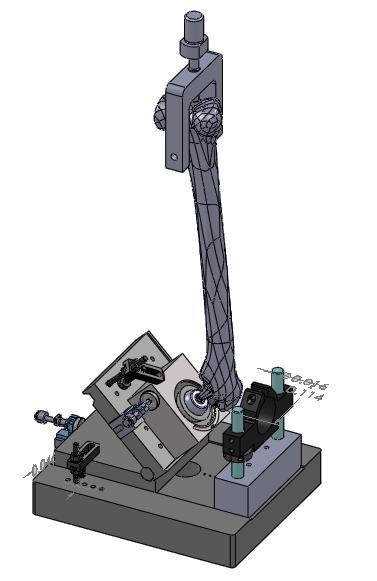
Rim cracking of polyethylene acetabular liners and squeaking in ceramic components are two important potential failure modes of hip implants, but the loads and stresses that cause such failures are not well understood. Contact stresses in hip implants are analyzed under worst case load conditions to develop new wear testing methods to improve the pre-clinical evaluation of next-generation hip implants and their materials. Complicated full-scale hip implant simulator tests are expensive and take months to complete. A primary goal of this work is to find inexpensive surrogate specimen shapes and loading modes that can, in inexpensive lab tests taking only a few hours, produce the same wear patterns as seen in full-scale prototype testing. Continue reading
Tag Archives: failure
Publication: On a viscoplastic model for rocks with mechanism-dependent characteristic times
A.F. Fossum and R.M. Brannon (2006)
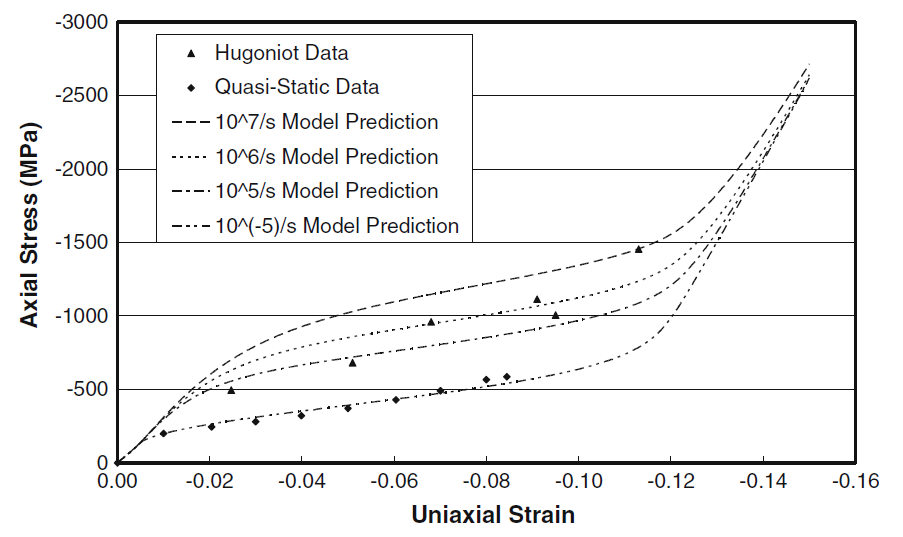
This paper summarizes the results of a theoretical and experimental program at Sandia National Laboratories aimed at identifying and modeling key physical features of rocks and rock-like materials at the laboratory scale over a broad range of strain rates. The mathematical development of a constitutive model is discussed and model predictions versus experimental data are given for a suite of laboratory tests. Concurrent pore collapse and cracking at the microscale are seen as competitive micromechanisms that give rise to the well-known macroscale phenomenon of a transition from volumetric compaction to dilatation under quasistatic triaxial compression. For high-rate loading, this competition between pore collapse and microcracking also seems to account for recently identified differences in strain-rate sensitivity between uniaxial-strain ‘‘plate slap’’ data compared to uniaxial-stress Kolsky bar data. A description is given of how this work supports ongoing efforts to develop a predictive capability in simulating deformation and failure of natural geological materials, including those that contain structural features such as joints and other spatial heterogeneities.
Available online:
http://dx.doi.org/10.1007/s11440-006-0010-z
http://www.mech.utah.edu/~brannon/pubs/7-2006FossumBrannonMechanismDependentViscoplasticity.pdf
