
Click here for the Mechanical Engineering anti-plagiarism document, which defines plagiarism in its many forms and provides some guidance about how to properly reference other people’s work (or even your own previously published work).
Category Archives: Research
Research related news, supplements, and documentation.
Tip for success: How to write a status memo

You might think that a traditional status memo is a thing of the past, but submitting a memo to your boss (even when not asked to do so) is a great way to get your work noticed and to help you set your own focus for work yet to come. Click here for a sample memo format that Dr. Brannon uses with her own research group.
The following article also seems to have some good tips:
“Business Memo Format.” Sophisticated Edge. N.p., n.d. Web. June 17, 2012 . .
Conference Poster: Scaled surrogate Hertzian bearing pairs for contact and wear testing
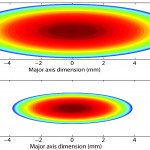
Contact pressures
Sanders, A. P., and R. M. Brannon. (2012). “ Scaled surrogate Hertzian bearing pairs for contact and wear testing.” Transactions of the Orthopaedic Research Society 2012 Annual Meeting, San Francisco, CA, Feb. 4-7, Poster 2070. 2012 ORS poster 01 small
Abstract
New implant bearing materials require extensive laboratory testing before clinical use, but the currently practiced contact and wear test methods impose limitations. Screening wear tests of prototype materials are typically done using simple bearing shapes (such as a ball-on-flat pair) and low loads. These tests are relatively simple and inexpensive, but they lack representative bearing shapes and contact stresses. Simulator wear tests on full-scale components overcome this shortcoming by implementing higher loads and complex, physiologic motion patterns. However, these tests are lengthy and expensive; so, they are reserved for final design testing. Surrogate test specimens that would mimic the contact mechanics of full-scale bearing pairs could improve the relevance of early screening tests. This research examines the hypothesis that a reduced-scale surrogate Hertzian contact pair can elicit a smaller scale, equal stress version of the contact response of a larger original contact pair. A chosen original contact pair mimics a knee implant femoral-tibial condylar interface, and a full-scale surrogate pair is found using recently published formulas. New formulas were derived to find a smaller version of the surrogate pair. The contact pairs were tested in quasi-static normal loading, and their contact patches were measured to evaluate the hypothesis.
Conference Poster: Modeling, Testing, and Analysis of Impulse Response of Femoral Head Reduction in Ceramic Hip Prostheses
Kakarla, D., A. P. Sanders, S. Siskey, K. Ong, N. Ames, J. O. Ochoa, and R. M. Brannon. (2012). “Modeling, Testing, and Analysis of Impulse Response of Femoral Head Reduction in Ceramic Hip Prostheses.” Transactions of the Orthopaedic Research Society 2012 Annual Meeting, San Francisco, CA, Feb. 4-7, Poster 2076.
Abstract
Hip simulator wear tests including micro-separation conditions have revealed that abnormal loading events can outweigh normal loading conditions in causing wear of hard-on-hard bearings. Yet, there is a paucity of data to describe the mechanics of abnormal events such as edge loading by femoral neck impingement or femoral head subluxation. Though the magnitude of head subluxation has been measured in-vivo for a variety of human activities, there are apparently no corresponding reports of the concurrent head-liner contact forces; accurate measurements of the same may be rendered difficult by the transient, impulsive nature of edge loading. This report provides initial laboratory results of an in-vitro and in-silico study of impulsive femoral head reduction whose ultimate aim is to quantify dynamic edge-loading contact forces and stresses. The study implements an engineering model of proximal-lateral head subluxation and edge loading as could occur in a lax hip during the swing phase of gait. Rapid reduction is caused by applying a sudden cranio-caudal motion to the acetabular liner. In the laboratory, the femur’s response to this input is measured with strain gages and a laser vibrometer.
Publication: Concomitant evolution of wear and squeaking in dual-severity, lubricated wear testing of ceramic-on-ceramic hip prostheses.
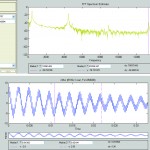
Spectral analysis of ceramic hip squeaking
Sanders, A., I. Tibbitts, and R. Brannon. (2012). “Concomitant evolution of wear and squeaking in dual-severity, lubricated wear testing of ceramic-on-ceramic hip prostheses.” Journal of Orthopaedic Research: DOI 10.1002/jor.22080.
Abstract
Ceramic-on-ceramic (CoC) hip bearings were tested in short-term wear tests with a systematically varied contact force. Continuous vibration and intermittent surface roughness measurements were obtained to elucidate potential causes of in vivo hip joint squeaking. The three-phase test comprised alternating cycles of edge loading (EL) and concentric articulation (CA), always using ample serum lubricant. A 50,000-cycle wear trial in which the contact force during CA was distant from the head’s wear patch yielded no squeaking and practically no liner roughening. In 10-cycle trials of an edge-worn head coupled with a pristine liner, the contact force was varied in magnitude and point of application; immediate, recurrent squeaking occurred only when the contact force exceeded a critical threshold value and was centered upon the head’s wear patch. In a 27,000-cycle wear trial with the contact force applied near the margin of the head’s wear patch, recurrent squeaking emerged progressively as the liner’s inner surface was roughened via its articulation with the worn portion of the head. The results reveal key conditions that yield recurrent squeaking in vitro in various scenarios without resorting to implausible dry conditions. A fundamental theory explains that hip squeaking is induced by myriad stress waves emanating from asperity collisions; yet, the root cause is edge loading.
Available online:
http://dx.doi.org/10.1002/jor.22080.
Publication: Thin Hard Crest on the Edge of Ceramic Acetabular Liners Accelerates Wear in Edge Loading.
Sanders, A. P., P. J. Dudhiya, and R. M. Brannon. (2012). “Thin Hard Crest on the Edge of Ceramic Acetabular Liners Accelerates Wear in Edge Loading.” Journal of Arthroplasty 27(1): 150-152.
Abstract
Ceramic acetabular liners may exhibit a small, sharp crest—an artifact of discontinuous machining steps—at the junction between the concave spherical surface and the interior edge. On 3 ceramic liners, this crest was found to form a 9° to 11° deviation from tangency. Edge loading wear tests were conducted directly on this crest and on a smoother region of the edge. The crest elicited 2 to 15 times greater volumetric wear on the femoral head. The propensity of the crest to rapidly (<2000 wear cycles) cause elevated wear under low contact force (200 N) suggests that the crest artifact of prevailing machining protocols might be a root cause of stripe wear and squeaking in ceramic acetabular bearings.
Available online:
doi:10.1016/j.arth.2011.08.012.

Centroidal Voronoi Tesselations
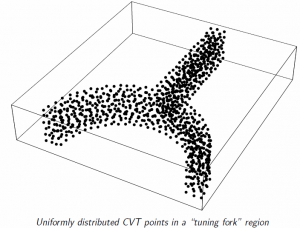
The CSM lab at the University of Utah is actively developing the Material Point Method (MPM). Like other particle methods, the MPM discretizes a body into a set of points at which problem data (velocity, stress, temperature, etc.) are stored. Centroidal Voronoi Tesselation is a promising way to distribute points within a domain in a way that is favorable to the MPM, where using a distribution of particles conforming to the boundary is highly desired. For a thorough overview, see Max Gunzburger’s website, http://people.sc.fsu.edu/~mgunzburger/cvt/cvt.html. Some excerpts from his site are shown below,
Aldridge (AKA Blake) spherical source verification test for dynamic continuum codes
This post has the following aims:
- Provide documentation and source code for a spherically symmetric wave propagation in a linear-elastic medium.
- Tell a story illustrating how this simple verification problem helped to validate a complicated rate-dependent and history-dependent geomechanics model.
- Warn against believing previously reported material parameters, since they might have been the result of constitutive parameter tweaking to compensate for unrelated errors in the host code. Continue reading
Publication: A model for statistical variation of fracture properties in a continuum mechanics code
NEWS FLASH: The print version of the Meyer-Brannon paper on statistical variation of fracture patterns in a continuum code (CTH) is now available at http://dx.doi.org/10.1016/j.ijimpeng.2010.09.007.
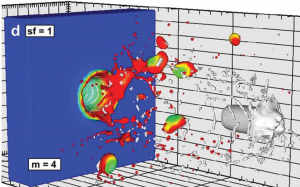
Perforation with Aleatory Uncertainty of high-pressure strength in an Eulerian Simulation.
Comparison of Uniaxial Stress and Uniaxial Strain States
When doing verification of material models it is a very good idea to check both uniaxial stress and uniaxial strain states. For a von Mises material, we can analytically determine what displacements and stresses will be present when the material yields. The following table was created to aid those that work with the von Mises (or J2 plasticity) material model.
There are only three parameters that are used for the table; specifically, the yield stress in uniaxial tension and any two elastic modulii. The table was written so that if only Young’s modulus and Poisson’s ratio are known, the reader can derive any other required values by using the equations included at the bottom of the table.
The LaTeX source for the table can be found here.
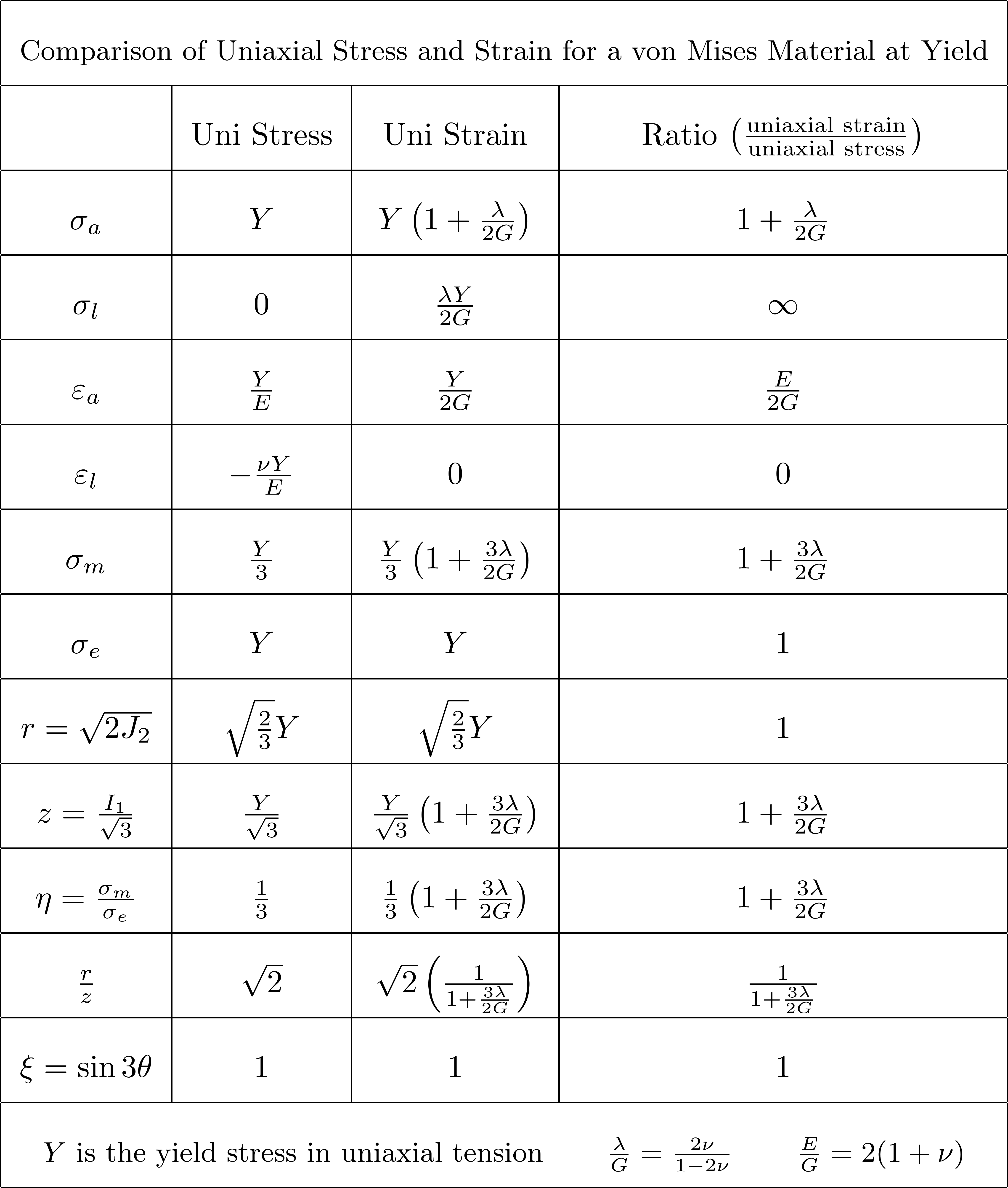
Comparison of Uniaxial Stress and Strain for a von Mises Material at Yield
 University of Utah CSM Group