
A.F. Fossum and R.M. Brannon (2006)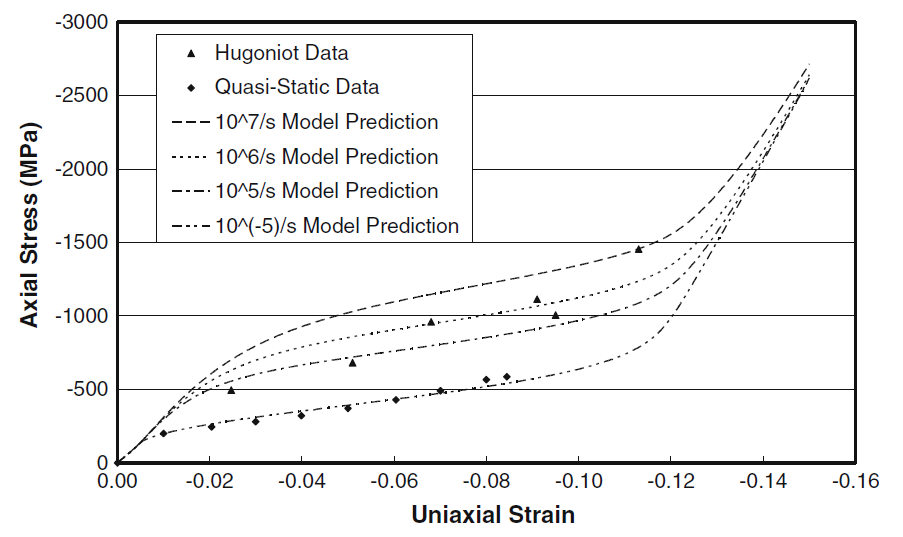
This paper summarizes the results of a theoretical and experimental program at Sandia National Laboratories aimed at identifying and modeling key physical features of rocks and rock-like materials at the laboratory scale over a broad range of strain rates. The mathematical development of a constitutive model is discussed and model predictions versus experimental data are given for a suite of laboratory tests. Concurrent pore collapse and cracking at the microscale are seen as competitive micromechanisms that give rise to the well-known macroscale phenomenon of a transition from volumetric compaction to dilatation under quasistatic triaxial compression. For high-rate loading, this competition between pore collapse and microcracking also seems to account for recently identified differences in strain-rate sensitivity between uniaxial-strain ‘‘plate slap’’ data compared to uniaxial-stress Kolsky bar data. A description is given of how this work supports ongoing efforts to develop a predictive capability in simulating deformation and failure of natural geological materials, including those that contain structural features such as joints and other spatial heterogeneities.
Available online:
http://dx.doi.org/10.1007/s11440-006-0010-z
http://www.mech.utah.edu/~brannon/pubs/7-2006FossumBrannonMechanismDependentViscoplasticity.pdf
 University of Utah CSM Group