

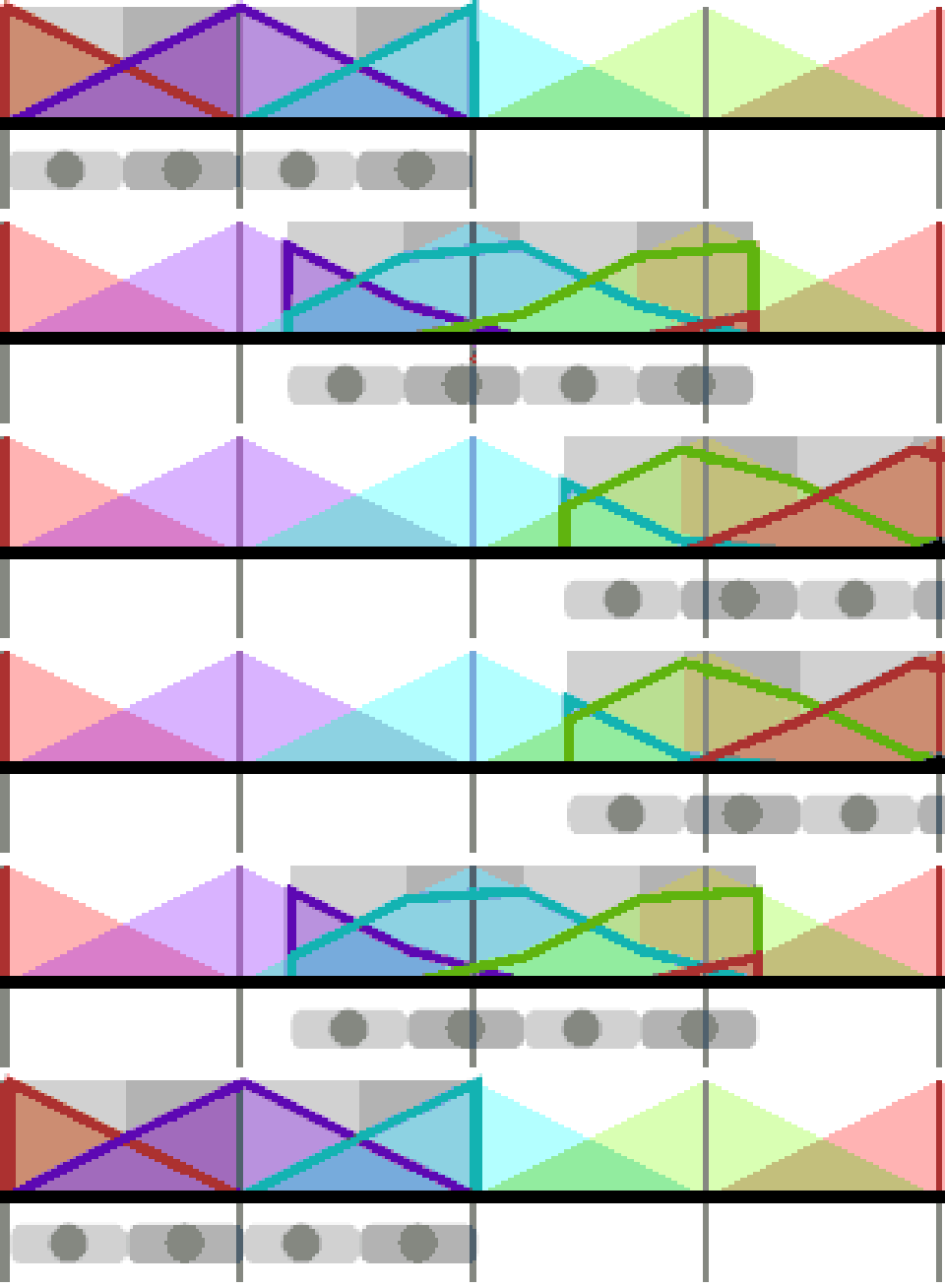
VibrationsHandNotes is a set of handwritten notes taken by Dr. Brannon when she was a student.
Aldridge (AKA Blake) spherical source verification test for dynamic continuum codes
This post has the following aims:
- Provide documentation and source code for a spherically symmetric wave propagation in a linear-elastic medium.
- Tell a story illustrating how this simple verification problem helped to validate a complicated rate-dependent and history-dependent geomechanics model.
- Warn against believing previously reported material parameters, since they might have been the result of constitutive parameter tweaking to compensate for unrelated errors in the host code. Continue reading
Thesis – Deepika Kakarla
Publication: A model for statistical variation of fracture properties in a continuum mechanics code
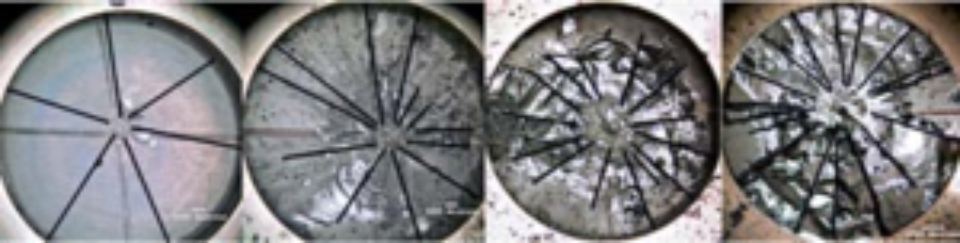
NEWS FLASH: The print version of the Meyer-Brannon paper on statistical variation of fracture patterns in a continuum code (CTH) is now available at http://dx.doi.org/10.1016/j.ijimpeng.2010.09.007.
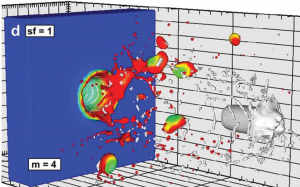
Perforation with Aleatory Uncertainty of high-pressure strength in an Eulerian Simulation.
Current opportunities for graduate students
We currently have openings for two PhD students in the CSM group:
PhD Student Opening#1: Research opportunites exist in the general area of computational mechanics with emphasis on development of advanced methods (expecially particle methods) for solving large-deformation high-rate problems in mechanics.
PhD Student Opening#2: Research opportunites exist in the general area of computational and theoretical constitutive modeling, with emphasis on large deformation inelasticity, failure, fracture, induced anisotropy, etc. Applications would include hierarchical upscaling (i.e., inferring macroscale properties from microscale simulations). Continue reading
Some topics in rock and brittle media modeling
The following slides are taken primarily from a standard collection that has been used over the last several years to introduce mechanics researchers to concepts such as third-invariant dependence of material failure, softening, mesh dependency, the need for regularization through introduction of a length scale, Weibull statistics in strength data, etc.
To download the PowerPoint slides, click here: Week11and12_PressureDependenceSmearedDamageUncertaintyAndVandVissues.pptx
CURRICULUM VITAE: MICHAEL A. HOMEL
Validation of the Plasticity Modes and Introduction of Hardening Laws
These are power-point slides that I used during my lectures in the Computational Constitutive Modelling on October 25 and 27, 2011. The power-point slides can be found here.
Comparison of Uniaxial Stress and Uniaxial Strain States
When doing verification of material models it is a very good idea to check both uniaxial stress and uniaxial strain states. For a von Mises material, we can analytically determine what displacements and stresses will be present when the material yields. The following table was created to aid those that work with the von Mises (or J2 plasticity) material model.
There are only three parameters that are used for the table; specifically, the yield stress in uniaxial tension and any two elastic modulii. The table was written so that if only Young’s modulus and Poisson’s ratio are known, the reader can derive any other required values by using the equations included at the bottom of the table.
The LaTeX source for the table can be found here.
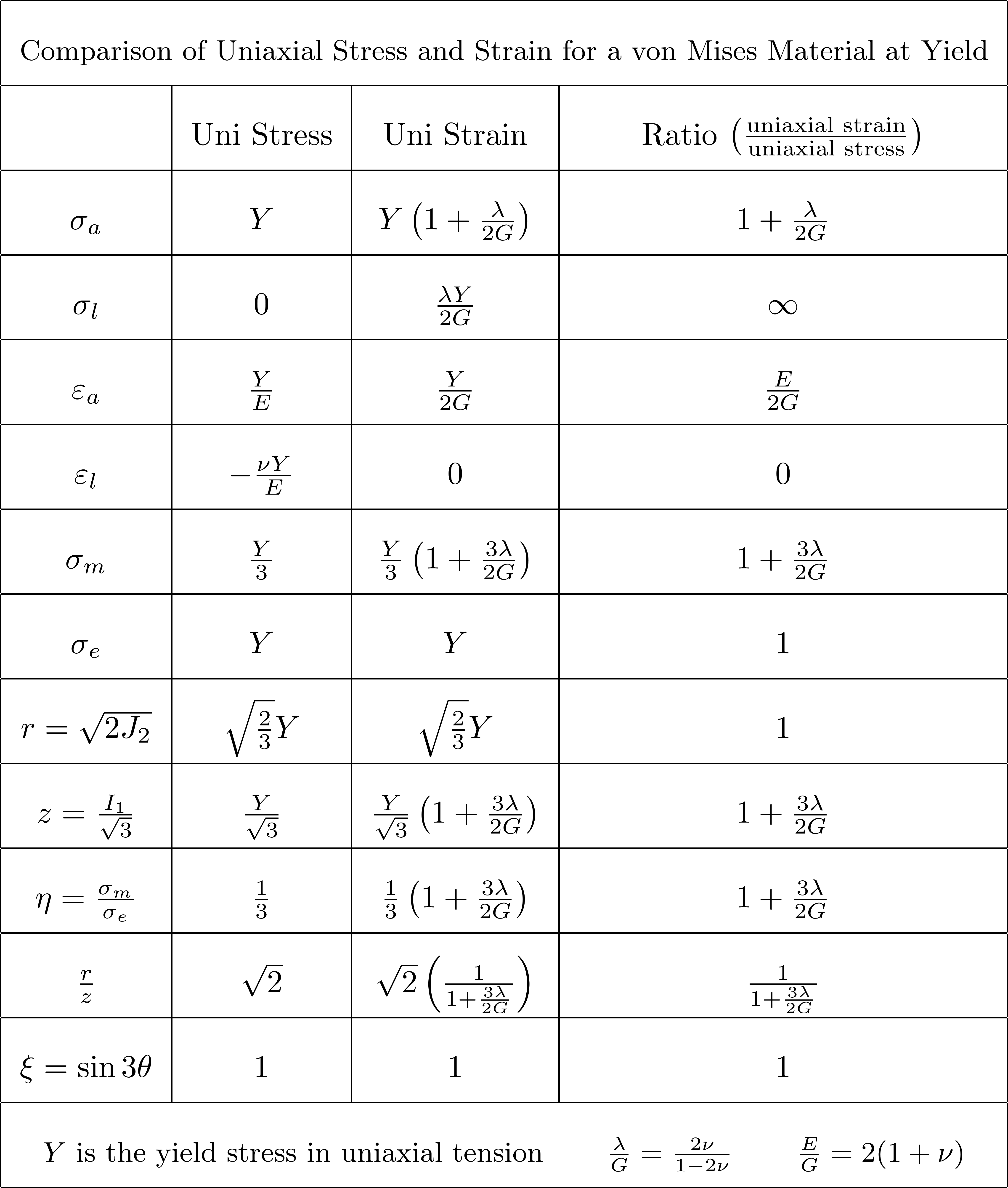
Comparison of Uniaxial Stress and Strain for a von Mises Material at Yield
Elastic Constants Converter
This program allows one to convert between the various elastic constants. If “Evaluate” is chosen in the downloadable version, the numbers entered below the chosen elastic properties are calculated, otherwise the Mathematica file displays the results symbolically. Continue reading
 University of Utah CSM Group