
Congratulations to Martin Berzins and the other four University of Utah faculty members, as well as collaborators at Boston University, Rensselaer Polytechnic, Penn State, Harvard, Brown, UC-Davis, and Polytechnic U (Turin Italy) on the recently awarded $16.4M 5-year project to use high-performance computing to aid in the development of more efficient and lighter power supplies for soldiers! For more information, see the news release at http://unews.utah.edu/news_releases/the-energy-efficient-soldier/.
Author Archives: Rebecca Brannon
Publication: Establishing credibility of particle methods through verification testing
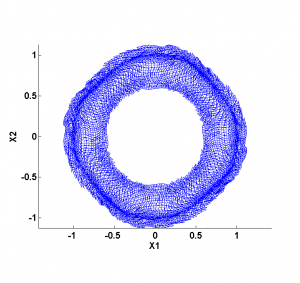
Evidence of discretization texture bias in a simulation that is supposed to exhibit polar symmetry
ABSTRACT:
Within the particle methods community, standard benchmark tests are needed to demonstrate that the governing equations are solved correctly.Whereas the finite element method (FEM) has long-established basic verification standards (patch tests, convergence testing, etc.), no such standards have been universally adopted within the particle method community. Continue reading
Centroidal Voronoi Tesselations
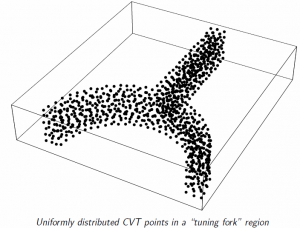
The CSM lab at the University of Utah is actively developing the Material Point Method (MPM). Like other particle methods, the MPM discretizes a body into a set of points at which problem data (velocity, stress, temperature, etc.) are stored. Centroidal Voronoi Tesselation is a promising way to distribute points within a domain in a way that is favorable to the MPM, where using a distribution of particles conforming to the boundary is highly desired. For a thorough overview, see Max Gunzburger’s website, http://people.sc.fsu.edu/~mgunzburger/cvt/cvt.html. Some excerpts from his site are shown below,
Handwritten notes on Vibrations
VibrationsHandNotes is a set of handwritten notes taken by Dr. Brannon when she was a student.
Aldridge (AKA Blake) spherical source verification test for dynamic continuum codes
This post has the following aims:
- Provide documentation and source code for a spherically symmetric wave propagation in a linear-elastic medium.
- Tell a story illustrating how this simple verification problem helped to validate a complicated rate-dependent and history-dependent geomechanics model.
- Warn against believing previously reported material parameters, since they might have been the result of constitutive parameter tweaking to compensate for unrelated errors in the host code. Continue reading
Publication: A model for statistical variation of fracture properties in a continuum mechanics code
NEWS FLASH: The print version of the Meyer-Brannon paper on statistical variation of fracture patterns in a continuum code (CTH) is now available at http://dx.doi.org/10.1016/j.ijimpeng.2010.09.007.
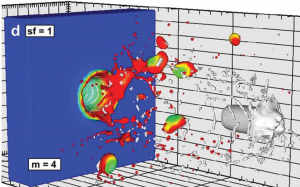
Perforation with Aleatory Uncertainty of high-pressure strength in an Eulerian Simulation.
Current opportunities for graduate students
We currently have openings for two PhD students in the CSM group:
PhD Student Opening#1: Research opportunites exist in the general area of computational mechanics with emphasis on development of advanced methods (expecially particle methods) for solving large-deformation high-rate problems in mechanics.
PhD Student Opening#2: Research opportunites exist in the general area of computational and theoretical constitutive modeling, with emphasis on large deformation inelasticity, failure, fracture, induced anisotropy, etc. Applications would include hierarchical upscaling (i.e., inferring macroscale properties from microscale simulations). Continue reading
Some topics in rock and brittle media modeling
The following slides are taken primarily from a standard collection that has been used over the last several years to introduce mechanics researchers to concepts such as third-invariant dependence of material failure, softening, mesh dependency, the need for regularization through introduction of a length scale, Weibull statistics in strength data, etc.
To download the PowerPoint slides, click here: Week11and12_PressureDependenceSmearedDamageUncertaintyAndVandVissues.pptx
Primer on von Mises (J2) plasticity
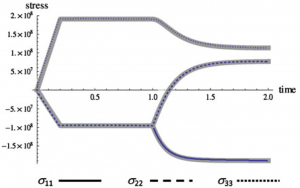 Below is a link to a primer showing how to write a very simple von Mises plasticity model using the classical radial return method. Highlighted in yellow you will see an important warning about the limitation of such models. Nevertheless, this primer is a good place for a beginner to start. Also, the last two pages of this primer describe two very simple verification tests, which anyone who runs a plasticity model in a code should always test first.
Delft Short Course: excerpts of discussion of basis and frame indifference
This posting links to a pdf, DelftExcerpts, which contains slides taken from a 2004 short course given in TU Delft (Netherlands) on the mathematics of tensor analysis. Following a review of the mathematics of line integrals, inexact differentials, and integrability, this set of slides provides some insight into the distinction between a global basis change (equivalent to the “space rotation” in the slides) and superimposed rotation. It also provides an introduction to the principle of material frame indifference (PMFI) as it applies to restricting allowable forms and input/output variables of computational constitutive models.
 University of Utah CSM Group