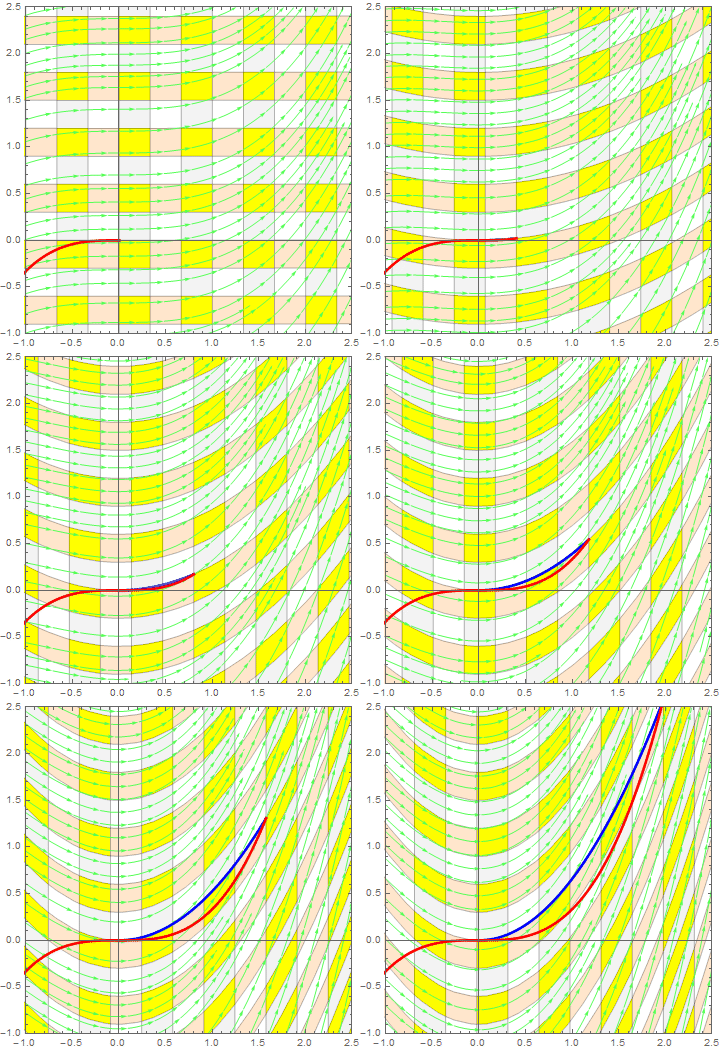
Streamlines, Streaklines, Pathlines, and Gridlines

GridStreamStreakPath

The above animation aims to be a slight improvement over one on Wikipedia, which (incidentally) does not correctly describe the velocity field that it is depicting. The Wikipedia image doesn’t show a checkerboard of moving material, nor does it have a nice depiction of streamlines.

Before describing this animation, it might be helpful to look at a simpler motion (a rolling body) in order to review the difference between streamlines, streaklines, and pathlines. Consider a simple rigid body consisting of a disk of small radius (shown in gray below) along which it rolls along a tabletop, along with a larger-radius extension of the body (shown in color below) which can dip down below the table surface (as if there is a slot cut into the table so that part of the body rolls under it).

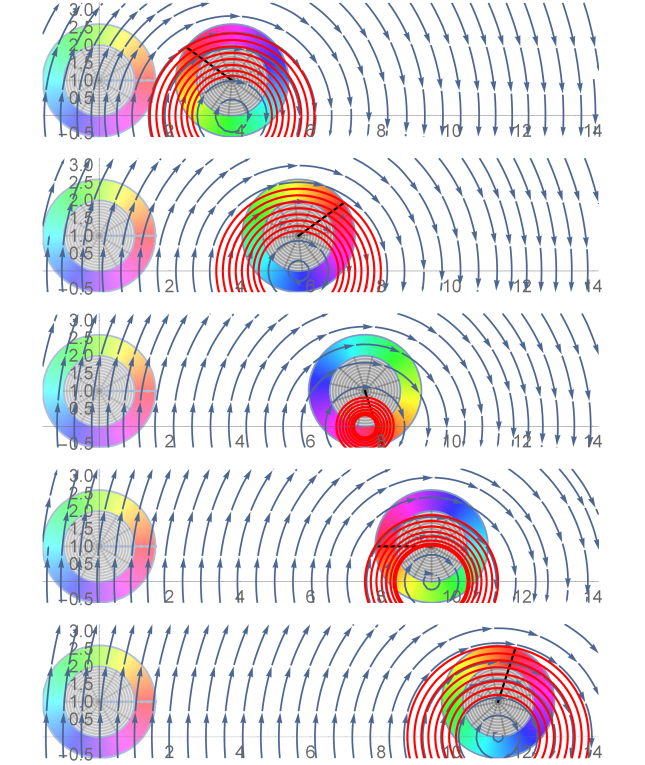
STREAMLINES: These are tangent to the instantaneous velocity field.  For a rolling rigid body, the motion is always circular about the instantaneous center of rotation at the bottom of the wheel. Accordingly, this image shows the streamlines at various points in time as the disk rolls along:
particleStreamLineRolling

This image of streamlines is drawn not just on the body itself but also on its “virtual extension” in order to emphasize that (for rigid rolling) the instantaneous velocity is circular around the instantaneous center of rotation (bottom of the wheel). A particular set of streamlines is drawn in red. These are the ones that pass through a set of points that are evenly distributed on a spoke of the wheel (shown in black).

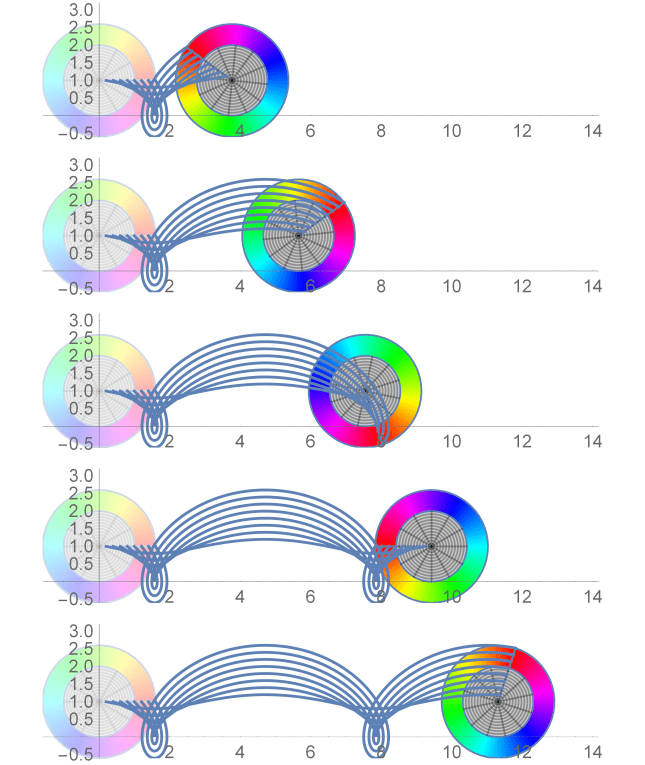
STREAKLINES: These are the lines you would see if a magic gremlin were to sit at a given location in space and “spraypaint” the material as it passes by.  Suppose that an assembly line of gremlins (located where you see the dots in the first image) are pointing their spray paint cans at the body while it rolls past. Then they would form the black streaklines shown here at various times:

streaklinesOnBefore

Important: The streaklines are made by gremlins who are sitting still and spraying material as it passes by.

PATHLINES: Are made by gremlins who “ride” with the material, spraying a record of where they have been (as if we were watching the rolling body from behind a window, and those whacky gremlins would spray paint onto the window as they pass by). Accordingly, here are the pathlines for group of gremlins who were initially coincident with the gremlins in the above streakline plot:
particlePathLineRolling

GRIDLINES are any set of lines that are painted on the body like tattoos. Such lines move with the body (like a tattoo).

 

Continue reading

Welcome new computational-mechanics professor Ashley Spear!

SpearMaterialsCharacterization

The University of Utah is pleased to welcome a multi-talented new computational mechanics professor: Ashley Spear, newly graduated from Tony Ingraffea’s group at Cornell.

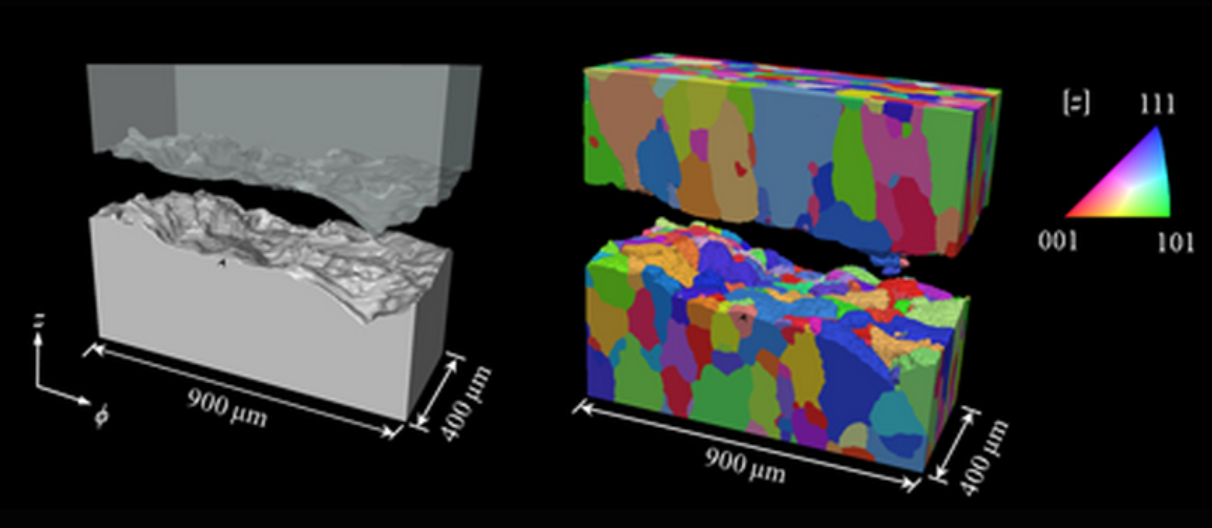
Dr. Spear's work (in collaboration with Carnegie Mellon and Lawrence Livermore Lab) using the Advanced Photon Source to obtain synchrotron-based measurments of 3D crack evolution in polycrystalline materials.

Dr. Spear’s work (in collaboration with Carnegie Mellon and Lawrence Livermore Lab) using the Advanced Photon Source to obtain synchrotron-based measurments of 3D crack evolution in polycrystalline materials.

Dr. Spear is a published expert in high-performance multiscale computing as well as experimental materials characterization, which is a perfect counterpart to the University if Utah’s existing focus on macroscale constitutive modeling with high-performance simulations using the Material Point Method.

Check out Dr. Spear’s research and CV (with contact information) at http://mmm.mech.utah.edu/!


Linux file navigation aide (MSSwan python3 script)

If you have a lot of places that you routinely visit in your file system, often with ludicrously long path names, then click here to download a tar file that will alleviate the problem (once downloaded, execute `tar -xvf pyfsmem.tar` to obtain the python 3.x script).

Follow instructions in the script’s prolog (especially adding aliases to your bashrc). Then you can “remember” frequently visited directories and return to them with only a couple of keystrokes.

IMO, this is far better than pushd and popd because favorite places are remembered indefinitely (even with power failures).

Thanks to M. Scot Swan for providing this gem!

Publication (Abstract and Erratum): Second-order convected particle domain interpolation (CPDI2) with enrichment for weak discontinuities at material interfaces

Abstract:

Convected particle domain interpolation (CPDI) is a recently developed extension of the material point method, in which the shape functions on the overlay grid are replaced with alternative shape functions, which (by coupling with the underlying particle topology) facilitate efficient and algorithmically straightforward evaluation of grid node integrals in the weak formulation of the governing equations. In the original CPDI algorithm, herein called CPDI1, particle domains are tracked as parallelograms in 2-D (or parallelepipeds in 3-D). In this paper, the CPDI method is enhanced to more accurately track particle domains as quadrilaterals in 2-D (hexahedra in 3-D). This enhancement will be referred to as CPDI2. Not only does this minor revision remove overlaps or gaps between particle domains, it also provides flexibility in choosing particle domain shape in the initial configuration and sets a convenient conceptual framework for enrichment of the fields to accurately solve weak discontinuities in the displacement field across a material interface that passes through the interior of a grid cell. The new CPDI2 method is demonstrated, with and without enrichment, using one-dimensional and two-dimensional examples.

Bib data:

Sadeghirad, A., R. M. Brannon, J.E. Guilkey (2013) Second-order convected particle domain interpolation (CPDI2) with enrichment for weak discontinuities at material interfaces, Int. J. Num. Meth. Engr., vol. 95, 928-952

URL: http://dx.doi.org/10.1002/nme.4526

Bibtex entry:

@ARTICLE{Sadeghirad2013,
author = {A. Sadeghirad and R.M. Brannon and J.E. Guilkey},
title = {Second-order convected particle domain interpolation ({CPDI2}) with
enrichment for weak discontinuities at material interfaces},
journal = {Intl. J. Num. Meth. Engng.},
year = {2013},
volume = {95},
pages = {928–952}
}

Erratum:  Eq. 33 should be

Corrected Eq. 33

Publication: Verification tests in solid mechanics

ABSTRACT: Code verification against analytical solutions is a prerequisite to code validation against experimental data. Though solid-mechanics codes have established basic verification standards such as patch tests and convergence tests, few (if any) similar standards exist for testing solid-mechanics constitutive models under nontrivial massive deformations. Increasingly complicated verification tests for solid mechanics are presented, starting with simple patch tests of frame-indifference and traction boundary conditions under affine deformations, followed by two large-deformation problems that might serve as standardized verification tests suitable to quantify accuracy, robustness, and convergence of momentum solvers used in solid-mechanics codes. These problems use an accepted standard of verification testing, the method of manufactured solutions (MMS), which is rarely applied in solid mechanics. Body forces inducing a specified deformation are found analytically by treating the constitutive model abstractly, with a specific model introduced only at the last step in examples. One nonaffine MMS problem subjects the momentum solver and constitutive model to large shears comparable to those in penetration, while ensuring natural boundary conditions to accommodate codes lacking support for applied tractions. Two additional MMS problems, one affine and one nonaffine, include nontrivial traction boundary conditions.

For a copy of the paper along an implementation of the vortex problem, see our simple matlab MPM code.

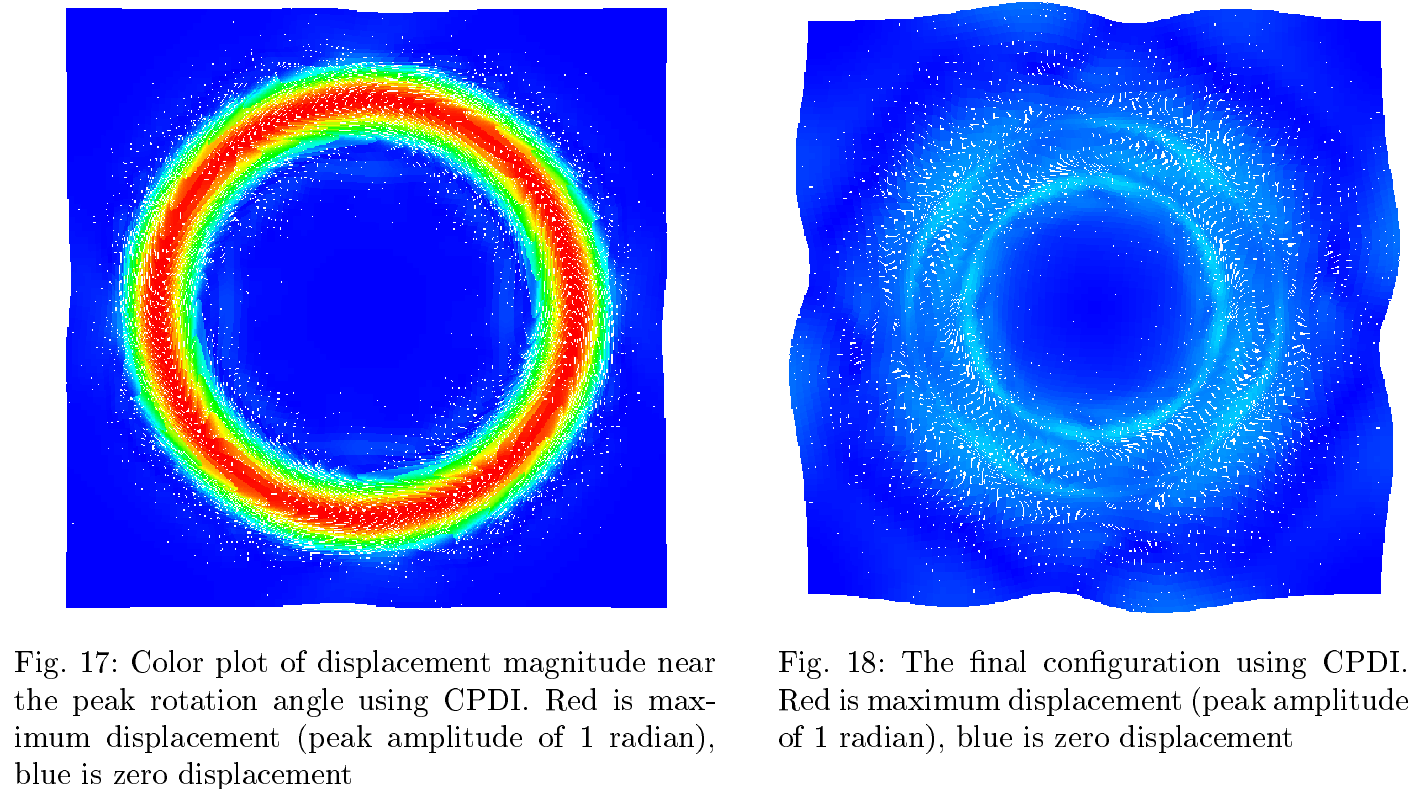
Here are some eye-catching graphics (see the paper itself for details):

2013verificationPic1 Continue reading

Publication: Aleatory quantile surfaces in damage mechanics

ABSTRACT: In statistical damage mechanics, a deterministic failure limit surface is replaced with a scale-dependent family of quantile surfaces. An idealized homogeneous isotropic matrix material containing cracks of random size and orientation is used to elucidate expected mathematical character
of aleatory uncertainty and scale effects for initiation of damage in a brittle material. Scope is limited to statistics and scale dependence for the ONSET (not subsequent progression) of shear-driven failure. Exact analytical solutions for probability of such failure (with an interesting pole-point visualization) are derived for axisymmetric extension or compression of a single-crack sample. A semi-analytical bound on the failure CDF is found for a multi-crack specimen by integrating the single-crack probability over an exponential crack size distribution for which the majority of flaws are small enough to be safe from failure at any orientation. Resulting tails of the predicted failure distribution differ from Weibull theory,
especially in the third invariant.

Selected cool pictures (see the article for more images):

2014AleatoryQuantileSurfacesPic1

Continue reading

Public display of affection for Prof. Gib Richards

Dear Prof. Richards:

When I was still a teenager, you were my undergraduate advisor at the University of New Mexico (UNM). While seated in your office surrounded by rubber chickens, whoopee cushions, and other fanciful toys (which you had because of your side hobby of being a clown), I asked: “How can I know if I will ultimately enjoy a career in Mechanical Engineering?” You replied: “If you are willing to graduate one or two semesters late, then you can find the answer to that question by doing a co-op student internship.” To prepare me for this opportunity, your first action was to help me get a local internship at the Air Force Research Laboratory (then named Weapons Laboratory) at Kirtland AFB. You made telephone calls and otherwise worked your magic to get me into a co-op during the next summer at Los Alamos National Laboratory, where I quickly came to realize that it was the PhDs who were doing the most interesting and self-directed work. I also learned at Los Alamos that educated people have the self-discipline to NOT SMOKE CIGARETTES and to NOT USE SWEAR WORDS. My supervisor at Los Alamos furthermore advised me to go back to UNM and take as many classes as possible from Buck Schreyer, which likewise delightfully shaped my career. Thus, Prof. Richards, you deserve more credit than anyone else for pointing me in the direction of a healthy PhD track, ultimately leading to 14 years as a researcher at Sandia National Laboratories and (most recently) as a professor of Mechanical Engineering since 2007.

I still fondly recall being the first of your students to use computer-generated graphics and laser printing in my senior research report, but that didn’t distract you from fulfilling your promise to find ten grammar/spelling errors. Did you ever fail in that quest with any other student? You were the person who graded my co-op report upon my return to UNM, where you taught me that “finite elements” is only *sometimes* hyphenated, consequently launching a campaign of my own to explain hyphenation rules to others (see, for example, my blog article https://csmbrannon.net/2013/08/04/hyphenation-in-technical-or-other-writing/).

In summary, Prof. Richards, you have profoundly influenced my life! I love you for everything you have done for me and for countless other students.

Sincerely, Rebecca Brannon

Holey Particle Basis functions for 2D CPDI

allpictab

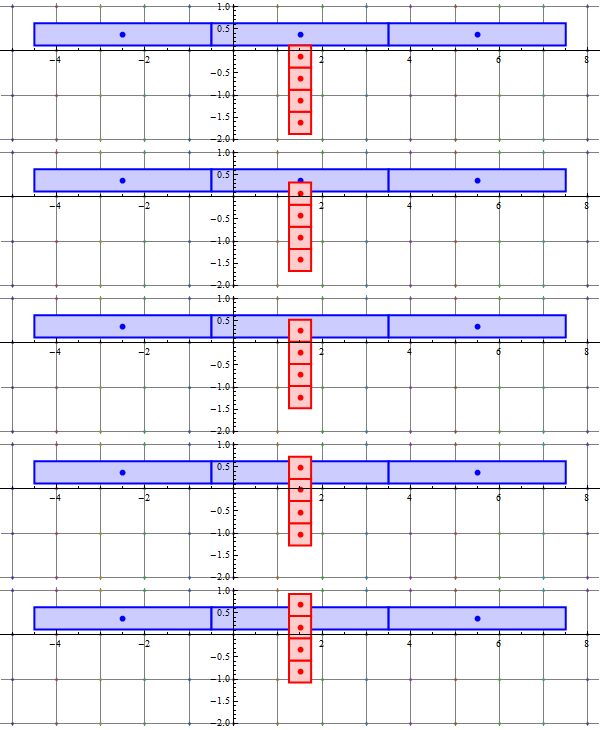
An older post (https://csmbrannon.net/2013/09/29/particle-basis-function-in-the-cpdi-method/) showed particle basis functions in 1D, demonstrating that they retain overlapping support with neighboring particles when using CPDI even when the particles are stretched to be large multiples of the grid cell length. In the 1D context of those examples, “holes” in CPDI basis functions are impossible.

This post shows an extreme 2D example (suggested by John Nairn, Jim Guilkey, and Michael Homel*) that can deleteriously lose overlapping support of particle shape functions, which can then allow non-physical material interpenetration.

Continue reading