Publication: The Use of Sphere Indentation Experiments to Characterize Ceramic Damage Models

R.B. Leavy; R.M. Brannon; O.E. Strack
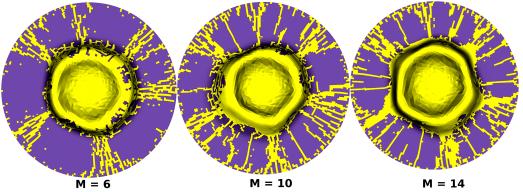
Weibull modulus effect on radial cracking in boron carbide simulations impacted at 400 m/s.

Sphere impact experiments are used to calibrate and validate ceramic models that include statistical variability and/or scale effects in strength and toughness parameters. These dynamic experiments supplement traditional characterization experiments such as tension, triaxial compression, Brazilian, and plate impact, which are commonly used for ceramic model calibration.The fractured ceramic specimens are analyzed using sectioning, X-ray computed tomography, microscopy, and other techniques. These experimental observations indicate that a predictive material model must incorporate a standard deviation in strength that varies with the nature of the loading. Methods of using the spherical indentation data to calibrate a statistical damage model are presented in which it is assumed that variability in strength is tied to microscale stress concentrations associated with microscale heterogeneity.

Available Online:
http://www.mech.utah.edu/~brannon/pubs/7-2009-LeavyBrannonStrack-IJACT.pdf
http://dx.doi.org/10.1111/j.1744-7402.2010.02487.x
Publication: Decomposition and Visualization of Fourth-Order Elastic-Plastic Tensors

A.G. Neeman; R.M. Brannon; B. Jeremic; A. Van Gelderand;  A. Pang

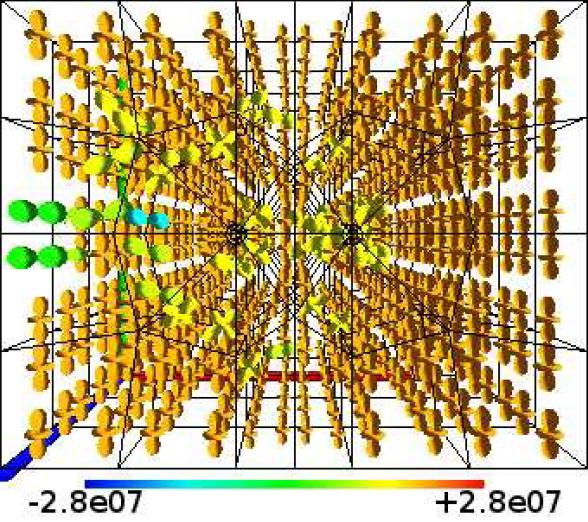
Top view (Z from above) of eigentensors for Drucker-Prager material, time step 124, colored by minimum stretch eigenvalue.

Visualization of fourth-order tensors from solid mechanics has not been explored in depth previously. Challenges include the large number of components (3x3x3x3 for 3D), loss of major symmetry and loss of positive definiteness(with possibly zero or negative eigenvalues). This paper presents a decomposition of fourth-order tensors that facilitates their visualization and understanding. Fourth-order tensors are used to represent a solid’s stiffness.The stiffness tensor represents the relationship between increments of stress and increments of strain. Visualizing stiffness is important to understand the changing state of solids during plastification and failure. In this work,we present a method to reduce the number of stiffness components to second-order 3×3 tensors for visualization.The reduction is based on polar decomposition, followed by eigen-decomposition on the polar “stretch”. If any resulting eigenvalue is significantly lower than the others, the material has softened in that eigen-direction. The associated second-order eigentensor represents the mode of stress (such as compression, tension, shear, or some combination of these) to which the material becomes vulnerable. Thus we can visualize the physical meaning of plastification with techniques for visualizing second-order symmetric tensors.

Available Online:

Publication: http://www.mech.utah.edu/~brannon/pubs/7-2008NeemanBrannonJeremicVanGelderPang.pdf

Poster: http://www.mech.utah.edu/~brannon/pubs/7-09NeemanBrannonEtAlNEESposter.pdf

Publication: Advances in X-ray Computed Tomography Diagnostics of Ballistic Impact Damage

J.M. Wells and R.M. Brannon

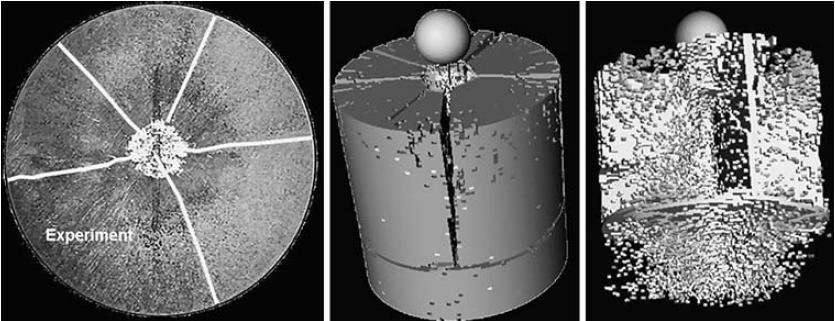
Dynamic indentation of SiC-N ceramic by a tungsten carbide sphere. Left: experimentally observed impact crater and radial cracking (both highlighted for clarity). Middle: BFS model prediction of externally visible damage. Right: prediction of internal damage (suitable for validation against XCT data).

With the relatively recent introduction of quantitative and volumetric X-ray computedtomography (XCT) applied to ballistic impact damage diagnostics, significant inroads have beenmade in expanding our knowledge base of the morphological variants of physical impactdamage. Yet, the current state of the art in computational and simulation modeling of terminalballistic performance remains predominantly focused on the penetration phenomenon, withoutdetailed consideration of the physical characteristics of actual impact damage. Similarly, armorceramic material improvements appear more focused on penetration resistance than on improved intrinsic damage tolerance and damage resistance. Basically, these approaches minimizeour understanding of the potential influence that impact damage may play in the mitigation orprevention of ballistic penetration. Examples of current capabilities of XCT characterization,quantification, and visualization of complex impact damage variants are demonstrated anddiscussed for impacted ceramic and metallic terminal ballistic target materials. Potential benefitsof incorporating such impact damage diagnostics in future ballistic computational modeling arealso briefly discussed.

Available Online:

http://dx.doi.org/10.1007/s11661-007-9304-5
http://www.mech.utah.edu/~brannon/pubs/7-2007WellsBrannonAdvancesInXrayComputedTomographyDiagnosticsOfBallisticDamage.pdf

Publication: On a viscoplastic model for rocks with mechanism-dependent characteristic times

A.F. Fossum and R.M. Brannon (2006)

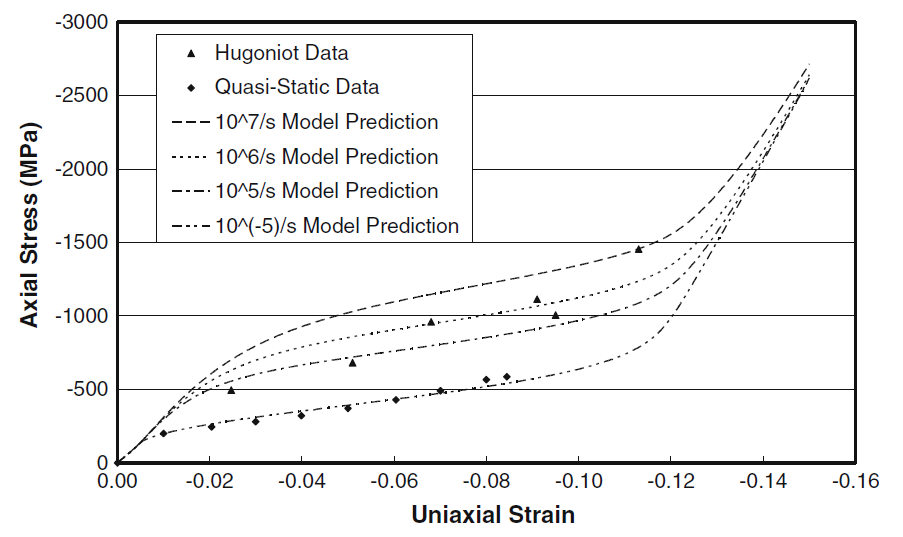
This paper summarizes the results of a theoretical and experimental program at Sandia National Laboratories aimed at identifying and modeling key physical features of rocks and rock-like materials at the laboratory scale over a broad range of strain rates. The mathematical development of a constitutive model is discussed and model predictions versus experimental data are given for a suite of laboratory tests. Concurrent pore collapse and cracking at the microscale are seen as competitive micromechanisms that give rise to the well-known macroscale phenomenon of a transition from volumetric compaction to dilatation under quasistatic triaxial compression. For high-rate loading, this competition between pore collapse and microcracking also seems to account for recently identified differences in strain-rate sensitivity between uniaxial-strain ‘‘plate slap’’ data compared to uniaxial-stress Kolsky bar data. A description is given of how this work supports ongoing efforts to develop a predictive capability in simulating deformation and failure of natural geological materials, including those that contain structural features such as joints and other spatial heterogeneities.

Available online:

http://dx.doi.org/10.1007/s11440-006-0010-z
http://www.mech.utah.edu/~brannon/pubs/7-2006FossumBrannonMechanismDependentViscoplasticity.pdf

Publication: Assessment of the applicability of the Hertzian contact theory to edge-loaded prosthetic hip bearings.

Sanders, A. P. and R. M. Brannon (2011). “Assessment of the applicability of the Hertzian contact theory to edge-loaded prosthetic hip bearings.” Journal of Biomechanics 44(16): 2802-2808.

Abstract

The components of prosthetic hip bearings may experience in-vivo subluxation and edge loading on the acetabular socket as a result of joint laxity, causing abnormally high, damaging contact stresses. In this research, edge-loaded contact of prosthetic hips is examined analytically and experimentally in the most commonly used categories of material pairs. In edge-loaded ceramic-on-ceramic hips, the Hertzian contact theory yields accurate (conservatively, <10% error) predictions of the contact dimensions. Moreover, the Hertzian theory successfully captures slope and curvature trends in the dependence of contact patch geometry on the applied load. In an edge-loaded ceramic-on-metal pair, a similar degree of accuracy is observed in the contact patch length; however, the contact width is less accurately predicted due to the onset of subsurface plasticity, which is predicted for loads >400N. The Hertzian contact theory is shown to be ill-suited to edge-loaded ceramic-on-polyethylene pairs due to polyethylene’s nonlinear material behavior. This work elucidates the methods and the accuracy of applying classical contact theory to edge-loaded hip bearings. The results help to define the applicability of the Hertzian theory to the design of new components and materials to better resist severe edge loading contact stresses.

Available online:

http://dx.doi.org/10.1016/j.jbiomech.2011.08.007;


Publication: Experimental Assessment of Unvalidated Assumptions in Classical Plasticity Theory

Abstract: This report investigates the validity of several key assumptions in classical plasticity theory regarding material response to changes in the loading direction. Three metals, two rock types, and one ceramic were subjected to non-standard loading directions, and the resulting strain response increments were displayed in Gudehus diagrams to illustrate the approximation error of classical plasticity theories. A rigorous mathematical framework for fitting classical theories to the data, thus quantifying the error, is provided. Further data analysis techniques are presented that allow testing for the effect of changes in loading direction without having to use a new sample and for inferring the yield normal and flow directions without having to measure the yield surface. Though the data are inconclusive, there is indication that classical, incrementally linear, plasticity theory may be inadequate over a certain range of loading directions. This range of loading directions also coincides with loading directions that are known to produce a physically inadmissible instability for any nonassociative plasticity model.

You may download the full report here.