Publication: Elements of Phenomenological Plasticity: Geometrical Insight, Computational Algorithms, and Topics in Shock Physics


This 2007 Book Chapter on the basics of plasticity theory reviews the terminology and governing equations of plasticity, with emphasis on amending misconceptions, providing physical insights, and outlining computational algorithms. Plasticity theory is part of a larger class of material models in which a pronounced change in material response occurs when the stress (or strain) reaches a critical threshold level. If the stress state is subcritical, then the material is modeled by classical elasticity. The bound- ary of the subcritical (elastic) stress states is called the yield surface. Plasticity equations apply if continuing to apply elasticity theory would predict stress states that extend beyond this the yield surface. The onset of plasticity is typically characterized by a pronounced slope change in a stress–strain dia-gram, but load reversals in experiments are necessary to verify that the slope change is not merely nonlinear elasticity or reversible phase transformation.
The threshold yield surface can appear to be significantly affected by the loading rate, which has a dominant effect in shock physics applications.

In addition to providing a much-needed tutorial survey of the governing equations and their solution (defining Lode angle and other Lode invariants and addressing the surprisingly persistent myth that closest-point return satisfies the governing equations), this book chapter includes some distinctive contributions such as a simple 2d analog of plasticity that exhibits the same basic features of plasticity (such as existence of a “yield” surface with associative flow and vertex theory), an extended discussion of apparent nonassociativity, stability and uniqueness concerns about nonassociativity, and a  summary of apparent plastic wave speeds in relation to elastic wave speeds (especially noting that non-associativity admits plastic waves that travel faster than elastic waves).

For the full manuscript with errata, click 2007 Book Chapter on the basics of plasticity theory.

Project: Bistable links improve effectiveness of protective structures

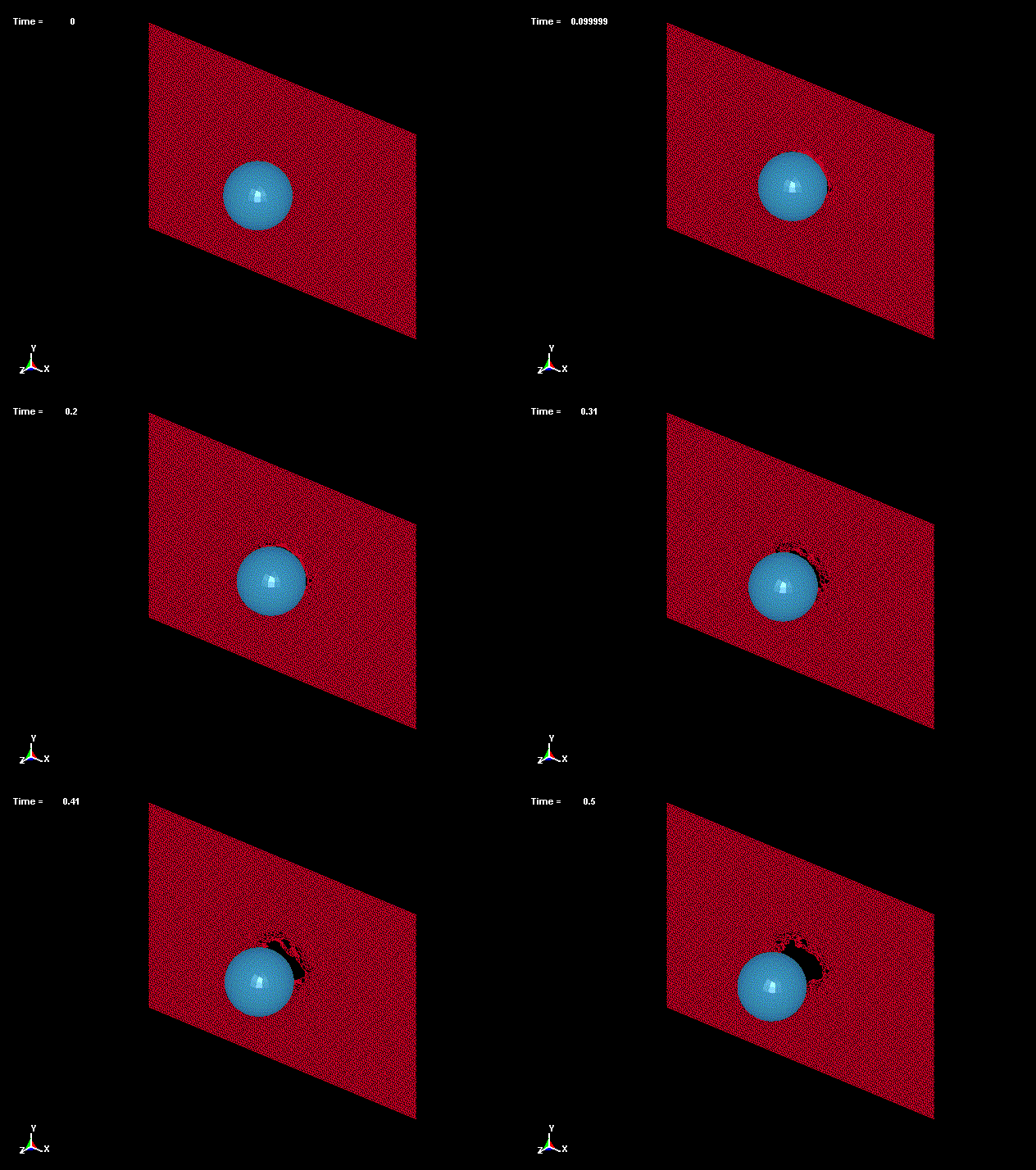
Click on either of the following images to see an animation.

The first structure is a regular lattice of breakable links, while next one, which successfully repels the projectile, consists of the same mass of links that are “bistable” meaning that they have a first breaking point followed by a backup link recovery, which allows damage to be better spread through the structure rather than being focused at the impact point.  By encouraging damage diffusion, the failure is no longer exclusively at the point of impact, as seen below by the red partially damaged bistable links. Continue reading

Streamline visualization of tensor fields in solid mechanics

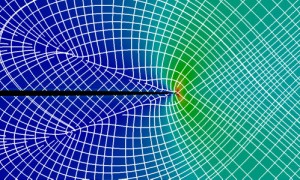
Stress net view of maximum shear lines inferred from molecular dynamics simulation of crack growth. Image from http://doi.ieeecomputersociety.org/10.1109/VIS.2005.33

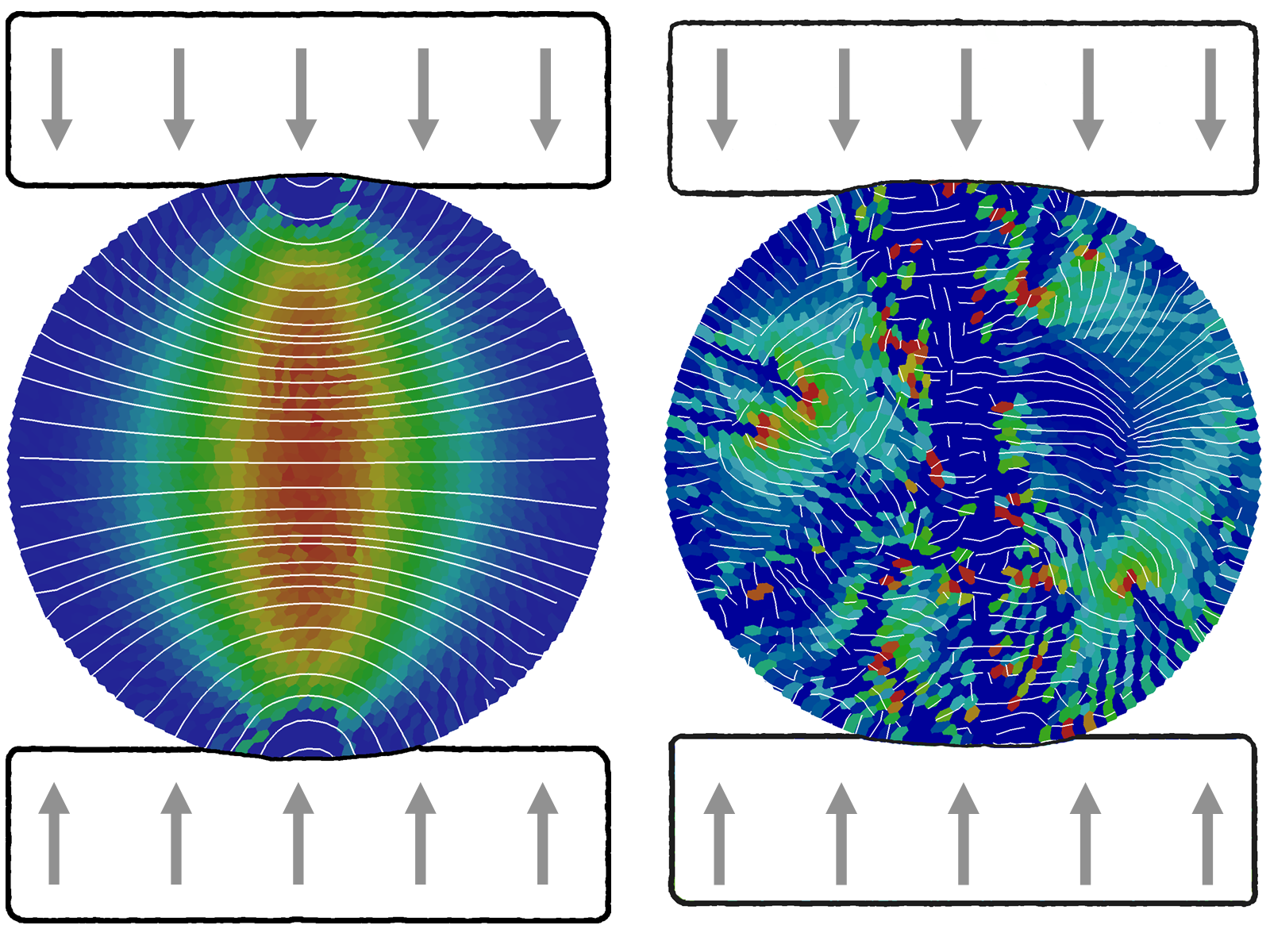
Brazilian stress net before and after material failure. Colors indicate maximum principal stress (showing tension in the center of this axially compressed disk). Lines show directions of max principal stress.

A stress net is simply a graphical depiction of principal stress directions (or other directions derived from them, such as rotating them by 45 degrees to get the maximum shear lines.)  Continue reading

Tip: How to set up videoconferencing with the CSM group

The following tutorial provides instructions for both the host (CSM group) and guest to set up videoconferencing.

METHOD 1 (for impromptu small meetings without graphics sharing)
Remote guest can make the request to Dr. Brannon, whose Skype name is rebecca.brannon

METHOD 2 (for extended multi-participant meetings with graphics sharing)

The Interactive Video Conferencing (IVC) equipment at the University of Utah allows us to connect to other people and places throughout the state and the world.

Host (CSM personnel) instructions:

The following steps are necessary for an IVC meeting:

  • To schedule an IVC meeting, the CSM personnel should contact the IVC through one of the following options:

1. call 435-879-4762

2. e-mail ivc@utah.edu

3. fill the forms here.

  • The IVC staff find an available room on campus and arrange a test call with the guest.
  • If the test connection is successful, the IVC staff schedule a connection for the actual meeting.
  • The CSM personnel should be trained on how to use the equipment. For this purpose, the IVC staff provide a short training session for the CSM personnel.

Guest instructions:

The guest should have the required equipment, and provide its IP number to the CSM personnel. The guest and the CSM personnel should be in contact to schedule a test call and troubleshoot any issue.

Research: Worn Ceramic-on-Ceramic Hip Implants Squeak Only When Dry Under Low Loads

Some ceramic-on-ceramic hip implants have been shown to squeak in vivo. While many researchers have investigated the squeaking phenomenon, the root cause is still debated. The most widely accepted hypotheses postulate that squeaking occurs as a result of edge-loading, stripe-wear, vibrations that are amplified by the femoral stem, dryness, or a combination of the foregoing. In our custom test apparatus to asses wear related squeaking, we found that even when both implants are severely worn, squeaking only occurs under dry conditions as shown in the attached video.

Ceramic-on-Ceramic Hip Implants Squeak Only When Dry

Presentation: Contact Mechanics of Impacting Slender Rods: Measurement and Analysis

Sanders, A., I. Tibbitts, D. Kakarla, S. Siskey, J. Ochoa, K. Ong, and R. Brannon. (2011). “Contact mechanics of impacting slender rods: measurement and analysis.” Society for Experimental Mechanics Annual Meeting. Uncasville, CT, June 13-16.

Abstract

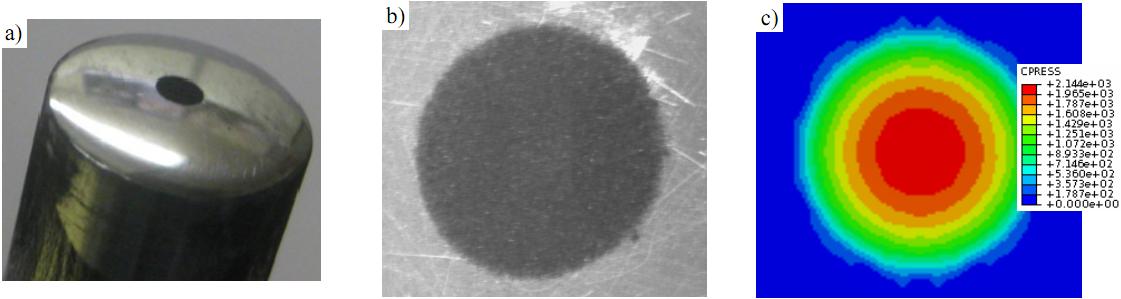
Images of a typical contact patch

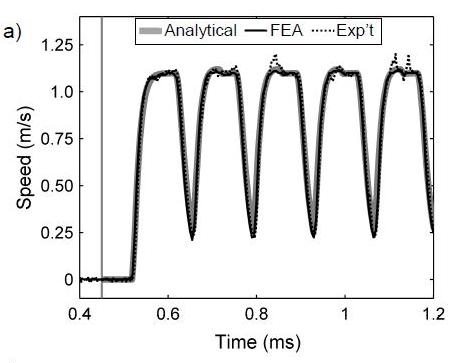
To validate models of contact mechanics in low speed structural impact, slender rods with curved tips were impacted in a drop tower, and measurements of the contact and vibration were compared to analytical and finite element (FE) models. The contact area was recorded using a thin-film transfer technique, and the contact duration was measured using electrical continuity. Strain gages recorded the vibratory strain in one rod, and a laser Doppler vibrometer measured velocity. The experiment was modeled analytically using a quasi-static Hertzian contact law and a system of delay differential equations. The FE model used axisymmetric elements, a penalty contact  algorithm, and explicit time integration. A small submodel taken from the initial global model economically refined the analysis in the small contact region. Measured contact areas were within 6% of both models’ predictions, peak speeds within 2%, cyclic strains within 12 microstrain (RMS value), and contact durations within 2 µs. The accuracy of the predictions for this simple test, as well as the versatility of the diagnostic tools, validates the theoretical and computational models, corroborates instrument calibration, and establishes confidence thatthe same methods may be used in an experimental and computational study of the impact mechanics of artificial hip joint.

Available Online:

http://www.mech.utah.edu/~brannon/pubs/2011SandersSEMconf274_san.pdf

http://www.springerlink.com/content/n09q8v08716n6865/

Global model results comparison with analytical and experimental results for speed at the midpoint of one of the rods

Publication: Uniaxial and Triaxial Compression Tests of Silicon Carbide Ceramics under Quasi-static Loading Condition

M.Y. Lee, R.M. Brannon and D.R. Bronowski

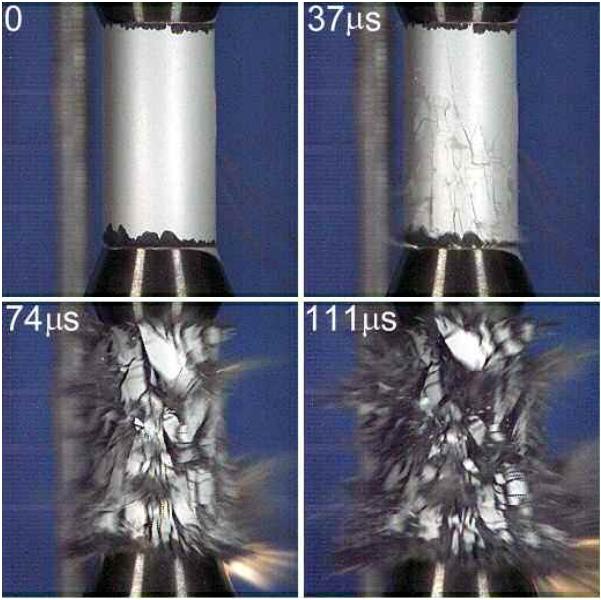
Explosive failure of the SICN-UC02 specimen (12.7 mm in diameter and 25.4 mm in length) subjected to the unconfined uniaxial compressive stress condition

To establish mechanical properties and failure criteria of silicon carbide (SiC-N) ceramics, a series of quasi-static compression tests has been completed using a high-pressure vessel and a unique sample alignment jig.  This report summarizes the test methods, set-up, relevant observations, and results from the constitutive experimental efforts. Combining these quasistatic triaxial compression strength measurements with existing data at higher pressures naturally results in different values for the least-squares fit to this function, appropriate over a broader pressure range. These triaxial compression tests are significant because they constitute the first successful measurements of SiC-N compressive strength under quasistatic conditions. Having an unconfined compressive strength of ~3800 MPa, SiC-N has been heretofore tested only under dynamic conditions to achieve a sufficiently large load to induce failure. Obtaining reliable quasi-static strength measurements has required design of a special alignment jig and loadspreader assembly, as well as redundant gages to ensure alignment. When considered in combination with existing dynamic strength measurements, these data significantly advance the characterization of pressure-dependence of strength, which is important for penetration simulations where failed regions are often at lower pressures than intact regions.

Available Online:

http://www.mech.utah.edu/~brannon/pubs/2004LeeBrannonBronowskiTriaxTestsSiC.pdf

http://www.osti.gov/bridge/purl.cover.jsp?purl=/920770-6YyIPp/

Publication: Experimental Assessment of Unvalidated Assumptions in Classical Plasticity Theory

R. Brannon, J.A. Burghardt, D. Bronowski, and S. Bauer

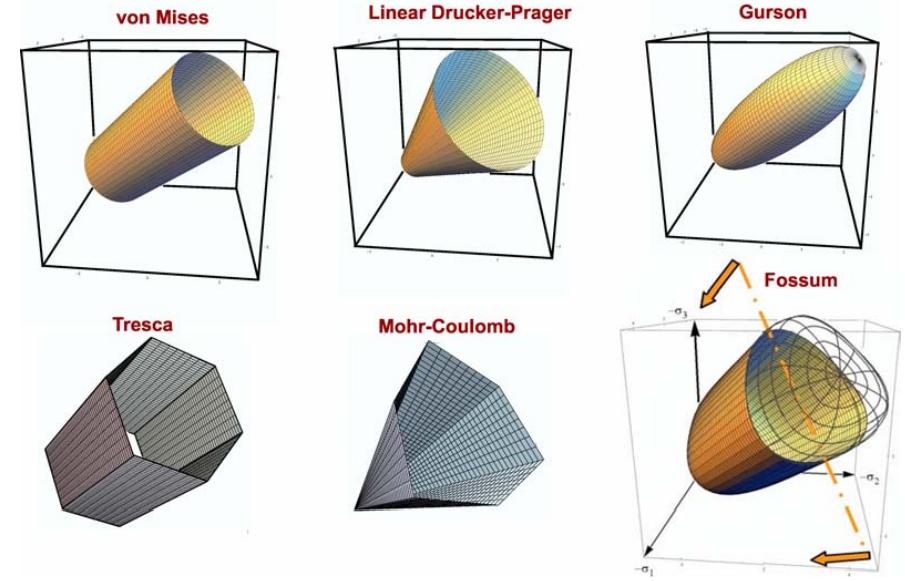
Common isotropic yield surfaces. Von Mises and Drucker-Prager models are often used for metals. Gurson’s function, and others like it, are used for porous media. Tresca and Mohr-Coulomb models approximate the yield threshold for brittle media. Fossum’s model, and others like it, combine these features to model realistic geological media.

This report investigates the validity of several key assumptions in classical plasticity theory regarding material response to changes in the loading direction. Three metals, two rock types, and one ceramic were subjected to non-standard loading directions, and the resulting strain response increments were displayed in Gudehus diagrams to illustrate the approximation error of classical plasticity theories. A rigorous mathematical framework for fitting classical theories to the data,thus quantifying the error, is provided. Further data analysis techniques are presented that allow testing for the effect of changes in loading direction without having to use a new sample and for inferring the yield normal and flow directions without having to measure the yield surface. Though the data are inconclusive, there is indication that classical, incrementally linear, plasticity theory may be inadequate over a certain range of loading directions. This range of loading directions also coincides with loading directions that are known to produce a physically inadmissible instability for any nonassociative plasticity model.

Available Online:

http://www.mech.utah.edu/~brannon/pubs/7-BrannonBurghardtSAND-Report2009-0351.pdf

http://www.osti.gov/energycitations/product.biblio.jsp?osti_id=948711