Publication: Determining a Surrogate Contact Pair in a Hertzian Contact Problem

Sanders, A. P. and R. M. Brannon (2011). “Determining a Surrogate Contact Pair in a Hertzian Contact Problem.” Journal of Tribology 133(2): 024502-024506.
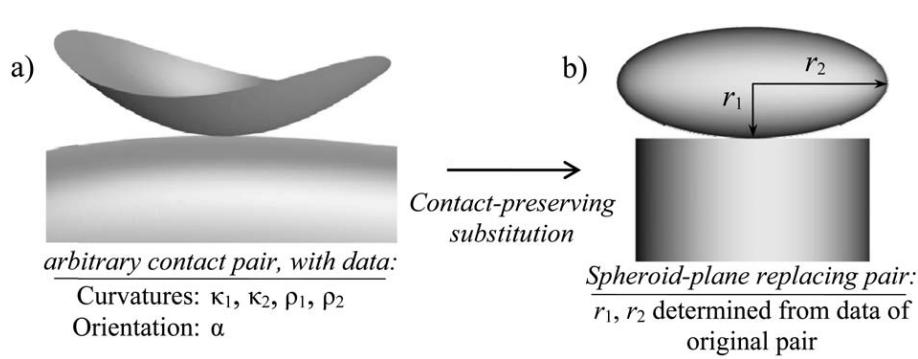
Hertzian substitution concept: An arbitrary contact pair (a) with given principal curvatures and orientation, is substituted with a simpler contact pair (b) consisting of a spheroid and a plane

Laboratory testing of contact phenomena can be prohibitively expensive if the interacting bodies are geometrically complicated. This work demonstrates means to mitigate such problems by exploiting the established observation that two geometrically dissimilar contact pairs may exhibit the same contact mechanics. Specific formulas are derived that allow a complicated Hertzian contact pair to be replaced with an inexpensively manufactured and more easily fixtured surrogate pair, consisting of a plane and a spheroid, which has the same (to second-order accuracy) contact area and pressure distribution as the original complicated geometry. This observation is elucidated by using direct tensor notation to review a key assertion in Hertzian theory; namely, geometrically complicated contacting surfaces can be described to second-order accuracy as contacting ellipsoids. The surrogate spheroid geometry is found via spectral decomposition of the original pair’s combined Hessian tensor. Some numerical examples using free-form surfaces illustrate the theory, and a laboratory test validates the theory under a common scenario of normally compressed convex surfaces. This theory for a Hertzian contact substitution may be useful in simplifying the contact, wear, or impact testing of complicated components or of their constituent materials.

Available Online:

http://www.mech.utah.edu/~brannon/pubs/7-2011-SandersBrannon-IJT.pdf

http://scitation.aip.org/getabs/servlet/GetabsServlet?prog=normal&id=JOTRE9000133000002024502000001&idtype=cvips&gifs=yes&ref=no

Publications: Nonuniqueness and instability of classical formulations of nonassociative plasticity

A plot of the frequency-dependent wave propagation velocity for the case study problem with an overlocal plasticity model, with the elastic and local hardening wave speeds shown for reference (left). Stress histories using an overlocal plasticity model with a nonlocal length scale of 1m and a mesh resolution of 0.125m (right)

The following series of three articles (with common authors J. Burghardt and R. Brannon of the University of Utah) describes a state of insufficient experimental validation of conventional formulations of nonassociative plasticity (AKA nonassociated and non-normality).  This work provides a confirmation that such models theoretically admit negative net work in closed strain cycles, but this simple prediction has never been validated or disproved in the laboratory!

  1. An early (mostly failed) attempt at experimental investigation of unvalidated plasticity assumptions (click to view),
  2. A simple case study confirming that nonassociativity can cause non-unique and unstable solutions to wave motion problems (click to view),
  3. An extensive study showing that features like rate dependence, hardening, etc. do not eliminate the instability and also showing that it is NOT related to conventional localization (click to view).

Continue reading

Publication: A model for statistical variation of fracture properties in a continuum mechanics code

H.W. Meyer Jr. and R.M. Brannon

[This post refers to the original on-line version of the publication. The final (paper) version with page numbers and volume is found at http://dx.doi.org/10.1016/j.ijimpeng.2010.09.007. Some further details and clarifications are in the 2012 posting about this article]

Simulation results for a reference volume of 0.000512 cm^3 ; sf is the size effect factor

Continuum mechanics codes modeling failure of materials historically have considered those materials to be homogeneous, with all elements of a material in the computation having the same failure properties. This is, of course, unrealistic but expedient. But as computer hardware and software has evolved, the time has come to investigate a higher level of complexity in the modeling of failure. The Johnsone-Cook fracture model is widely used in such codes, so it was chosen as the basis for the current work. The CTH finite difference code is widely used to model ballistic impact and penetration, so it also was chosen for the current work. The model proposed here does not consider individual flaws in a material, but rather varies a material’s Johnsone-Cook parameters from element to element to achieve in homogeneity. A Weibull distribution of these parameters is imposed, in such a way as to include a size effect factor in the distribution function. The well-known size effect on the failure of materials must be physically represented in any statistical failure model not only for the representations of bodies in the simulation (e.g., an armor plate), but also for the computational elements, to mitigate element resolution sensitivity of the computations.The statistical failure model was tested in simulations of a Behind Armor Debris (BAD) experiment, and found to do a much better job at predicting the size distribution of fragments than the conventional (homogeneous) failure model. The approach used here to include a size effect in the model proved to be insufficient, and including correlated statistics and/or flaw interactions may improve the model.

Available Online:

http://www.mech.utah.edu/~brannon/pubs/7-2011MeyerBrannon_IE_1915_final_onlinePublishedVersion.pdf

http://www.sciencedirect.com/science/article/pii/S0734743X10001466

Publication: On the thermodynamic requirement of elastic stiffness anisotropy in isotropic materials

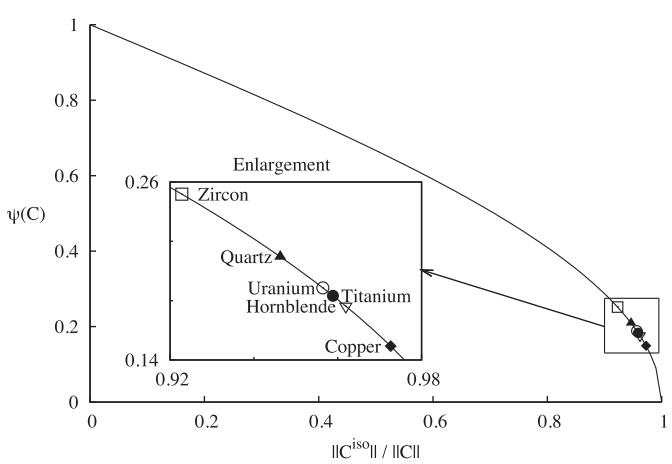
Measure of anisotropy for Zircon, Quartz, Uranium, Titanium, Hornblende, and Copper.

T. Fuller and R.M. Brannon

In general, thermodynamic admissibility requires isotropic materials develop reversible deformation induced anisotropy (RDIA) in their elastic stiffnesses. Taking the elastic potential for an isotropic material to be a function of the strain invariants, isotropy of the elastic stiffness is possible under distortional loading if and only if the bulk modulus is independent of the strain deviator and the shear modulus is constant. Previous investigations of RDIA have been limited to applications in geomechanics where material non-linearityand large deformations are commonly observed. In the current paper, the degree of RDIA in other materials is investigated. It is found that the resultant anisotropy in materials whose strength does not vary appreciably with pressure, such as metals, is negligible, but in materials whose strength does vary with pressure, the degree of RDIA can be significant. Algorithms for incorporating RDIA in a classical elastic–plastic model are provided.

Available Online:

http://www.mech.utah.edu/~brannon/pubs/7-2011FullerBrannonInducedElasticAnisotropy.pdf

http://www.sciencedirect.com/science/article/pii/S0020722511000024

Publication: A convected particle domain interpolation technique to extend applicability of the material point method for problems involving massive deformations

A. Sadeghirad, R. M. Brannon, and J. Burghardt

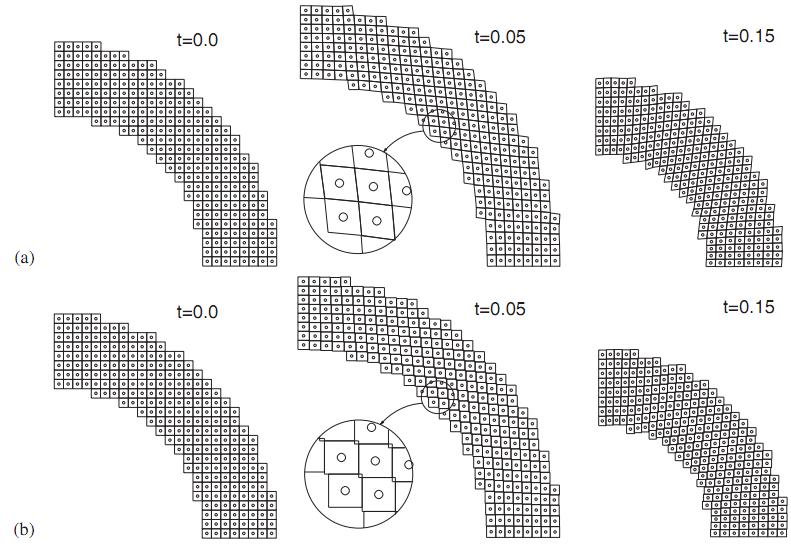
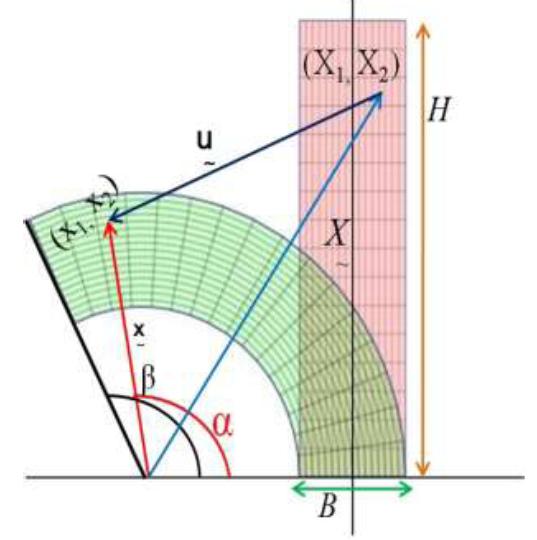
Three snapshots of the model with 248 particles in simulation of the radial expansion of a ring problem using: (a) CPDI method and (b) cpGIMP

A new algorithm is developed to improve the accuracy and efficiency of the material point method for problems involving extremely large tensile deformations and rotations. In the proposed procedure, particle domains are convected with the material motion more accurately than in the generalized interpolation material point method. This feature is crucial to eliminate instability in extension, which is a common shortcoming of most particle methods. Also, a novel alternative set of grid basis functions is proposed for efficiently calculating nodal force and consistent mass integrals on the grid. Specifically, by taking advantage of initially parallelogram-shaped particle domains, and treating the deformation gradient as constant over the particle domain, the convected particle domain is a reshaped parallelogram in the deformed configuration. Accordingly, an alternative grid basis function over the particle domain is constructed by a standard 4-node finite element interpolation on the parallelogram. Effectiveness of the proposed modifications is demonstrated using several large deformation solid mechanics problems.

Available Online:

http://www.mech.utah.edu/~brannon/pubs/7-2011-SadeghiradBrannonBurghardt-NME.pdf

http://onlinelibrary.wiley.com/doi/10.1002/nme.3110/abstract

Publication: Validating Theories for Brittle Damage

R.M. Brannon, J.M. Wells, and O.E. Strack

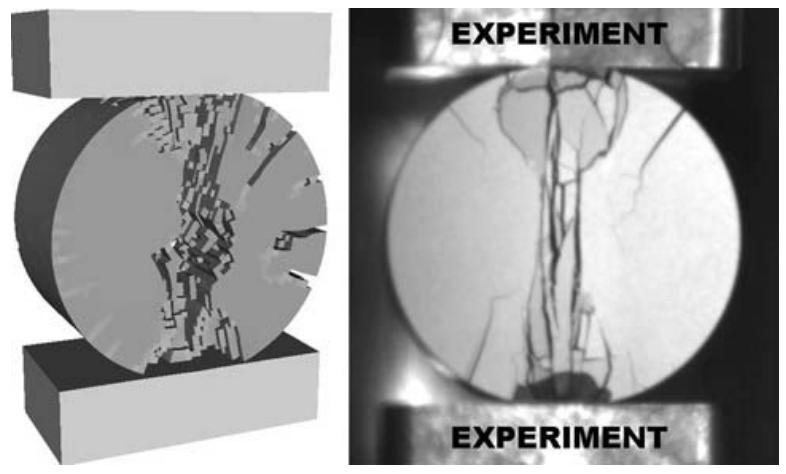
Realistic-looking, uneven damage zones in Brazilian simulations compare favorably with laboratory data for observable damage

Validating simulated predictions of internal damage within armor ceramics is preferable to simply assessing a models ability to predict penetration depth, especially if one hopes to perform subsequent ‘‘second strike’’ analyses. We present the results of a study in which crack networks are seeded by using a statistically perturbed strength, the median of which is inherited from a deterministic ‘‘smeared damage’’ model, with adjustments to reflect experimentally established size effects. This minor alteration of an otherwise conventional damage model noticeably mitigates mesh dependencies and, at virtually no computational cost, produces far more realistic cracking patterns that are well suited for validation against X-ray computed tomography (XCT) images of internal damage patterns. For Brazilian, spall, and indentation tests, simulations share qualitative features with externally visible damage. However, the need for more stringent quantitative validation, software quality testing, and subsurface XCT validation, is emphasized.

Continue reading

Publication: On a viscoplastic model for rocks with mechanism-dependent characteristic times

A. F. Fossum and R. M. Brannon

Rate Dependance

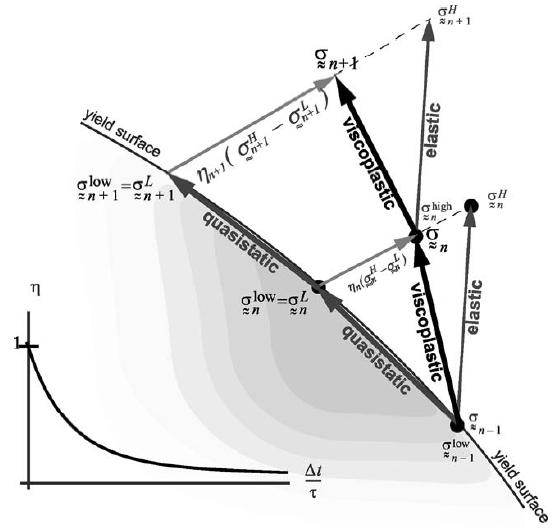
This paper summarizes the results of a theoretical and experimental program at Sandia National Laboratories aimed at identifying and modeling key physical features of rocks and rock-like materials at the laboratory scale over a broad range of strain rates. The mathematical development of a constitutive model is discussed and model predictions versus experimental data are given for a suite of laboratory tests. Concurrent pore collapse and cracking at the microscale are seen as competitive micromechanisms that give rise to the well-known macroscale phenomenon of a transition from volumetric compaction to dilatation under quasistatic triaxial compression. For high-rate loading, this competition between pore collapse and microcracking also seems to account for recently identified differences in strain-rate sensitivity between uniaxial-strain ‘‘plate slap’’ data compared to uniaxial-stress Kolsky bar data. A description is given of how this work supports ongoing efforts to develop a predictive capability in simulating deformation and failure of natural geological materials, including those that contain structural features such as joints and other spatial heterogeneities.

Available Online:

http://www.mech.utah.edu/~brannon/pubs/7-2006FossumBrannonMechanismDependentViscoplasticity.pdf


Research: Weibull fragmentation in the Uintah MPM code

Tough disk impacting brittle disk

Below are links to two simulations of disks colliding. The first is elastic and the second uses a fracture model with spatially variable strength based on a scale-dependent Weibull realization. Both take advantage of the automatic contact property of the MPM.

WeibConstMovie:  disks colliding without fracture

WeibPerturbedGood: disks colliding with heterogeneous fracture

This basic capability to support statistically variable strength in a damage model has been extended to the Kayenta plasticity model in Uintah.

Publication: Statistical perturbation of material properties in Uintah

Swan, S. and R. Brannon (2009)

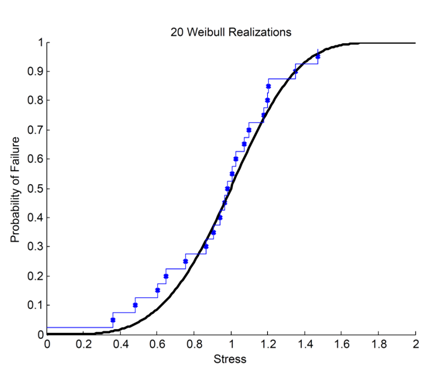
Illustration of stair-stepping typical of finite sampling from a Weibull distribution

Current simulations of material deformation are a balance between computational effort and accuracy of the simulation. To increase the accuracy of the simulated material response, the simulation becomes more computationally intensive with finer meshes and shorter timesteps, increasing the time and resource requirements needed to perform the simulation.  One method for improving predictions of brittle failure while minimizing computational overhead is to implement statistical variability for the material properties being simulated. This method has low computational overhead and requires a relatively small increase in resource requirements while significantly increasing the precision of simulation results. Currently, most simulation frameworks inaccurately describe brittle and heterogeneous materials as uniform bodies of equal strength and consistency. This over-simplification underscores the need to implement statistical variability to help better predict material response and failure modes for materials that contain intermittent abnormalities such as changes in hardness, strength, and grain size throughout the specimen. Uintah, the computational framework developed by the University of Utah’s C-SAFE program, has a simplistic native Gaussian distribution function that was hard-coded into select material models. The goal of this research is to create an easily duplicable method for enabling dynamic global variability according to a Weibull distribution in constitutive models in Uintah and to implement said ability into the constitutive model Kayenta. The main application of Kayenta is to simulate geological response to penetration and perforation. For the purpose of simulating failure in brittle geological samples, the Weibull distribution produces realistic statistical scatter in constituent properties that correlates well to flaws and irregularities observed in laboratory tests.

Available online:
http://www.mech.utah.edu/~brannon/pubs/2009SWAN_spring2009UROPfinalReport.pdf

Publication: Verification Of Frame Indifference For Complicated Numerical Constitutive Models

K. Kamojjala, R. M. Brannon (2011)

Snapshot of the deformation in time

The principle of material frame indifference require spatial stresses to rotate with the material, whereas reference stresses must be insensitive to rotation. Testing of a classical uniaxial strain problem with superimposed rotation reveals that a very common approach to strong incremental objectivity taken in finite element codes to satisfy frame indifference(namely working in an approximate un-rotated frame) fails this simplistic test. A more complicated verification example is constructed based on the method of manufactured solutions (MMS) which involves the same character of loading at all points, providing a means to test any nonlinear-elastic arbitrarily anisotropic constitutive model.

Available Online:

http://www.mech.utah.edu/~brannon/pubs/7-2010KamojjalaBrannon_ASME-ECTC.pdf