
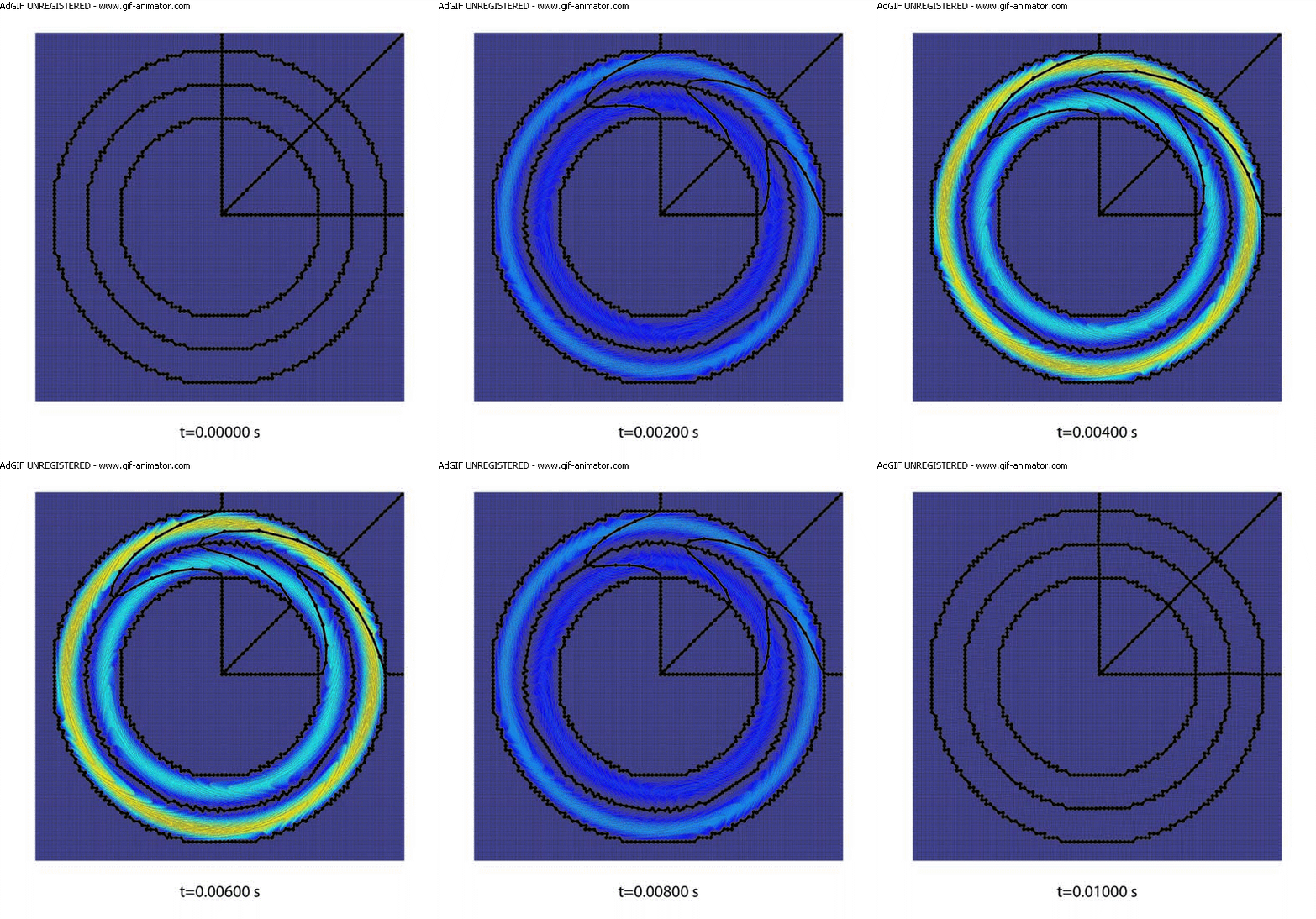
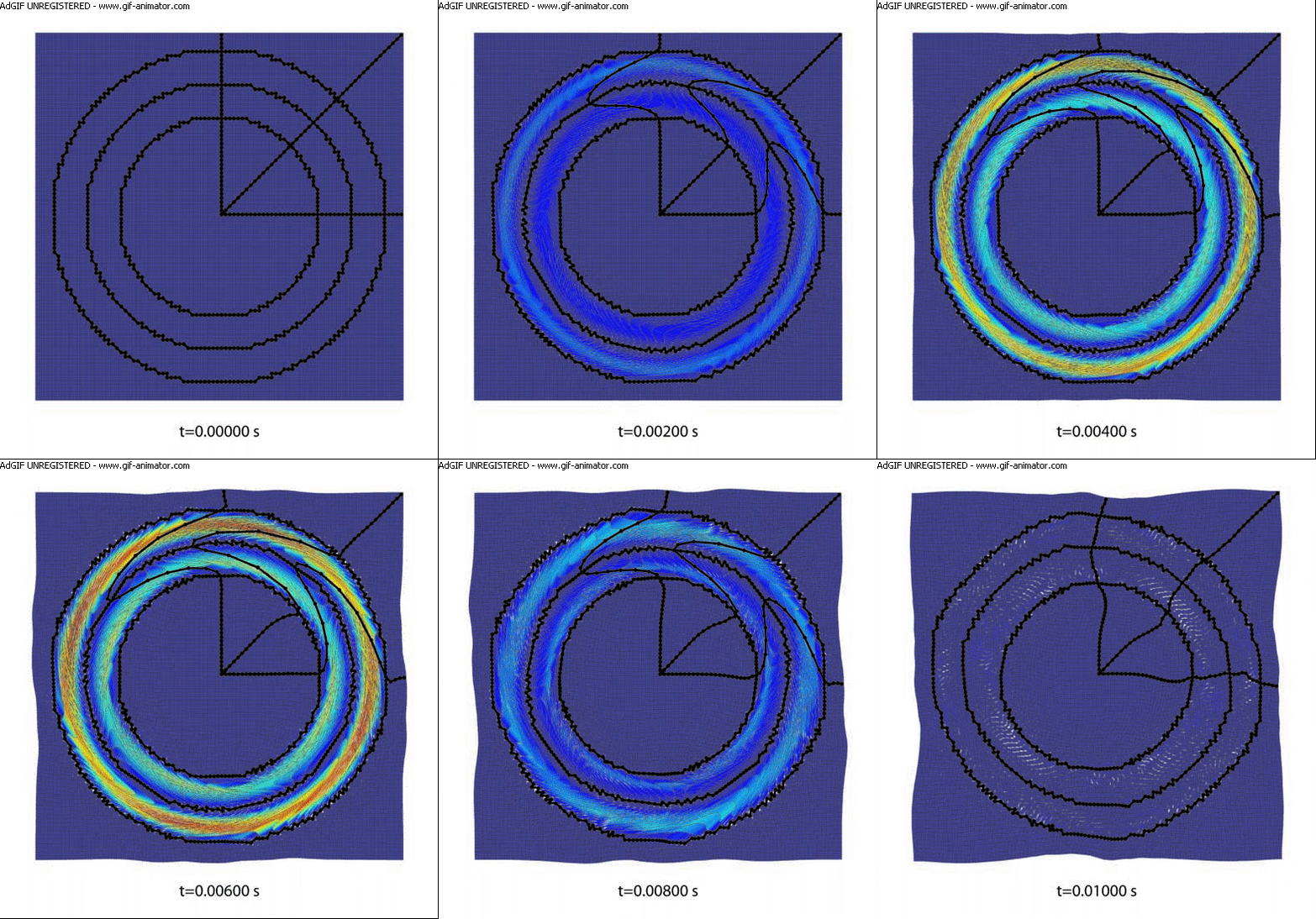
Below are shown comparisons of the exact and numerical solution for the vortex ring problem on a square domain.
Category Archives: Research
Research related news, supplements, and documentation.
CPDI shape functions for the Material Point Method
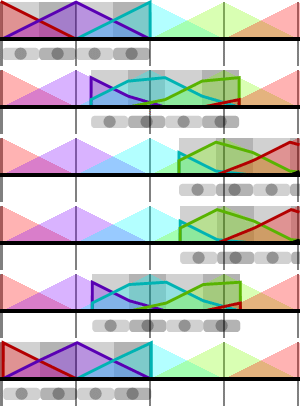
In a conventional MPM formulation, the shape functions on the grid are the same as in a traditional FEM solution. In the CPDI, the shape functions on the grid are replaced by alternative (and still linearly complete*) shape functions, given by piecewise linear interpolations of the traditional FEM shape functions to the boundaries of the particles. This change provides FEM-level accuracy in moderately deforming regions while retaining the attractive feature of MPM that particles can move arbitrarily relative to one another in massively deforming regions (provided, of course, that the deformation is updated in a manner compatible with the constitutive model).
In the images below, the shaded regions are the traditional FEM “tent” linear shape functions in 1-D, and the solid lines are the CPDI interpolated shape functions, which clearly change based on particle position relative to the grid. Both the traditional FEM tent functions and these new CPDI functions are linearly complete (i.e., they can exactly fit any affine function). The tremendous advantage of CPDI is that the basis functions are extraordinarily simple over a particle domain, thus facilitating exact and efficient evaluation of integrals over particle domains.

Research: Radial cracking as a means to infer aleatory uncertainty parameters
Aleatory uncertainty in constitutive modeling refers to the intrinsic variability in material properties caused by differences in micromorphology (e.g., grain orientation or size, microcracks, inclusions, etc.) from sample to sample. Accordingly, a numerical simulation of a nominally axisymmetric problem must be run in full 3D (non-axisymmetric) mode if there is any possibility of a bifurcation from stability.
Dynamic indentation experiments, in which a spherical ball impacts to top free surface of a cylindrical specimen, nicely illustrate that fracture properties must have spatial variability — in fact, the intrinsic instability that leads to radial cracking is regarded by the Utah CSM group as a potential inexpensive means of inferring the spatial frequency of natural variations in material properties.

Radial cracking in dynamic indentation experiments.
Research: Thermodynamic Consistency, and Strain-Based Failure
The Kayenta geological material model has been enhanced to span a broader range of pressures and loading rates. Temperature dependence of yield strength has been added along with nonlinear thermoelasticity that can accommodate pressure dependence of the shear modulus and entropy dependence of the bulk modulus in a thermodynamically consistent manner. Continue reading
Research: Instability of *ANY* nonassociative plasticity model
The CSM group has independently confirmed a case study demonstrating the truth of a claim in the literature that any non-associative rate-independent model admits a non-physical dynamic achronistity instability. By stimulating a non-associative material in the “Sandler-Rubin wedge” (above yield but below the flow surface), plastic waves are generated that travel faster than elastic waves, thus introducing a negative net work in a closed strain cycle that essentially feeds energy into a propagating wave to produce unbounded increases in displacement with time.

Sandler-Rubin instability: an infinitesimal pulse grows as it propagates
Merits and shortcomings of conventional smeared damage models
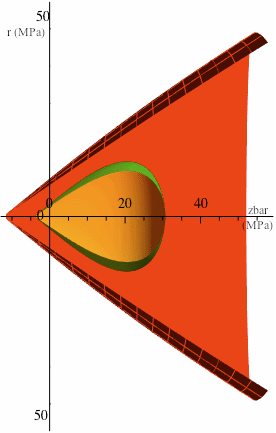
Initial teardrop yield and third-invariant limit surfaces in the Kayenta model
Four classical damage models for concrete (three of which are available in commercial codes) have been compared and critiqued, showing that they all share the notions of a “teardrop” yield surface that can harden and (for some models) translate until reaching a three-invariant fracture limit surface that then collapses to account for softening (i.e., permanent loss of strength). Practical engineering models for rock and ceramics are similar. The common drawbacks of these models (primarily severe mesh dependence) can be mitigated, though not eliminated, by seeding their material properties in the simulation with spatial variability (aleatory uncertainty) and by using appropriate scale effects for the strength and failure progression properties. Continue reading
Powder metal jet penetration into stressed rock
The Uintah computational framework (UCF) has been adopted for simulation of shaped charge jet penetration and subsequent damage to geological formations. The Kayenta geomechanics model, as well as a simplified model for shakedown simulations has been incorporated within the UCF and is undergoing extensive development to enhance it to account for fluid in pore space.
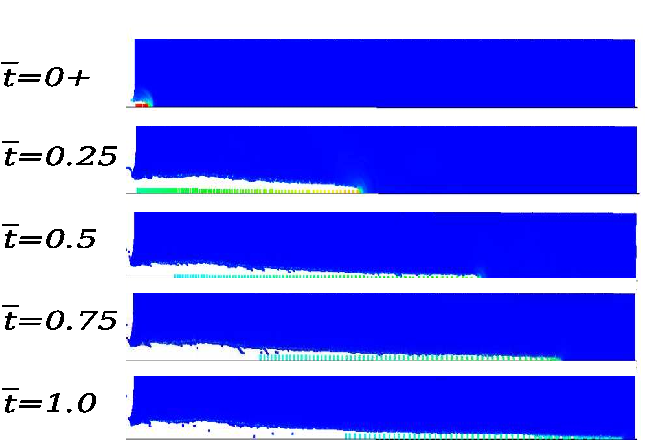
A generic penetration simulation using Uintah
The host code (Uintah) itself has been enhanced to accommodate material variability and scale effects. Simulations have been performed that import flash X-ray data for the velocity and geometry of a particulated metallic jet so that uncertainty about the jet can be reduced to develop predictive models for target response. Uintah’s analytical polar decomposition has been replaced with an iterative algorithm to dramatically improve accuracy under large deformations. Continue reading
Accelerated hip implant wear testing
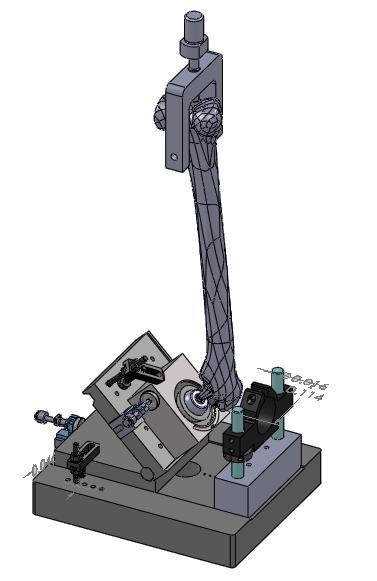
3D model Experimental Setup
Rim cracking of polyethylene acetabular liners and squeaking in ceramic components are two important potential failure modes of hip implants, but the loads and stresses that cause such failures are not well understood. Contact stresses in hip implants are analyzed under worst case load conditions to develop new wear testing methods to improve the pre-clinical evaluation of next-generation hip implants and their materials. Complicated full-scale hip implant simulator tests are expensive and take months to complete. A primary goal of this work is to find inexpensive surrogate specimen shapes and loading modes that can, in inexpensive lab tests taking only a few hours, produce the same wear patterns as seen in full-scale prototype testing. Continue reading
Nonclassical plasticity validation
Analysis and computations have been performed by the Utah CSM group to support experimental investigations of unvalidated assumptions in plasticity theory. The primary untested assumption is that of a regular flow rule in which it is often assumed that the direction of the inelastic strain increment is unaffected by the total strain increment itself. To support laboratory testing of this hypothesis, the general equations of classical plasticity theory were simplified for the case of axisymmetric loading to provide experimentalists with two-parameter control of the axial and lateral stress increments corresponding to a specified loading trajectory in stress space. Loading programs involving changes in loading directions were designed. New methods for analyzing the data via a moving least squares fit to tensor-valued input-output data were used to quantitatively infer the apparent plastic tangent modulus matrix and thereby detect violations of the regular flow rule. Loading programs were designed for validating isotropic cap hardening models by directly measuring the effect of shear loading on the hydrostatic elastic limit.
UofU Contributors/collaborators:
Michael Braginski (postdoc, Mech. Engr., UofU)
Jeff Burghardt (PhD student, Mech. Engr., UofU)
External collaborators/mentors:
Stephen Bauer (Manager, Sandia National Labs geomechanics testing lab)
David Bronowski (Sandia geomechanics lab technician)
Erik Strack (Manager, Sandia Labs Computational Physics)
Engineered microstructures for optimal energy absorbtion: design, validation, and verification
Breaking from conventional monolithic, layered, or woven designs for protective structures (bumpers, armor, etc.), micromanufacturing technology is now maturing to the point where precisely engineered microstructures may soon be possible. In anticipation of such advances, novel microstructures are being here designed to optimize the ability of protective structures to thwart impact loadings. Preliminary work shows that a variety of specially designed microstructures can distribute structural damage away from an impact site rather than allowing damage to be concentrated at the impact zone. The merits of these design concept are investigated numerically and experimentally in the scope of safety net design.
UofU contributors/collaborators:
S. Leelavanichkul (Research fellow, Mechanical Engineering, UofU)
A. Cherkaev (Prof. of Mathematics, UofU)
 University of Utah CSM Group