Aldridge (AKA Blake) spherical source verification test for dynamic continuum codes

This post has the following aims:

  • Provide documentation and source code for a spherically symmetric wave propagation in a linear-elastic medium.
  • Tell a story illustrating how this simple verification problem helped to validate a complicated rate-dependent and history-dependent geomechanics model.
  • Warn against believing previously reported material parameters, since they might have been the result of constitutive parameter tweaking to compensate for unrelated errors in the host code. Continue reading

Project: Bistable links improve effectiveness of protective structures

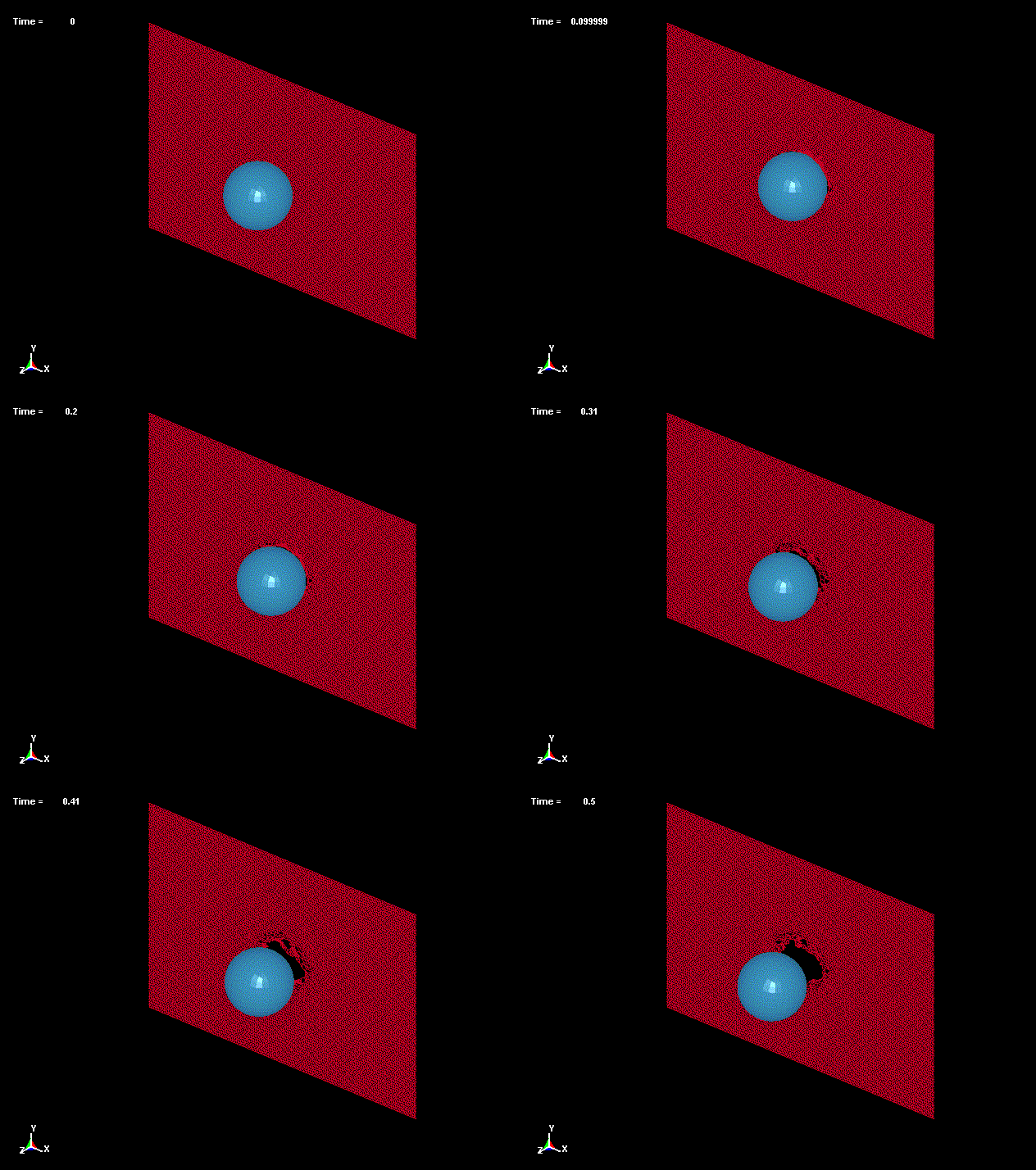
Click on either of the following images to see an animation.

The first structure is a regular lattice of breakable links, while next one, which successfully repels the projectile, consists of the same mass of links that are “bistable” meaning that they have a first breaking point followed by a backup link recovery, which allows damage to be better spread through the structure rather than being focused at the impact point.  By encouraging damage diffusion, the failure is no longer exclusively at the point of impact, as seen below by the red partially damaged bistable links. Continue reading

Streamline visualization of tensor fields in solid mechanics

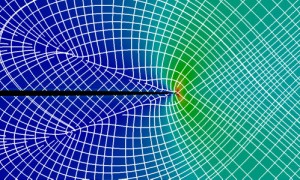
Stress net view of maximum shear lines inferred from molecular dynamics simulation of crack growth. Image from http://doi.ieeecomputersociety.org/10.1109/VIS.2005.33

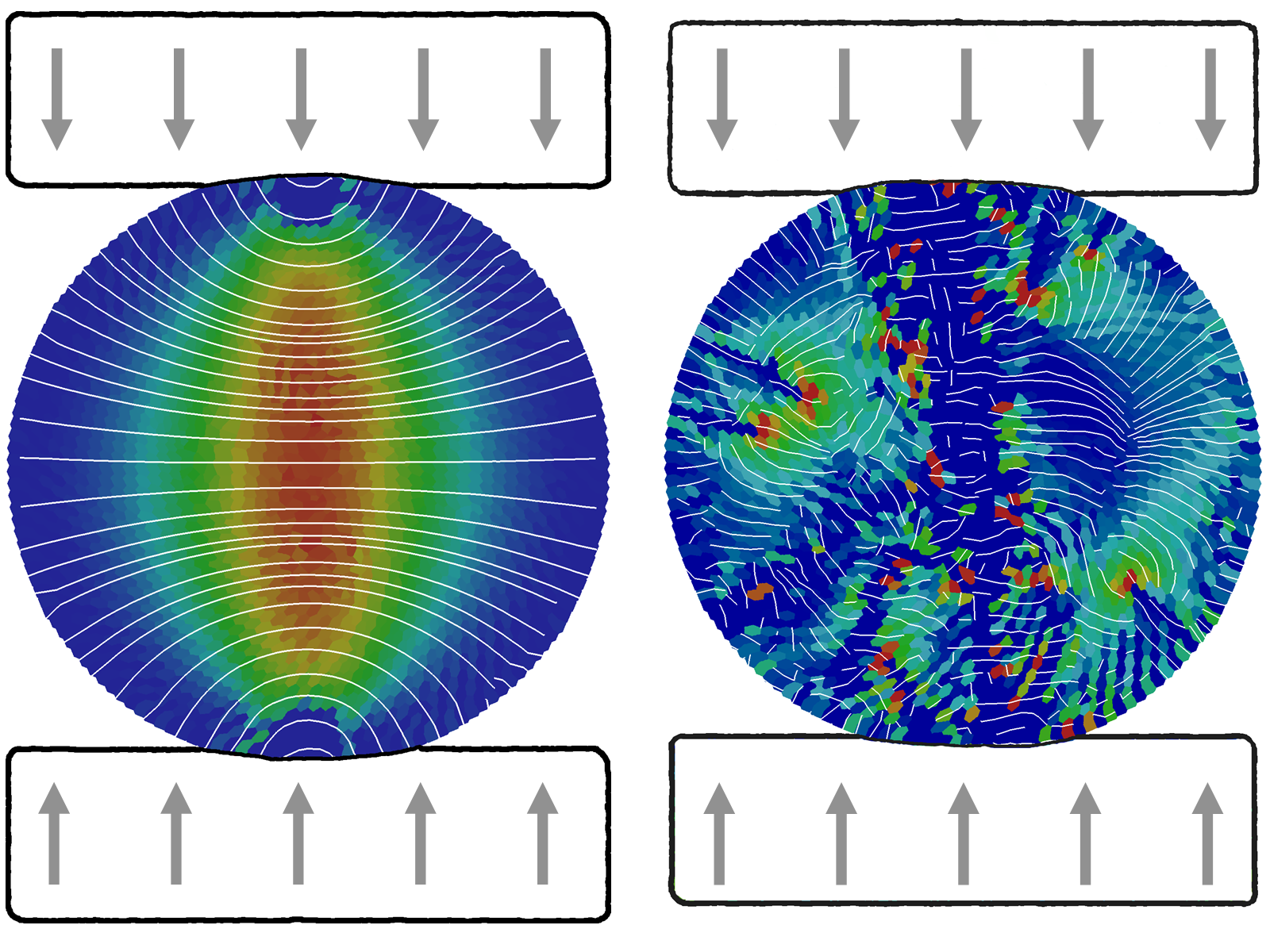
Brazilian stress net before and after material failure. Colors indicate maximum principal stress (showing tension in the center of this axially compressed disk). Lines show directions of max principal stress.

A stress net is simply a graphical depiction of principal stress directions (or other directions derived from them, such as rotating them by 45 degrees to get the maximum shear lines.)  Continue reading

Research: Worn Ceramic-on-Ceramic Hip Implants Squeak Only When Dry Under Low Loads

Some ceramic-on-ceramic hip implants have been shown to squeak in vivo. While many researchers have investigated the squeaking phenomenon, the root cause is still debated. The most widely accepted hypotheses postulate that squeaking occurs as a result of edge-loading, stripe-wear, vibrations that are amplified by the femoral stem, dryness, or a combination of the foregoing. In our custom test apparatus to asses wear related squeaking, we found that even when both implants are severely worn, squeaking only occurs under dry conditions as shown in the attached video.

Ceramic-on-Ceramic Hip Implants Squeak Only When Dry

Presentation: Contact Mechanics of Impacting Slender Rods: Measurement and Analysis

Sanders, A., I. Tibbitts, D. Kakarla, S. Siskey, J. Ochoa, K. Ong, and R. Brannon. (2011). “Contact mechanics of impacting slender rods: measurement and analysis.” Society for Experimental Mechanics Annual Meeting. Uncasville, CT, June 13-16.

Abstract

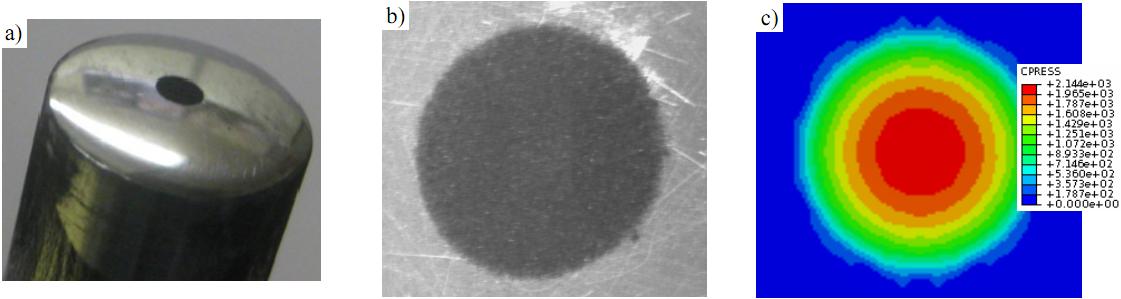
Images of a typical contact patch

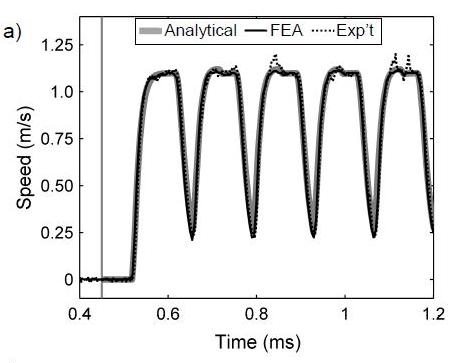
To validate models of contact mechanics in low speed structural impact, slender rods with curved tips were impacted in a drop tower, and measurements of the contact and vibration were compared to analytical and finite element (FE) models. The contact area was recorded using a thin-film transfer technique, and the contact duration was measured using electrical continuity. Strain gages recorded the vibratory strain in one rod, and a laser Doppler vibrometer measured velocity. The experiment was modeled analytically using a quasi-static Hertzian contact law and a system of delay differential equations. The FE model used axisymmetric elements, a penalty contact  algorithm, and explicit time integration. A small submodel taken from the initial global model economically refined the analysis in the small contact region. Measured contact areas were within 6% of both models’ predictions, peak speeds within 2%, cyclic strains within 12 microstrain (RMS value), and contact durations within 2 µs. The accuracy of the predictions for this simple test, as well as the versatility of the diagnostic tools, validates the theoretical and computational models, corroborates instrument calibration, and establishes confidence thatthe same methods may be used in an experimental and computational study of the impact mechanics of artificial hip joint.

Available Online:

http://www.mech.utah.edu/~brannon/pubs/2011SandersSEMconf274_san.pdf

http://www.springerlink.com/content/n09q8v08716n6865/
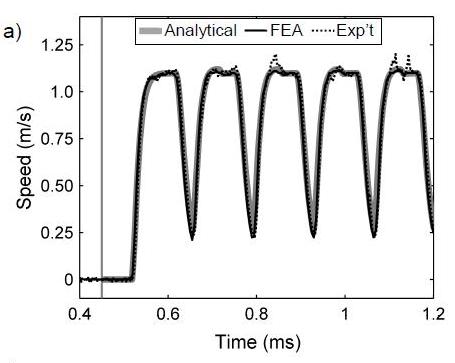
Global model results comparison with analytical and experimental results for speed at the midpoint of one of the rods

Publication: Experimental Assessment of Unvalidated Assumptions in Classical Plasticity Theory

R. Brannon, J.A. Burghardt, D. Bronowski, and S. Bauer

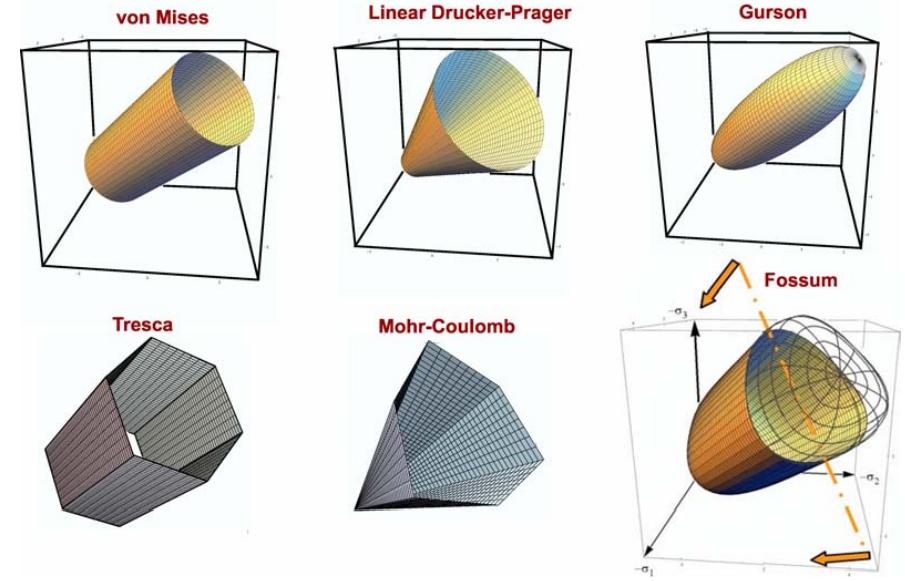
Common isotropic yield surfaces. Von Mises and Drucker-Prager models are often used for metals. Gurson’s function, and others like it, are used for porous media. Tresca and Mohr-Coulomb models approximate the yield threshold for brittle media. Fossum’s model, and others like it, combine these features to model realistic geological media.

This report investigates the validity of several key assumptions in classical plasticity theory regarding material response to changes in the loading direction. Three metals, two rock types, and one ceramic were subjected to non-standard loading directions, and the resulting strain response increments were displayed in Gudehus diagrams to illustrate the approximation error of classical plasticity theories. A rigorous mathematical framework for fitting classical theories to the data,thus quantifying the error, is provided. Further data analysis techniques are presented that allow testing for the effect of changes in loading direction without having to use a new sample and for inferring the yield normal and flow directions without having to measure the yield surface. Though the data are inconclusive, there is indication that classical, incrementally linear, plasticity theory may be inadequate over a certain range of loading directions. This range of loading directions also coincides with loading directions that are known to produce a physically inadmissible instability for any nonassociative plasticity model.

Available Online:

http://www.mech.utah.edu/~brannon/pubs/7-BrannonBurghardtSAND-Report2009-0351.pdf

http://www.osti.gov/energycitations/product.biblio.jsp?osti_id=948711

Publication: Determining a Surrogate Contact Pair in a Hertzian Contact Problem

Sanders, A. P. and R. M. Brannon (2011). “Determining a Surrogate Contact Pair in a Hertzian Contact Problem.” Journal of Tribology 133(2): 024502-024506.

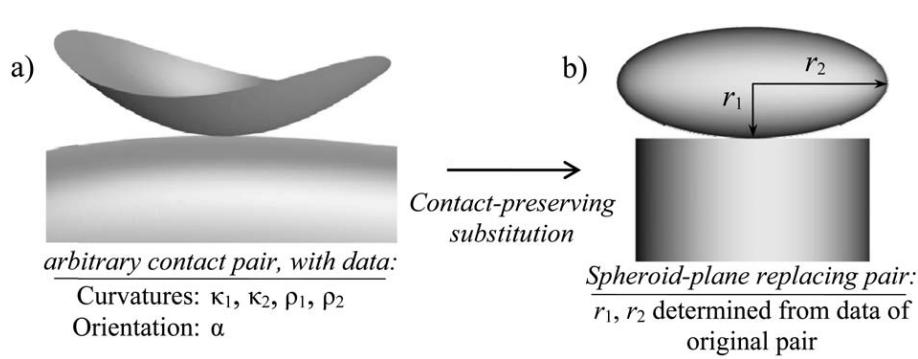
Hertzian substitution concept: An arbitrary contact pair (a) with given principal curvatures and orientation, is substituted with a simpler contact pair (b) consisting of a spheroid and a plane

Laboratory testing of contact phenomena can be prohibitively expensive if the interacting bodies are geometrically complicated. This work demonstrates means to mitigate such problems by exploiting the established observation that two geometrically dissimilar contact pairs may exhibit the same contact mechanics. Specific formulas are derived that allow a complicated Hertzian contact pair to be replaced with an inexpensively manufactured and more easily fixtured surrogate pair, consisting of a plane and a spheroid, which has the same (to second-order accuracy) contact area and pressure distribution as the original complicated geometry. This observation is elucidated by using direct tensor notation to review a key assertion in Hertzian theory; namely, geometrically complicated contacting surfaces can be described to second-order accuracy as contacting ellipsoids. The surrogate spheroid geometry is found via spectral decomposition of the original pair’s combined Hessian tensor. Some numerical examples using free-form surfaces illustrate the theory, and a laboratory test validates the theory under a common scenario of normally compressed convex surfaces. This theory for a Hertzian contact substitution may be useful in simplifying the contact, wear, or impact testing of complicated components or of their constituent materials.

Available Online:

http://www.mech.utah.edu/~brannon/pubs/7-2011-SandersBrannon-IJT.pdf

http://scitation.aip.org/getabs/servlet/GetabsServlet?prog=normal&id=JOTRE9000133000002024502000001&idtype=cvips&gifs=yes&ref=no

Publications: Nonuniqueness and instability of classical formulations of nonassociative plasticity

A plot of the frequency-dependent wave propagation velocity for the case study problem with an overlocal plasticity model, with the elastic and local hardening wave speeds shown for reference (left). Stress histories using an overlocal plasticity model with a nonlocal length scale of 1m and a mesh resolution of 0.125m (right)

The following series of three articles (with common authors J. Burghardt and R. Brannon of the University of Utah) describes a state of insufficient experimental validation of conventional formulations of nonassociative plasticity (AKA nonassociated and non-normality).  This work provides a confirmation that such models theoretically admit negative net work in closed strain cycles, but this simple prediction has never been validated or disproved in the laboratory!

  1. An early (mostly failed) attempt at experimental investigation of unvalidated plasticity assumptions (click to view),
  2. A simple case study confirming that nonassociativity can cause non-unique and unstable solutions to wave motion problems (click to view),
  3. An extensive study showing that features like rate dependence, hardening, etc. do not eliminate the instability and also showing that it is NOT related to conventional localization (click to view).

Continue reading

Publication: A model for statistical variation of fracture properties in a continuum mechanics code

H.W. Meyer Jr. and R.M. Brannon

[This post refers to the original on-line version of the publication. The final (paper) version with page numbers and volume is found at http://dx.doi.org/10.1016/j.ijimpeng.2010.09.007. Some further details and clarifications are in the 2012 posting about this article]

Simulation results for a reference volume of 0.000512 cm^3 ; sf is the size effect factor

Continuum mechanics codes modeling failure of materials historically have considered those materials to be homogeneous, with all elements of a material in the computation having the same failure properties. This is, of course, unrealistic but expedient. But as computer hardware and software has evolved, the time has come to investigate a higher level of complexity in the modeling of failure. The Johnsone-Cook fracture model is widely used in such codes, so it was chosen as the basis for the current work. The CTH finite difference code is widely used to model ballistic impact and penetration, so it also was chosen for the current work. The model proposed here does not consider individual flaws in a material, but rather varies a material’s Johnsone-Cook parameters from element to element to achieve in homogeneity. A Weibull distribution of these parameters is imposed, in such a way as to include a size effect factor in the distribution function. The well-known size effect on the failure of materials must be physically represented in any statistical failure model not only for the representations of bodies in the simulation (e.g., an armor plate), but also for the computational elements, to mitigate element resolution sensitivity of the computations.The statistical failure model was tested in simulations of a Behind Armor Debris (BAD) experiment, and found to do a much better job at predicting the size distribution of fragments than the conventional (homogeneous) failure model. The approach used here to include a size effect in the model proved to be insufficient, and including correlated statistics and/or flaw interactions may improve the model.

Available Online:

http://www.mech.utah.edu/~brannon/pubs/7-2011MeyerBrannon_IE_1915_final_onlinePublishedVersion.pdf

http://www.sciencedirect.com/science/article/pii/S0734743X10001466

Publication: On the thermodynamic requirement of elastic stiffness anisotropy in isotropic materials

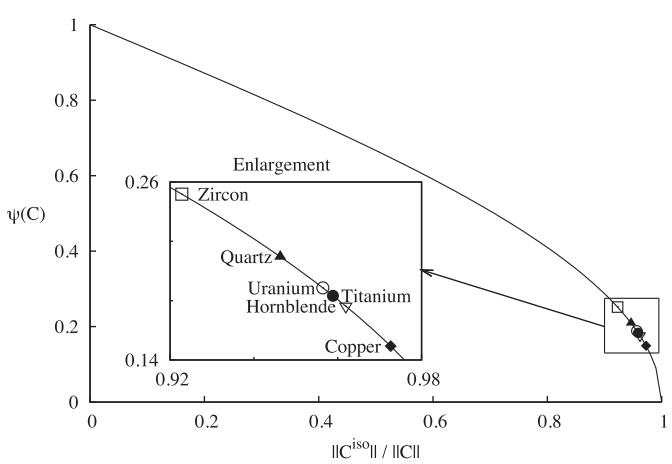
Measure of anisotropy for Zircon, Quartz, Uranium, Titanium, Hornblende, and Copper.

T. Fuller and R.M. Brannon

In general, thermodynamic admissibility requires isotropic materials develop reversible deformation induced anisotropy (RDIA) in their elastic stiffnesses. Taking the elastic potential for an isotropic material to be a function of the strain invariants, isotropy of the elastic stiffness is possible under distortional loading if and only if the bulk modulus is independent of the strain deviator and the shear modulus is constant. Previous investigations of RDIA have been limited to applications in geomechanics where material non-linearityand large deformations are commonly observed. In the current paper, the degree of RDIA in other materials is investigated. It is found that the resultant anisotropy in materials whose strength does not vary appreciably with pressure, such as metals, is negligible, but in materials whose strength does vary with pressure, the degree of RDIA can be significant. Algorithms for incorporating RDIA in a classical elastic–plastic model are provided.

Available Online:

http://www.mech.utah.edu/~brannon/pubs/7-2011FullerBrannonInducedElasticAnisotropy.pdf

http://www.sciencedirect.com/science/article/pii/S0020722511000024