Should you say “finite element” or “finite-element?” Which is better: a “beautifully-written” manuscript, or “beautifully written” one? Are your equations non-linear or nonlinear? Our one-page list of hyphenation rules summarizes information found in a variety of authoritative sources (Princeton Review, Strunk & White, etc.). Happy technical writing!
Making a movie for a selected part of a simulation in Visit
Here is a brief tutorial on making a movie in visit for selected portion of your simulation domain. I used sphere to represent the particles, but you do not have any restrictipn on how to show your particles. click visit_movie for the tutorial.
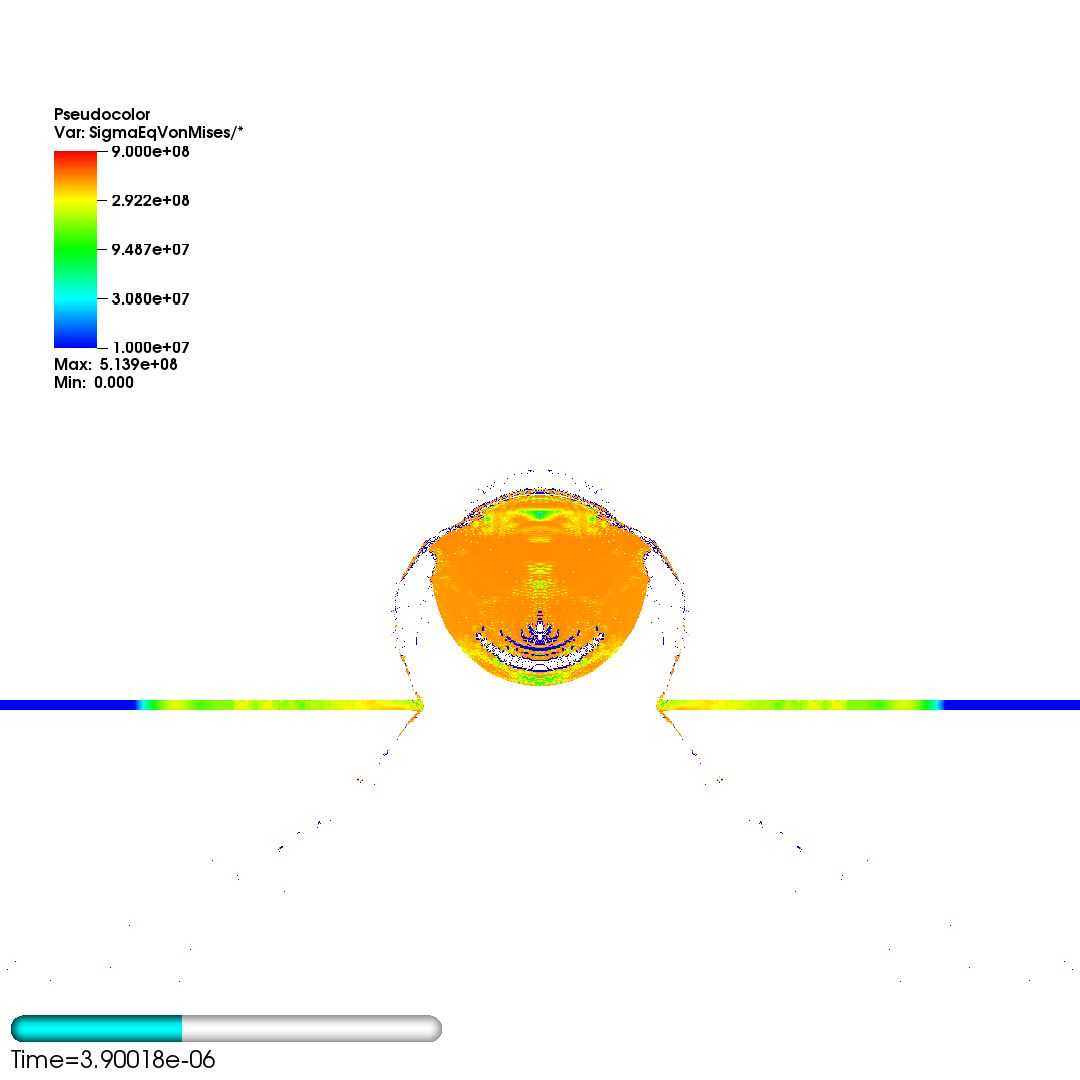
Uintah Simulations of Perforation Experiments
ABSTRACT: A simulation of a simple penetration experiment is performed using Material Point Method (MPM) through the Uintah Computational Framework (UCF) and interpreted using the post-processing visualization program VisIt. MPM formatting sets a background mesh with explicit boundaries and monitors the interaction of particles within that mesh to predict the varying movements and orientations of a material in response to loads. The modeled experiment compares the effects of an aluminum sphere impacting an aluminum sheet at varying velocities. In this work, the experiment called launch T-1428 (by Piekutowski and Poorman) is simulated using UCF and VisIt. The two materials in the experiment are both simulated using a hypoelastic-plastic model. Varying grid resolutions were used to verify the convergent behavior of the simulations to the experimental results. The validity of the simulation is quantified by comparing perforation hole diameter. A full 3-D simulation followed and was also compared to experimental results. Results and issues in both 2-D and 3-D simulation efforts are discussed. Both the axisymmetric and 3-D simulation results provided very good data with clear convergent behavior.
See the link below for the full report.
Abstract: Deformation and Fracture of Heterogeneous Media using Boundary-Conforming Convected Particle Characteristic Functions in the Material Point Method
This is an abstract for
NWU2013: Advances in Computational Mechanics with Emphasis on Fracture and Multiscale Phenomena. Workshop honoring Professor Ted Belytschko’s 70th Birthday. April 18, 2013 – April 20, 2013, Evanston, IL, USA
The organizers allocated only 10 minutes for each person’s talk (including big wigs like Tom Hughes), so we might just present this topic in the form of a puppet show with enough information to tickle the audience to chat with us about it in the hallway!
Authors:
Rebecca Brannon*, Alireza Sadeghirad, James Guilkey
Department of Mechanical Engineering
University of Utah
Salt Lake City, UT, 84112
*Email: Rebecca.Brannon@utah.edu
Tangent mapping


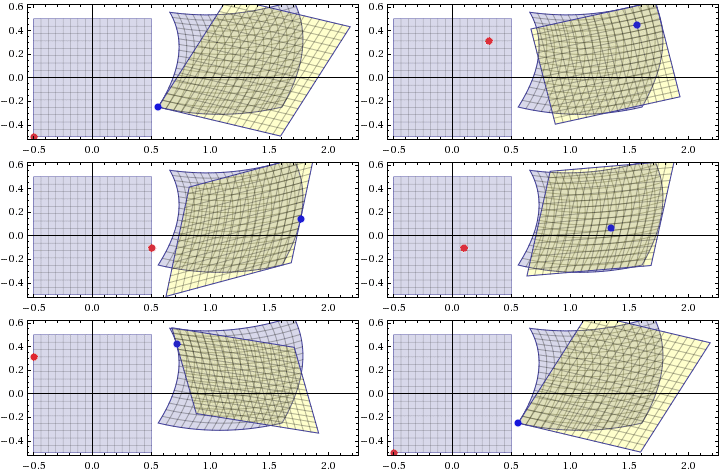
These images show the initial configuration of a body (square) and a nonlinear deformation of that body into a curvy shape (to the right of the square). Overlaid on the actual deformed shape is the so-called tangent mapping at the indicated point. It coincides with the nonlinear mapping to first-order accuracy.
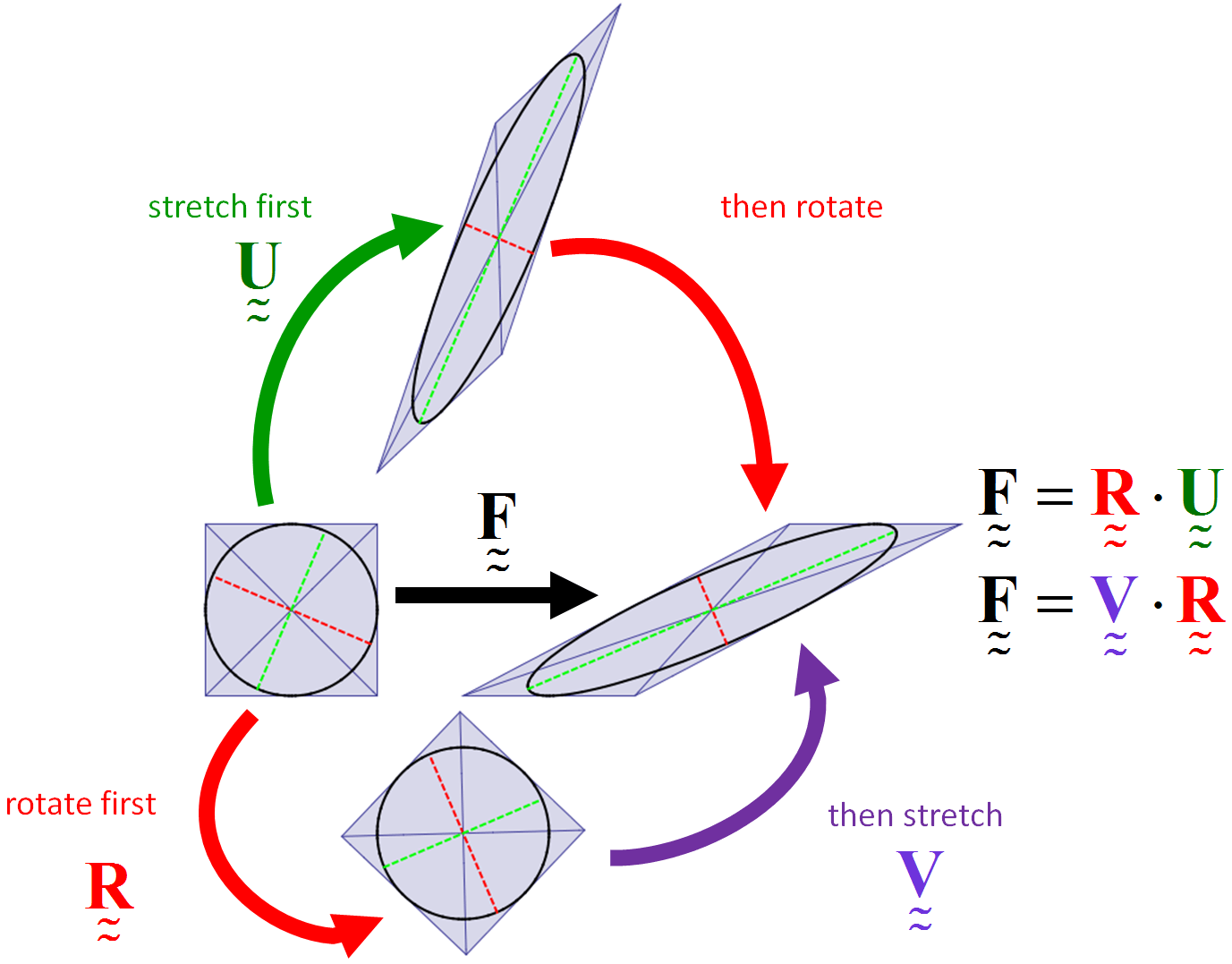
Illustration of polar decomposition
This posting explains the meaning of a polar decomposition, and it gives two numerical methods for computing it.
Below is shown simple shear of a unit square. The inscribed circle and the lines from corner to corner should be regarded as painted on the material, so they flow with deformation. The green and red dashed lines show the principal directions of stretch, which are aligned with the major axes of the deformed ellipse and hence move relative to the material as the deformation proceeds. In the deformed state (far right), the red and green dashed lines are defined to be aligned with the major axes of the deformed ellipse (far right). The red and green dashed lines in the other states show the material points covered by those green and red lines in the deformed state.

Abstract: Simulation of Buried Explosives
Click here to see an invited talk for the 2013 Advances in Computational Mechanics Conference celebrating the 70th birthday of Thomas J.R. Hughes.
Stretch, rotation, and intuition about strain rate approximations
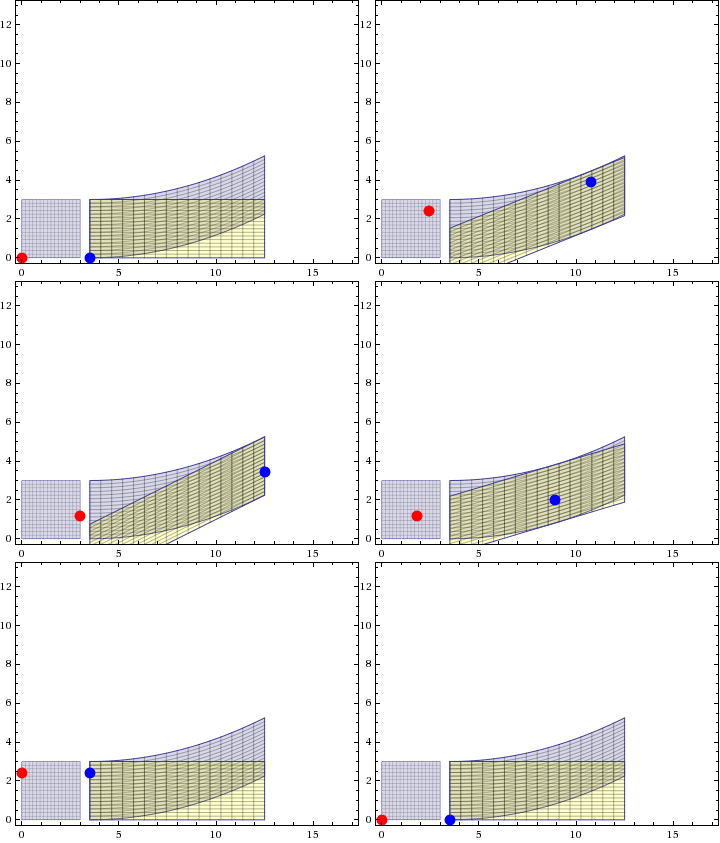
The animation below shows
RED: simple shear in physical configuration
BLUE: simple shear with the polar rotation removed (i.e., the pure stretch)
GREEN: the deformation corresponding to the approximation that D-bar (given by the unrotated symmetric part of the velocity gradient) is actually the rate of reference logarithmic strain. This is found by integrating D-bar through time to obtain the apparent logarithmic strain, and then exponentiating this apparent strain to obtain an apparent reference stretch.
GRAY: rotation of the green deformation back to the spatial configuration.

Distinction between uniaxial stress and uniaxial strain
Uniaxial stress is a form of loading in which the 11 (axial) component of stress is nonzero, while all other components of stress are zero.
Uniaxial strain is a form of loading in which the 11 (axial) component of strain is nonzero, while all other components of strain are zero.
PUBLICATION: Influence of nonclassical plasticity features on shock wave existence and spectral solutions
A scanned copy is available here.
ABSTRACT (from OCR so has some typos): The influence of non-classical elastic-plastic constitutive features on dynamically moving discontinuities in stress, strain, and material velocity is investigated. Non-classical behavior here includes non-normality of the plastic strain increment to the yield surface, plastic compressibility, pressure sensitivity of yield, and dependence of the elastic moduli on plastic strain. DRUGAN and SHEN’s (1987) analysis of dynamically moving discontinuities with strain as well as stress jumps in classical materials is shown to be valid for a broad class of non-associative material models until deviation from normality exceeds a critical (non-infinitesimal) level. For these non-classical materials, an inequality that bounds the magnitude of the stress jump is derived, which is information not obtainable from a standard spectral analysis of a shock. For the special case of stress discontinuities with continuous strain, or for quasi-static deformations, this inequality is shown to rule out jumps in specific projections of the stress tensor unless the non-normality is sufficiently large. These results invalidate a … claim in the literature that an infinitesimal amount of non-normality permits moving surfaces of discontinuity in stress (with no strain jump) near the tip of a dynamically advancing crack tip.
Using a very general plastic constitutive law that subsumes most non-classical (and classical) descriptions currently in use, a complete closed-form solution is obtained for the plastic wave speeds and eigenvectors. A novel feature of the analysis is the clarity and completeness of the solutions. If the elastic part of the response is isotropic, one plastic wave speed equals the elastic shear wave speed, while the other two possible wave speeds depend in general on the stress and plastic strain within the shock transition layer. Concise necessary and sufficient conditions for real eigenvalues and for vanishing eigenvalues are derived. The real eigenvalues are classified by numerical sign and ordering relative to the elastic eigenvalues. The geometric multiplicity of plastic eigenvectors associated with elastic eigenvalues is shown to depend on the stress state within the shock transition layer. These solutions, several of which hold for arbitrary elastic anisotropy, are also applicable to acceleration waves and localization problems, and to materials with dependence of the elastic moduli on plastic strain. Such elastic–plastic coupling is shown to imply a non-self-adjoint fourth order tangent stiffness tensor even if the plastic constitutive law is associative.
A scanned copy is available here.