Rate of Hencky (logarithmic) strain and similar tasks

The logarithmic (Hencky) strain is evaluated by taking the log of the symmetric stretch tensor in continuum mechanics. Doing so requires transforming to the principal stretch basis, taking logs of the principal stretch eigenvalues, and transforming the result back to the lab basis.  While this procedure is a bit tedious, it certainly is straightforward.

The harder — almost freakishly daunting — question is: how do you get the rate of the logarithmic strain?  This rate must include contributions from both the rate of the stretch eigenvalues and the rate of the stretch eigenvectors, which is difficult to handle when there are repeated eigenvalues causing extra ambiguity of eigenvectors.  Continue reading
Tutorial: Visualizing Deformation

If you’ve never heard of a continuum mapping, read our introduction to mappings.

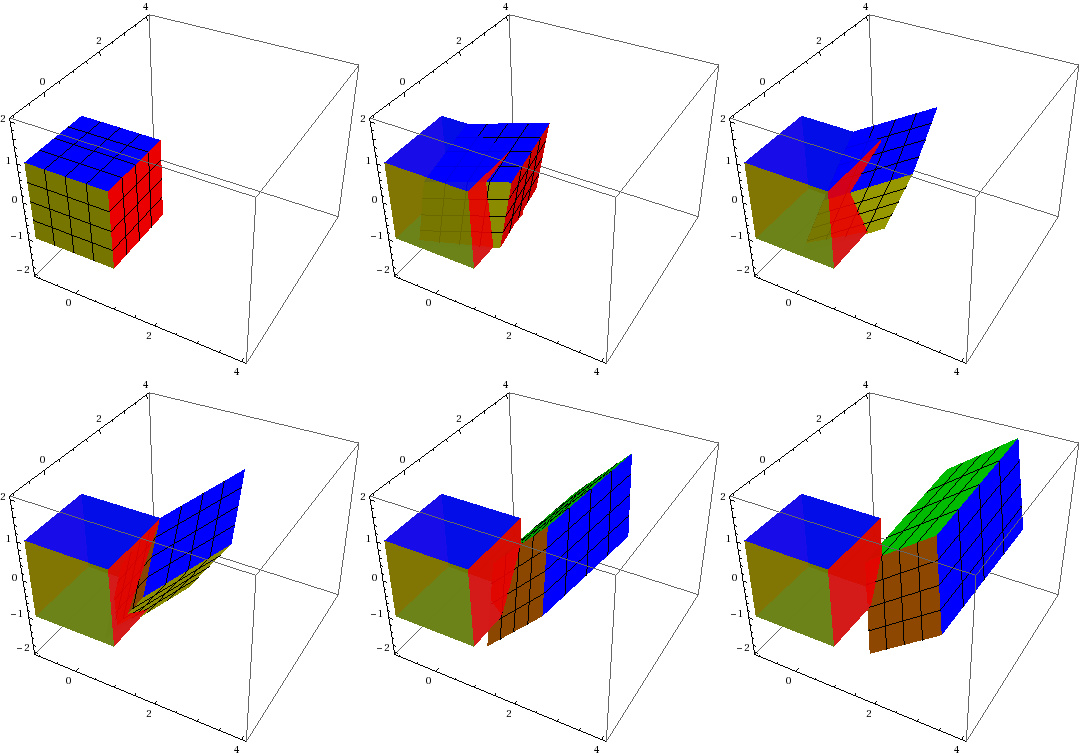
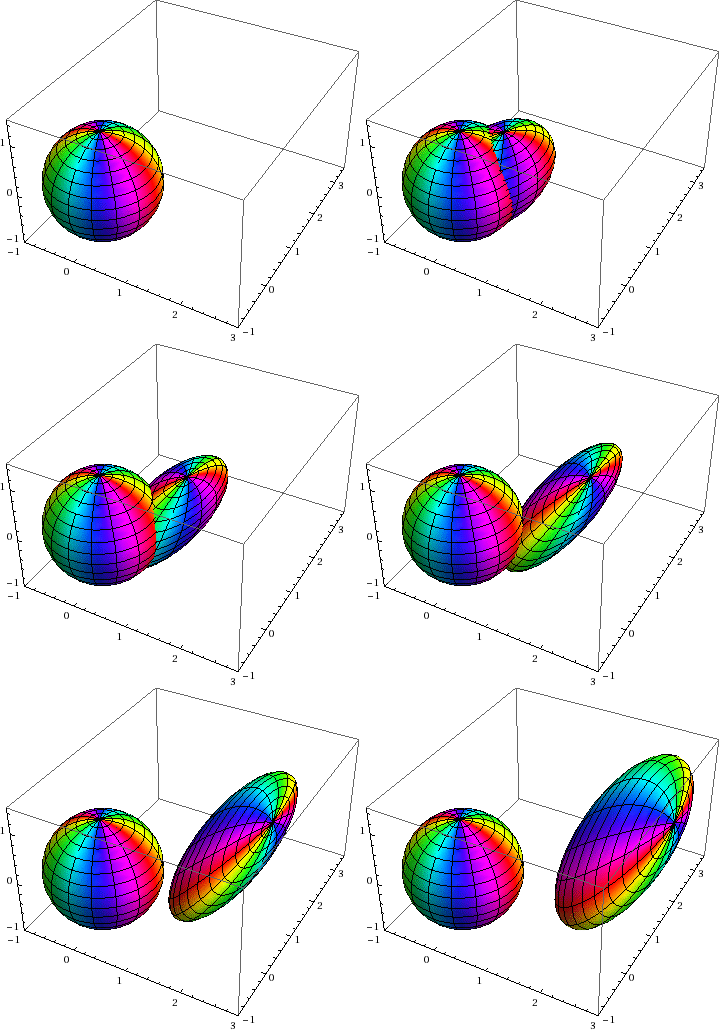
This posting discusses the two most common visualization methods for 3D homogeneous mappings: Showing how a sphere transforms to an ellipsoid and how a cube transforms to a parallelepiped:
Sphere transforming to ellipsoidBox transforming to parallelepiped

Continue reading

Tip: How to set up videoconferencing with the CSM group

The following tutorial provides instructions for both the host (CSM group) and guest to set up videoconferencing.

METHOD 1 (for impromptu small meetings without graphics sharing)
Remote guest can make the request to Dr. Brannon, whose Skype name is rebecca.brannon

METHOD 2 (for extended multi-participant meetings with graphics sharing)

The Interactive Video Conferencing (IVC) equipment at the University of Utah allows us to connect to other people and places throughout the state and the world.

Host (CSM personnel) instructions:

The following steps are necessary for an IVC meeting:

  • To schedule an IVC meeting, the CSM personnel should contact the IVC through one of the following options:

1. call 435-879-4762

2. e-mail ivc@utah.edu

3. fill the forms here.

  • The IVC staff find an available room on campus and arrange a test call with the guest.
  • If the test connection is successful, the IVC staff schedule a connection for the actual meeting.
  • The CSM personnel should be trained on how to use the equipment. For this purpose, the IVC staff provide a short training session for the CSM personnel.

Guest instructions:

The guest should have the required equipment, and provide its IP number to the CSM personnel. The guest and the CSM personnel should be in contact to schedule a test call and troubleshoot any issue.

Resource: Perfect triples, “nice” unit vectors, and “nice” orthogonal matrices

“NICE” lists:

Perfect Triangles

Perfect Triangles

Have you ever noticed that textbooks often involve so-called 3-4-5 triangles? They do that to make the algebraic manipulations easier for students.  If the two legs of a right triangle are of length 3 and 4, then the hypotenuse (found from the Pythagorean theorem) has a length of 5, which is “nice” in the sense that it is an integer rather than an irrational square root that more typically comes from solving the Pythagorean theorem. As discussed in many elementary math sites (such as MakingMathematics.org), another example of a “nice” triangle is the 5-12-13 triangle, since 5^2+12^2=13^2 .

The external links in this posting contain a list of more of these so-called perfect triples of integers \{a,b,c\} for which a^2+b^2=c^2 . Perfect triples are also used to create “nice” 2D unit vectors whose components are each rational numbers (instead of involving irrational square roots from the normalization process). For example, the classic unit vector based on the 3-4-5 perfect triple is simply \{\frac{3}{5},\frac{4}{5}\} . Continue reading

Research: Worn Ceramic-on-Ceramic Hip Implants Squeak Only When Dry Under Low Loads

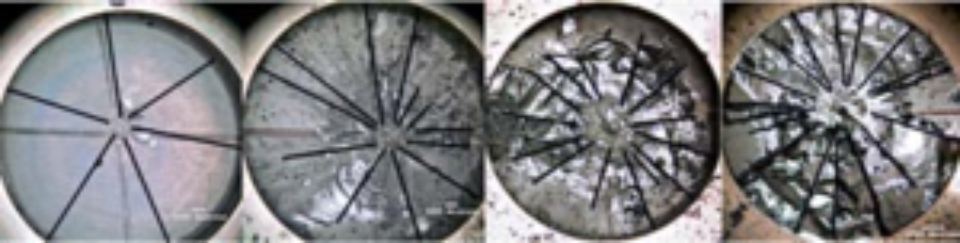
Some ceramic-on-ceramic hip implants have been shown to squeak in vivo. While many researchers have investigated the squeaking phenomenon, the root cause is still debated. The most widely accepted hypotheses postulate that squeaking occurs as a result of edge-loading, stripe-wear, vibrations that are amplified by the femoral stem, dryness, or a combination of the foregoing. In our custom test apparatus to asses wear related squeaking, we found that even when both implants are severely worn, squeaking only occurs under dry conditions as shown in the attached video.

Ceramic-on-Ceramic Hip Implants Squeak Only When Dry

Tutorial: multi-linear regression

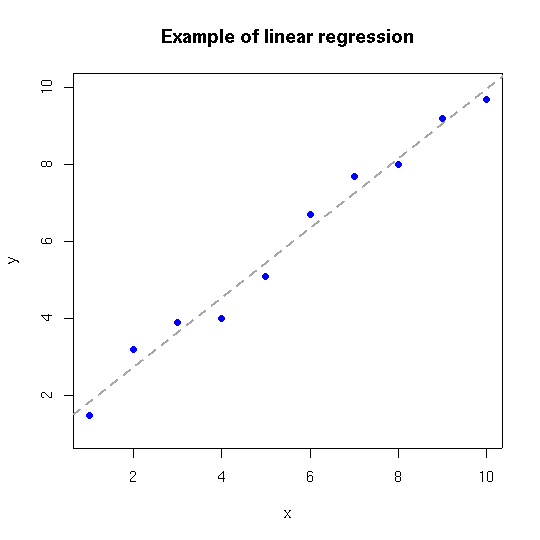
The straight line is the linear regression of a function that takes scalars (x-values) as input and returns scalars (y-values) as output. (figure from GANFYD)

You’ve probably seen classical equations for linear regression, which is a procedure that finds the straight line that best fits a set of discrete points \{(x_1,y_1), (x_2,y_2),...,(x_N,y_N)\} . You might also be aware that similar formulas exist to find a straight line that is a best (least squares) fit to a continuous function y(x) .

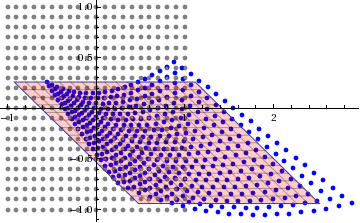
The pink parallelogram is the multi-linear regression of a function that takes vectors (gray dots) as input and returns vectors (blue dots) as output

The bottom of this post provides a link to a tutorial on how to generalize the concept of linear regression to fit a function \vec{y}(\vec{x}) that takes a vector \vec{x} as input and produces a vector \vec{y} as output. In mechanics, the most common example of this type of function is a mapping function that describes material deformation: the input vector is the initial location of a point on a body, and the output vector is the deformed location of the same point. The image shows a collection of input vectors (initial positions, as grey dots) and a collection of output vectors (deformed locations as blue dots). The affine fit to these descrete data is the pink parallelogram. Continue reading
Course offering: ME 7960 (special topics) Computational Constitutive Modeling

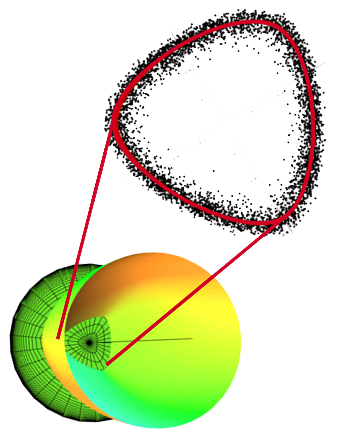
Third invariant yield surface with uncertainty

Constitutive modeling refers to the development of equations describing the way that materials respond to various stimuli. In classical deformable body mechanics, a simple constitutive model might predict the stress required to induce a given strain; the canonical example is Hooke’s law of isotropic linear elasticity. More broadly, a constitutive model predicts increments in some macroscale state variables of interest (such as stress, entropy, polarization, etc.) that arise from changes in other macroscale state variables (strain, temperature, electric field, etc.).

Constitutive equations are ultimately implemented into a finite element code to close the set of equations required to solve problems of practical interest. This course describes a few common constitutive equations, explaining what features you would see in experimental data or structural behavior that would prompt you to select one constitutive model over another, how to use them in a code, how to test your understanding of the model, how to check if the code is applying the model as advertised in its user’s manual, and how to quantitatively assess the mathematical and physical believability of the solution.

Continue reading

WordPress Tutorial: How to Re-size and Crop Pictures

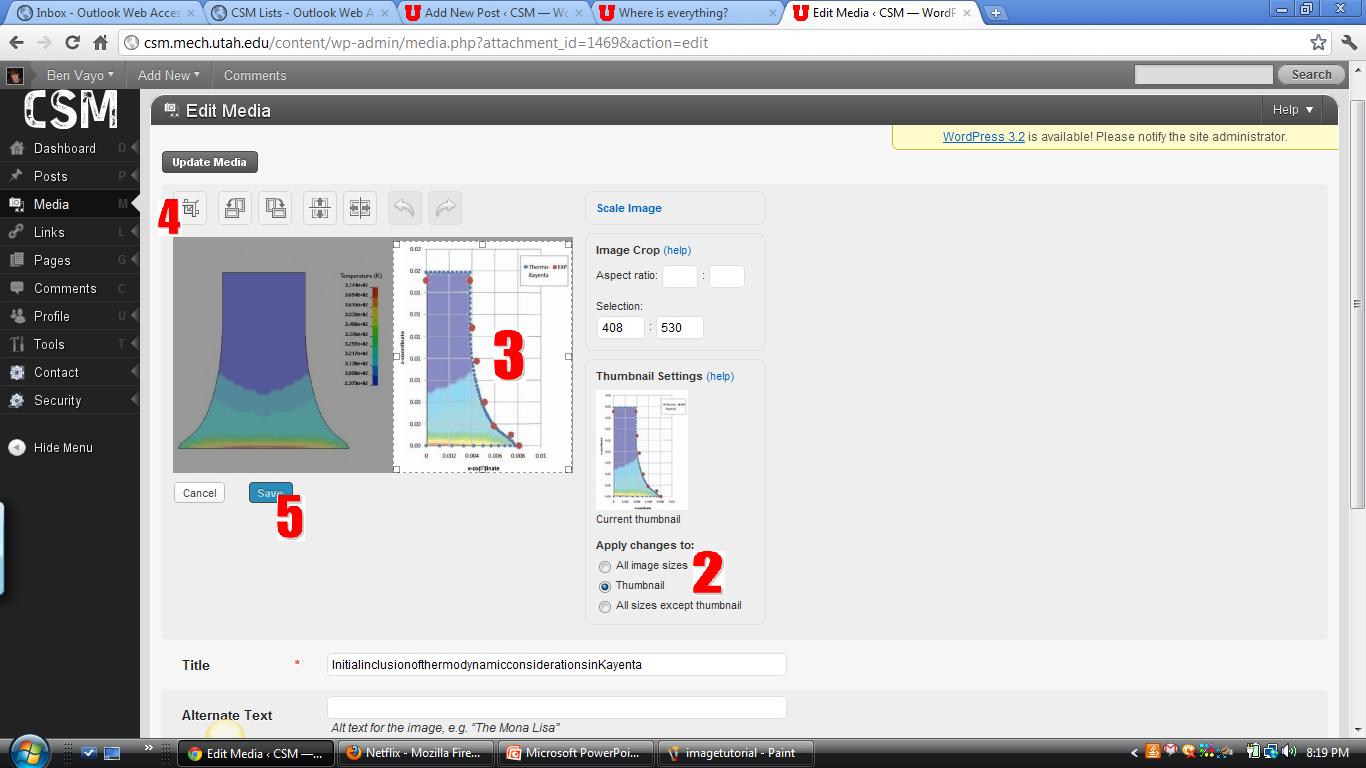
After you have uploaded a picture, there may be a chance that you will want to crop or re-size it to make it look better; you may also want to change what portion of the image shows up in the thumbnail. The following steps will help you with these goals:

1)In the media library, click on the image you would like to edit. On the next screen click the “Edit Image” button underneath the picture.

2)Select whether the changes you are about to make should apply to the full image or the thumbnail.

3)Drag a box, on the image, over the part that you would like to keep (or show up in the thumbnail).

4)Click the crop icon above the image. This will then show you what the cropped image looks like.

5)Once satisfied with the cropping, click the save button below the image. This will take you out of the edit page.

6)Finally, click the update image button and you are done.

Red numbers correspond with the steps above

However, if you are editing an image that you have already put in a post you will need to take one additional step. Go into the edit page for the post and remove the current image, then insert the image you just edited. It should carry over the previous caption/settings. As always, check the post to make sure it looks good and you are done!