
Tag Archives: models
Publication: KAYENTA: Theory and User’s Guide
R.M. Brannon, A.F. Fossum, and O.E. Strack
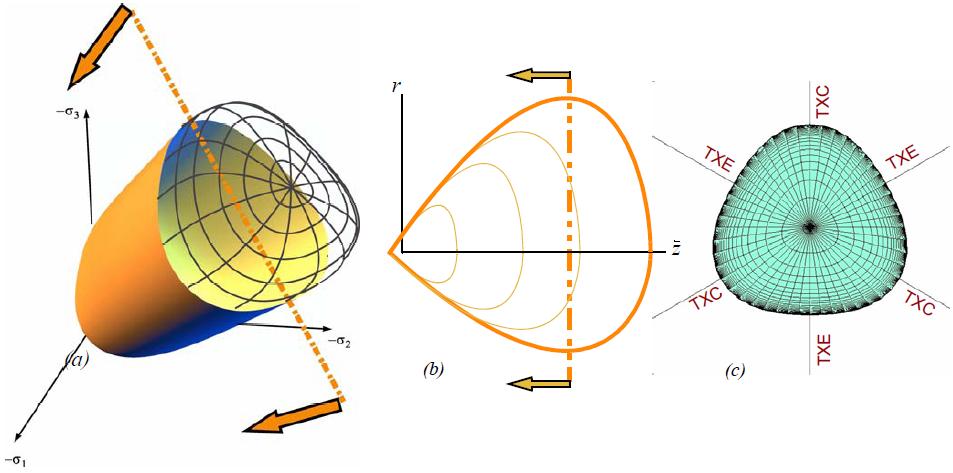
Kayenta continuous yield surface. (a) three-dimensional view in principal stress space, (b) the meridional “side” view (thick line), and (c) the octahedral view
The physical foundations and domain of applicability of the Kayenta constitutive model are presented along with descriptions of the source code and user instructions. Kayenta, which is an outgrowth of the Sandia GeoModel, includes features and fitting functions appropriate to a broad class of materials including rocks, rock-like engineered materials (such as concretes and ceramics),and metals. Fundamentally, Kayenta is a computational framework for generalized plasticity models. As such, it includes a yield surface, but the term“yield” is generalized to include any form of inelastic material response including microcrack growth and pore collapse. Kayenta supports optional anisotropic elasticity associated with ubiquitous joint sets. Kayenta support optional deformation-induced anisotropy through kinematic hardening (inwhich the initially isotropic yield surface is permitted to translate in deviatoric stress space to model Bauschinger effects). The governing equations are otherwise isotropic. Because Kayenta is a unification and generalization of simple models, it can be run using as few as 2 parameters (for linear elasticity) to as many as 40 material and control parameters in the exceptionally rare case when all features are used. For high-strain-rate applications, Kayenta support rate dependence through an overstress model. Isotropic damage is model through loss of stiffness and strength.
Available Online:
http://www.mech.utah.edu/~brannon/pubs/7-2009Kayenta_Users_Guide.pdf
http://dx.doi.org/10.1111/j.1744-7402.2010.02487.x
Publication: Survey of Four Damage Models for Concrete
R.M. Brannon and S. Leelavanichkul
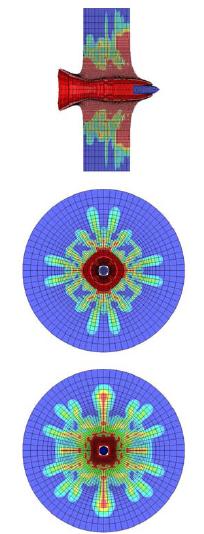
RHT Model: Contour plots of damage: side, front, and back view of the target (top to bottom).
Four conventional damage plasticity models for concrete, the Karagozian and Case model (K&C),the Riedel-Hiermaier-Thoma model (RHT), the Brannon-Fossum model (BF1), and the Continuous Surface Cap Model (CSCM) are compared. The K&C and RHT models have been used in commercial finite element programs many years, whereas the BF1 and CSCM models are relatively new. All four models are essentially isotropic plasticity models for which plasticity is regarded as any form of inelasticity. All of the models support nonlinear elasticity, but with different formulations.All four models employ three shear strength surfaces. The yield surface bounds an evolving set of elastically obtainable stress states. The limit surface bounds stress states that can be reached by any means (elastic or plastic). To model softening, it is recognized that some stress states might be reached once, but, because of irreversible damage, might not be achievable again. In other words, softening is the process of collapse of the limit surface, ultimately down to a final residual surface for fully failed material. The four models being compared differ in their softening evolution equations, as well as in their equations used to degrade the elastic stiffness. For all four models, the strength surfaces are cast in stress space. For all four models, it is recognized that scale effects are important for softening, but the models differ significantly in their approaches. The K&C documentation, for example, mentions that a particular material parameter affecting the damage evolution rate must be set by the user according to the mesh size to preserve energy to failure. Similarly, the BF1 model presumes that all material parameters are set to values appropriate to the scale of the element, and automated assignment of scale-appropriate values is available only through an enhanced implementation of BF1 (called BFS) that regards scale effects to be coupled to statistical variability of material properties. The RHT model appears to similarly support optional uncertainty and automated settings for scale-dependent material parameters. The K&C, RHT, and CSCM models support rate dependence by allowing the strength to be a function of strain rate, whereas the BF1 model uses Duvaut-Lion viscoplasticity theory to give a smoother prediction of transient effects. During softening, all four models require a certain amount of strain to develop before allowing significant damage accumulation. For the K&C, RHT, and CSCM models, the strain-to-failure is tied to fracture energy release, whereas a similar effect is achieved indirectly in the BF1 model by a time-based criterion that is tied to crack propagation speed.
Available Online:
http://www.mech.utah.edu/~brannon/pubs/7-2009BrannonLeelavanichkulSurveyConcrete.pdf
Publication: A multi-stage return algorithm for solving the classical damage component of constitutive models for rocks, ceramics, and other rock-like media
R. M. Brannon and S. Leelavanichkul
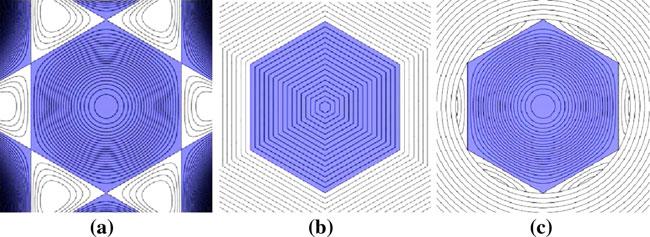
Octahedral isosurfaces for a) the unacceptable, b) the admissible, and c) the admissible
Classical plasticity and damage models for porous quasi-brittle media usually suffer from mathematical defects such as non-convergence and nonuniqueness.Yield or damage functions for porous quasi-brittle media often have yield functions with contours so distorted that following those contours to the yield surface in a return algorithm can take the solution to a false elastic domain. A steepest-descent return algorithm must include iterative corrections; otherwise,the solution is non-unique because contours of any yield function are non-unique. A multi-stage algorithm has been developed to address both spurious convergence and non-uniqueness, as well as to improve efficiency. The region of pathological isosurfaces is masked by first returning the stress state to the Drucker–Prager surface circumscribing the actual yield surface. From there, steepest-descent is used to locate a point on the yield surface. This first-stage solution,which is extremely efficient because it is applied in a 2D subspace, is generally not the correct solution,but it is used to estimate the correct return direction.The first-stage solution is projected onto the estimated correct return direction in 6D stress space. Third invariant dependence and anisotropy are accommodated in this second-stage correction. The projection operation introduces errors associated with yield surface curvature,so the two-stage iteration is applied repeatedly to converge. Regions of extremely high curvature are detected and handled separately using an approximation to vertex theory. The multi-stage return is applied holding internal variables constant to produce a non-hardening solution. To account for hardening from pore collapse (or softening from damage), geometrical arguments are used to clearly illustrate the appropriate scaling of the non-hardening solution needed to obtain the hardening (or softening) solution.
For errata (transcription errors in two of the verification solutions), please see:
Available Online:
http://www.mech.utah.edu/~brannon/pubs/7-2009BrannonLeelavanichkul-IJF.pdf
http://dx.doi.org/10.1007/s10704-009-9398-4
Publication: The Use of Sphere Indentation Experiments to Characterize Ceramic Damage Models
R.B. Leavy; R.M. Brannon; O.E. Strack
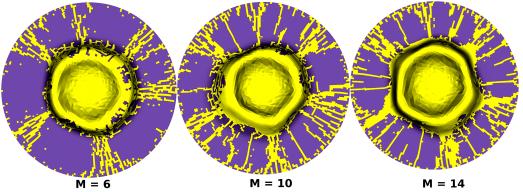
Weibull modulus effect on radial cracking in boron carbide simulations impacted at 400 m/s.
Sphere impact experiments are used to calibrate and validate ceramic models that include statistical variability and/or scale effects in strength and toughness parameters. These dynamic experiments supplement traditional characterization experiments such as tension, triaxial compression, Brazilian, and plate impact, which are commonly used for ceramic model calibration.The fractured ceramic specimens are analyzed using sectioning, X-ray computed tomography, microscopy, and other techniques. These experimental observations indicate that a predictive material model must incorporate a standard deviation in strength that varies with the nature of the loading. Methods of using the spherical indentation data to calibrate a statistical damage model are presented in which it is assumed that variability in strength is tied to microscale stress concentrations associated with microscale heterogeneity.
Available Online:
http://www.mech.utah.edu/~brannon/pubs/7-2009-LeavyBrannonStrack-IJACT.pdf
http://dx.doi.org/10.1111/j.1744-7402.2010.02487.x

Research: Radial cracking as a means to infer aleatory uncertainty parameters
Aleatory uncertainty in constitutive modeling refers to the intrinsic variability in material properties caused by differences in micromorphology (e.g., grain orientation or size, microcracks, inclusions, etc.) from sample to sample. Accordingly, a numerical simulation of a nominally axisymmetric problem must be run in full 3D (non-axisymmetric) mode if there is any possibility of a bifurcation from stability.
Dynamic indentation experiments, in which a spherical ball impacts to top free surface of a cylindrical specimen, nicely illustrate that fracture properties must have spatial variability — in fact, the intrinsic instability that leads to radial cracking is regarded by the Utah CSM group as a potential inexpensive means of inferring the spatial frequency of natural variations in material properties.

Radial cracking in dynamic indentation experiments.
Research: Thermodynamic Consistency, and Strain-Based Failure
The Kayenta geological material model has been enhanced to span a broader range of pressures and loading rates. Temperature dependence of yield strength has been added along with nonlinear thermoelasticity that can accommodate pressure dependence of the shear modulus and entropy dependence of the bulk modulus in a thermodynamically consistent manner. Continue reading
Merits and shortcomings of conventional smeared damage models
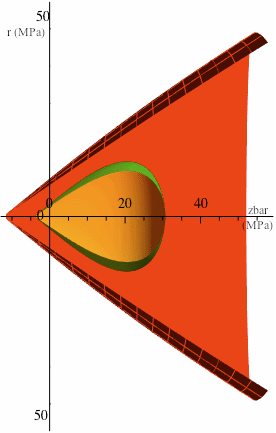
Initial teardrop yield and third-invariant limit surfaces in the Kayenta model
Four classical damage models for concrete (three of which are available in commercial codes) have been compared and critiqued, showing that they all share the notions of a “teardrop” yield surface that can harden and (for some models) translate until reaching a three-invariant fracture limit surface that then collapses to account for softening (i.e., permanent loss of strength). Practical engineering models for rock and ceramics are similar. The common drawbacks of these models (primarily severe mesh dependence) can be mitigated, though not eliminated, by seeding their material properties in the simulation with spatial variability (aleatory uncertainty) and by using appropriate scale effects for the strength and failure progression properties. Continue reading
Powder metal jet penetration into stressed rock
The Uintah computational framework (UCF) has been adopted for simulation of shaped charge jet penetration and subsequent damage to geological formations. The Kayenta geomechanics model, as well as a simplified model for shakedown simulations has been incorporated within the UCF and is undergoing extensive development to enhance it to account for fluid in pore space.
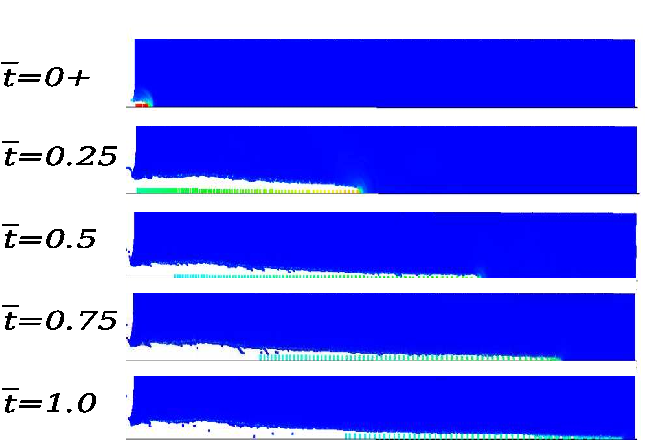
A generic penetration simulation using Uintah
The host code (Uintah) itself has been enhanced to accommodate material variability and scale effects. Simulations have been performed that import flash X-ray data for the velocity and geometry of a particulated metallic jet so that uncertainty about the jet can be reduced to develop predictive models for target response. Uintah’s analytical polar decomposition has been replaced with an iterative algorithm to dramatically improve accuracy under large deformations. Continue reading
Nonclassical plasticity validation
Analysis and computations have been performed by the Utah CSM group to support experimental investigations of unvalidated assumptions in plasticity theory. The primary untested assumption is that of a regular flow rule in which it is often assumed that the direction of the inelastic strain increment is unaffected by the total strain increment itself. To support laboratory testing of this hypothesis, the general equations of classical plasticity theory were simplified for the case of axisymmetric loading to provide experimentalists with two-parameter control of the axial and lateral stress increments corresponding to a specified loading trajectory in stress space. Loading programs involving changes in loading directions were designed. New methods for analyzing the data via a moving least squares fit to tensor-valued input-output data were used to quantitatively infer the apparent plastic tangent modulus matrix and thereby detect violations of the regular flow rule. Loading programs were designed for validating isotropic cap hardening models by directly measuring the effect of shear loading on the hydrostatic elastic limit.
UofU Contributors/collaborators:
Michael Braginski (postdoc, Mech. Engr., UofU)
Jeff Burghardt (PhD student, Mech. Engr., UofU)
External collaborators/mentors:
Stephen Bauer (Manager, Sandia National Labs geomechanics testing lab)
David Bronowski (Sandia geomechanics lab technician)
Erik Strack (Manager, Sandia Labs Computational Physics)
 University of Utah CSM Group