Publication: Survey of Four Damage Models for Concrete

R.M. Brannon and S. Leelavanichkul
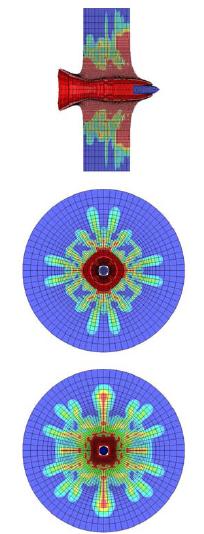
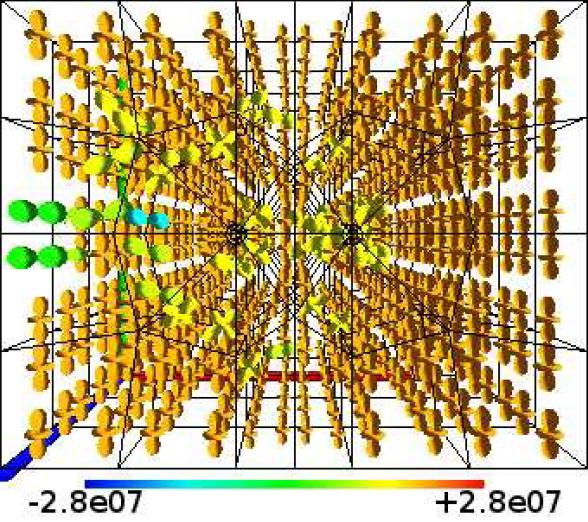
RHT Model: Contour plots of damage: side, front, and back view of the target (top to bottom).

Four conventional damage plasticity models for concrete, the Karagozian and Case model (K&C),the Riedel-Hiermaier-Thoma model (RHT), the Brannon-Fossum model (BF1), and the Continuous Surface Cap Model (CSCM) are compared. The K&C and RHT models have been used in commercial finite element programs many years, whereas the BF1 and CSCM models are relatively new. All four models are essentially isotropic plasticity models for which plasticity is regarded as any form of inelasticity. All of the models support nonlinear elasticity, but with different formulations.All four models employ three shear strength surfaces. The yield surface bounds an evolving set of elastically obtainable stress states. The limit surface bounds stress states that can be reached by any means (elastic or plastic). To model softening, it is recognized that some stress states might be reached once, but, because of irreversible damage, might not be achievable again. In other words, softening is the process of collapse of the limit surface, ultimately down to a final residual surface for fully failed material. The four models being compared differ in their softening evolution equations, as well as in their equations used to degrade the elastic stiffness. For all four models, the strength surfaces are cast in stress space. For all four models, it is recognized that scale effects are important for softening, but the models differ significantly in their approaches. The K&C documentation, for example, mentions that a particular material parameter affecting the damage evolution rate must be set by the user according to the mesh size to preserve energy to failure. Similarly, the BF1 model presumes that all material parameters are set to values appropriate to the scale of the element, and automated assignment of scale-appropriate values is available only through an enhanced implementation of BF1 (called BFS) that regards scale effects to be coupled to statistical variability of material properties. The RHT model appears to similarly support optional uncertainty and automated settings for scale-dependent material parameters. The K&C, RHT, and CSCM models support rate dependence by allowing the strength to be a function of strain rate, whereas the BF1 model uses Duvaut-Lion viscoplasticity theory to give a smoother prediction of transient effects. During softening, all four models require a certain amount of strain to develop before allowing significant damage accumulation. For the K&C, RHT, and CSCM models, the strain-to-failure is tied to fracture energy release, whereas a similar effect is achieved indirectly in the BF1 model by a time-based criterion that is tied to crack propagation speed.

Available Online:

http://www.mech.utah.edu/~brannon/pubs/7-2009BrannonLeelavanichkulSurveyConcrete.pdf
Publication: A multi-stage return algorithm for solving the classical damage component of constitutive models for rocks, ceramics, and other rock-like media

R. M. Brannon and S. Leelavanichkul

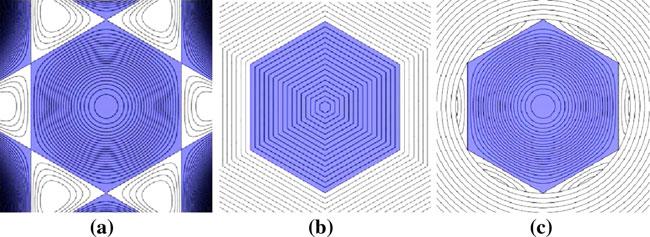
Octahedral isosurfaces for a) the unacceptable, b) the admissible, and c) the admissible

Classical plasticity and damage models for porous quasi-brittle media usually suffer from mathematical defects such as non-convergence and nonuniqueness.Yield or damage functions for porous quasi-brittle media often have yield functions with contours so distorted that following those contours to the yield surface in a return algorithm can take the solution to a false elastic domain. A steepest-descent return algorithm must include iterative corrections; otherwise,the solution is non-unique because contours of any yield function are non-unique. A multi-stage algorithm has been developed to address both spurious convergence and non-uniqueness, as well as to improve efficiency. The region of pathological isosurfaces is masked by first returning the stress state to the Drucker–Prager surface circumscribing the actual yield surface. From there, steepest-descent is used to locate a point on the yield surface. This first-stage solution,which is extremely efficient because it is applied in a 2D subspace, is generally not the correct solution,but it is used to estimate the correct return direction.The first-stage solution is projected onto the estimated correct return direction in 6D stress space. Third invariant dependence and anisotropy are accommodated in this second-stage correction. The projection operation introduces errors associated with yield surface curvature,so the two-stage iteration is applied repeatedly to converge. Regions of extremely high curvature are detected and handled separately using an approximation to vertex theory. The multi-stage return is applied holding internal variables constant to produce a non-hardening solution. To account for hardening from pore collapse (or softening from damage), geometrical arguments are used to clearly illustrate the appropriate scaling of the non-hardening solution needed to obtain the hardening (or softening) solution.

For errata (transcription errors in two of the verification solutions), please see:

Errata for two verification publications

Available Online:
http://www.mech.utah.edu/~brannon/pubs/7-2009BrannonLeelavanichkul-IJF.pdf
http://dx.doi.org/10.1007/s10704-009-9398-4

Publication: Decomposition and Visualization of Fourth-Order Elastic-Plastic Tensors

A.G. Neeman; R.M. Brannon; B. Jeremic; A. Van Gelderand;  A. Pang

Top view (Z from above) of eigentensors for Drucker-Prager material, time step 124, colored by minimum stretch eigenvalue.

Visualization of fourth-order tensors from solid mechanics has not been explored in depth previously. Challenges include the large number of components (3x3x3x3 for 3D), loss of major symmetry and loss of positive definiteness(with possibly zero or negative eigenvalues). This paper presents a decomposition of fourth-order tensors that facilitates their visualization and understanding. Fourth-order tensors are used to represent a solid’s stiffness.The stiffness tensor represents the relationship between increments of stress and increments of strain. Visualizing stiffness is important to understand the changing state of solids during plastification and failure. In this work,we present a method to reduce the number of stiffness components to second-order 3×3 tensors for visualization.The reduction is based on polar decomposition, followed by eigen-decomposition on the polar “stretch”. If any resulting eigenvalue is significantly lower than the others, the material has softened in that eigen-direction. The associated second-order eigentensor represents the mode of stress (such as compression, tension, shear, or some combination of these) to which the material becomes vulnerable. Thus we can visualize the physical meaning of plastification with techniques for visualizing second-order symmetric tensors.

Available Online:

Publication: http://www.mech.utah.edu/~brannon/pubs/7-2008NeemanBrannonJeremicVanGelderPang.pdf

Poster: http://www.mech.utah.edu/~brannon/pubs/7-09NeemanBrannonEtAlNEESposter.pdf

CPDI shape functions for the Material Point Method

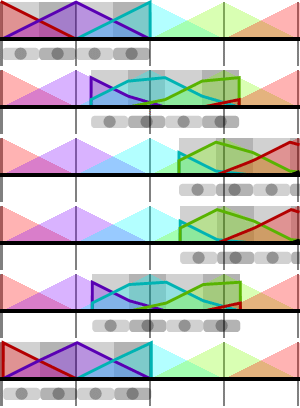
In a conventional MPM formulation, the shape functions on the grid are the same as in a traditional FEM solution. In the CPDI, the shape functions on the grid are replaced by alternative (and still linearly complete*) shape functions, given by piecewise linear interpolations of the traditional FEM shape functions to the boundaries of the particles.  This change provides FEM-level accuracy in moderately deforming regions while retaining the attractive feature of MPM that particles can move arbitrarily relative to one another in massively deforming regions (provided, of course, that the deformation is updated in a manner compatible with the constitutive model).

In the images below, the shaded regions are the traditional FEM “tent” linear shape functions in 1-D, and the solid lines are the CPDI interpolated shape functions, which clearly change based on particle position relative to the grid.  Both the traditional FEM tent functions and these new CPDI functions are linearly complete (i.e., they can exactly fit any affine function). The tremendous advantage of CPDI is that the basis functions are extraordinarily simple over a particle domain, thus facilitating exact and efficient evaluation of integrals over particle domains.

Continue reading

Research: Radial cracking as a means to infer aleatory uncertainty parameters

Aleatory uncertainty in constitutive modeling refers to the intrinsic variability in material properties caused by differences in micromorphology (e.g., grain orientation or size, microcracks, inclusions, etc.) from sample to sample. Accordingly, a numerical simulation of a nominally axisymmetric problem must be run in full 3D (non-axisymmetric) mode if there is any possibility of a bifurcation from stability.

Dynamic indentation experiments, in which a spherical ball impacts to top free surface of a cylindrical specimen, nicely illustrate that fracture properties must have spatial variability — in fact, the intrinsic instability that leads to radial cracking is regarded by the Utah CSM group as a potential inexpensive means of inferring the spatial frequency of natural variations in material properties.

Radial cracking in dynamic indentation experiments.

Continue reading

Research: Thermodynamic Consistency, and Strain-Based Failure

The Kayenta geological material model has been enhanced to span a broader range of pressures and loading rates. Temperature dependence of yield strength has been added along with nonlinear thermoelasticity that can accommodate pressure dependence of the shear modulus and entropy dependence of the bulk modulus in a thermodynamically consistent manner.   Continue reading

Research: Instability of *ANY* nonassociative plasticity model

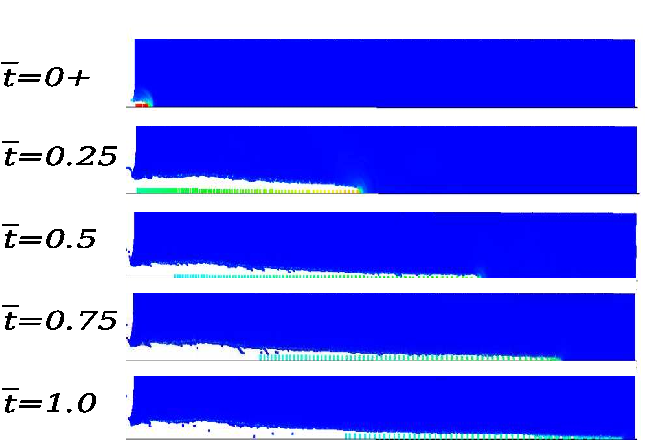
The CSM group has independently confirmed  a case study demonstrating the truth of a claim in the literature that any non-associative rate-independent model admits a non-physical dynamic achronistity instability. By stimulating a non-associative material in the “Sandler-Rubin wedge” (above yield but below the flow surface), plastic waves are generated that travel faster than elastic waves, thus introducing a negative net work in a closed strain cycle that essentially feeds energy into a propagating wave to produce unbounded increases in displacement with time.

Sandler-Rubin instability: an infinitesimal pulse grows as it propagates

Continue reading

Merits and shortcomings of conventional smeared damage models

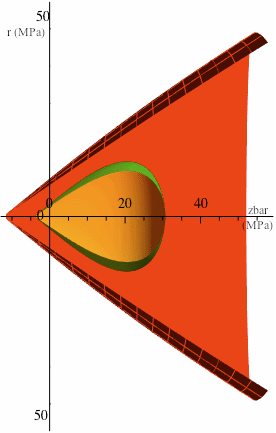
Initial teardrop yield and third-invariant limit surfaces in the Kayenta model

Four classical damage models for concrete (three of which are available in commercial codes) have been compared and critiqued, showing that they all share the notions of a “teardrop” yield surface that can harden and (for some models) translate until reaching a three-invariant fracture limit surface that then collapses to account for softening (i.e., permanent loss of strength).   Practical engineering models for rock and ceramics are similar.  The common drawbacks of these models (primarily severe mesh dependence) can be mitigated, though not eliminated, by seeding their material properties in the simulation with spatial variability (aleatory uncertainty) and by using appropriate scale effects for the strength and failure progression properties. Continue reading

Powder metal jet penetration into stressed rock

The Uintah computational framework (UCF) has been adopted for simulation of shaped charge jet penetration and subsequent damage to geological formations.  The Kayenta geomechanics model, as well as a simplified model for shakedown simulations has been  incorporated within the UCF and is undergoing extensive development to enhance it to account for fluid in pore space.

A generic penetration simulation using Uintah

The host code (Uintah) itself has been enhanced to accommodate  material variability and scale effects. Simulations have been performed that import flash X-ray data for the velocity and geometry of a particulated metallic jet so that uncertainty about the jet can be reduced to develop predictive models for target response.  Uintah’s analytical polar decomposition has been replaced with an iterative algorithm to dramatically improve accuracy under large deformations. Continue reading