Publication: The Use of Sphere Indentation Experiments to Characterize Ceramic Damage Models

R.B. Leavy; R.M. Brannon; O.E. Strack
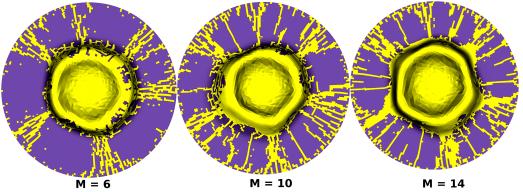
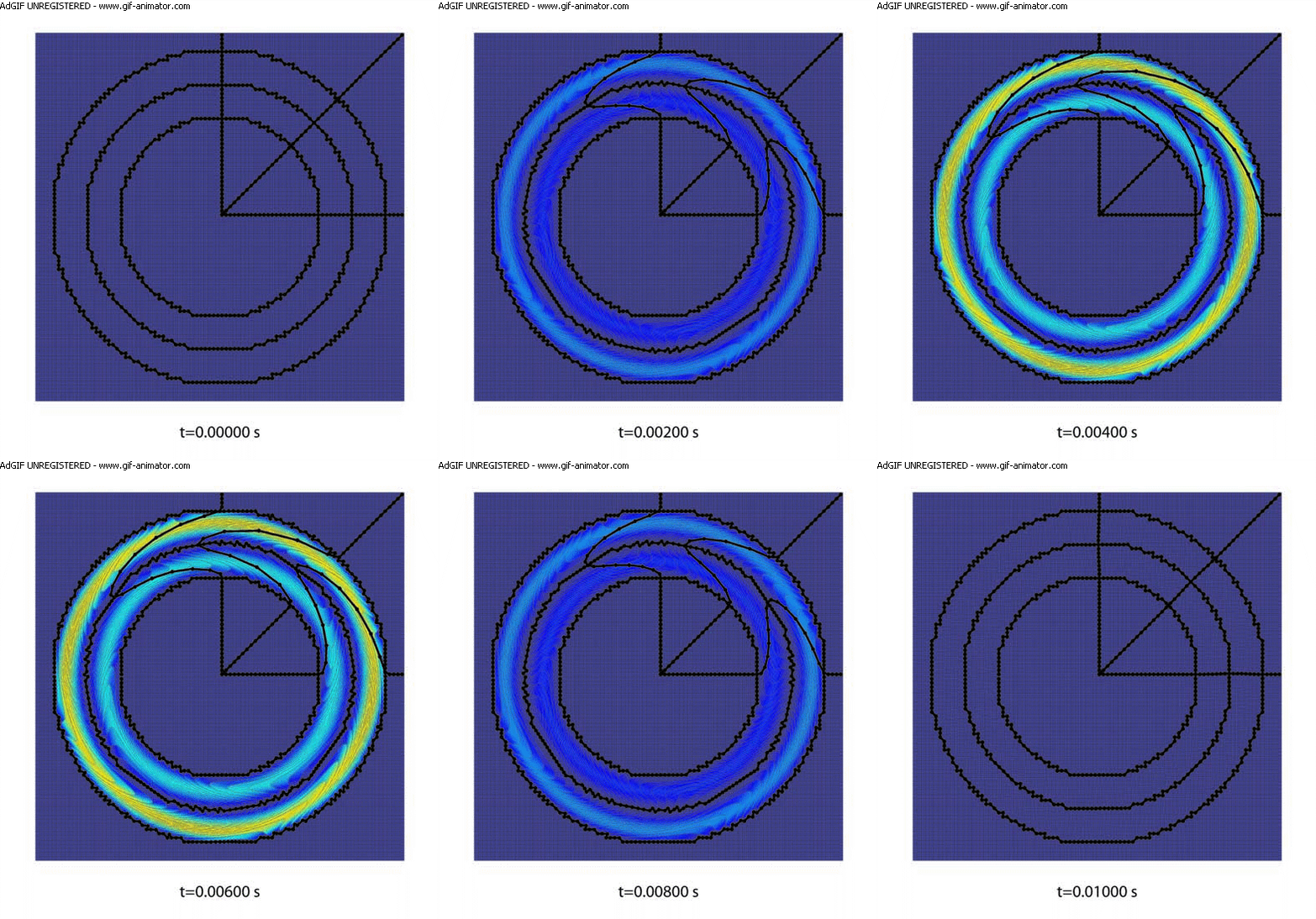
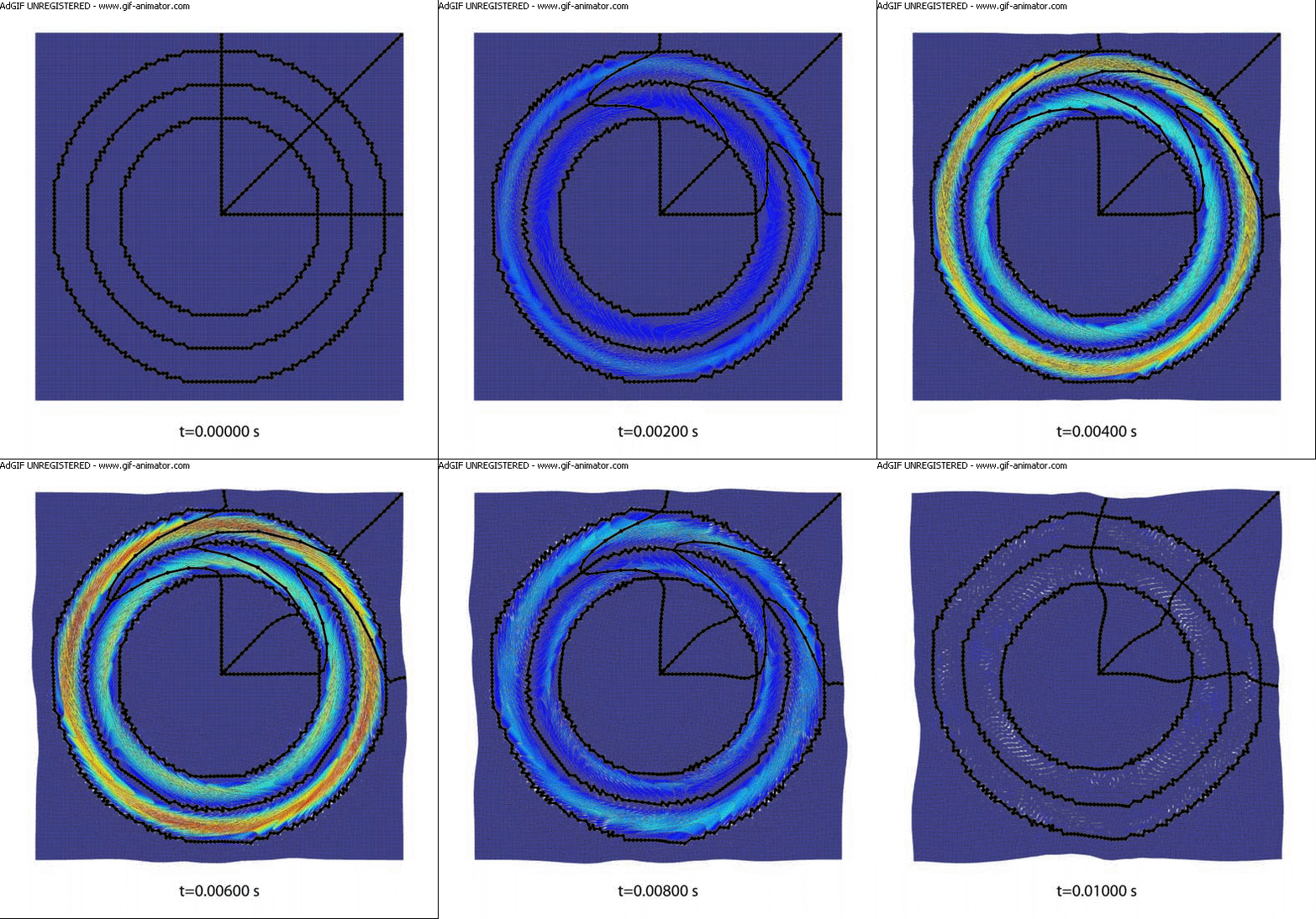
Weibull modulus effect on radial cracking in boron carbide simulations impacted at 400 m/s.

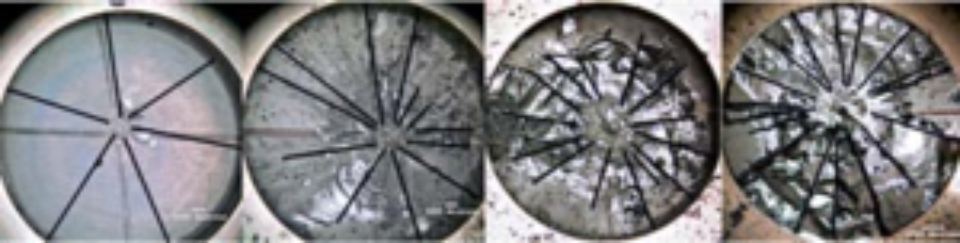
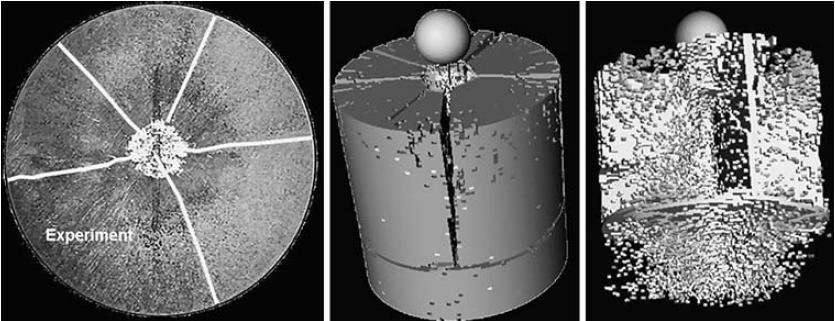
Sphere impact experiments are used to calibrate and validate ceramic models that include statistical variability and/or scale effects in strength and toughness parameters. These dynamic experiments supplement traditional characterization experiments such as tension, triaxial compression, Brazilian, and plate impact, which are commonly used for ceramic model calibration.The fractured ceramic specimens are analyzed using sectioning, X-ray computed tomography, microscopy, and other techniques. These experimental observations indicate that a predictive material model must incorporate a standard deviation in strength that varies with the nature of the loading. Methods of using the spherical indentation data to calibrate a statistical damage model are presented in which it is assumed that variability in strength is tied to microscale stress concentrations associated with microscale heterogeneity.

Available Online:
http://www.mech.utah.edu/~brannon/pubs/7-2009-LeavyBrannonStrack-IJACT.pdf
http://dx.doi.org/10.1111/j.1744-7402.2010.02487.x
Publication: Decomposition and Visualization of Fourth-Order Elastic-Plastic Tensors

A.G. Neeman; R.M. Brannon; B. Jeremic; A. Van Gelderand;  A. Pang

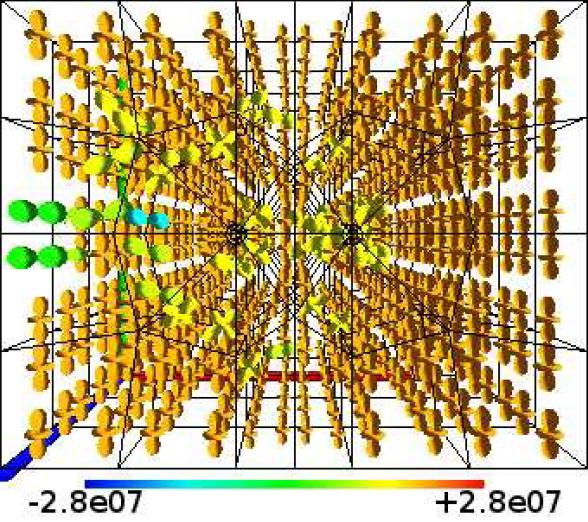
Top view (Z from above) of eigentensors for Drucker-Prager material, time step 124, colored by minimum stretch eigenvalue.

Visualization of fourth-order tensors from solid mechanics has not been explored in depth previously. Challenges include the large number of components (3x3x3x3 for 3D), loss of major symmetry and loss of positive definiteness(with possibly zero or negative eigenvalues). This paper presents a decomposition of fourth-order tensors that facilitates their visualization and understanding. Fourth-order tensors are used to represent a solid’s stiffness.The stiffness tensor represents the relationship between increments of stress and increments of strain. Visualizing stiffness is important to understand the changing state of solids during plastification and failure. In this work,we present a method to reduce the number of stiffness components to second-order 3×3 tensors for visualization.The reduction is based on polar decomposition, followed by eigen-decomposition on the polar “stretch”. If any resulting eigenvalue is significantly lower than the others, the material has softened in that eigen-direction. The associated second-order eigentensor represents the mode of stress (such as compression, tension, shear, or some combination of these) to which the material becomes vulnerable. Thus we can visualize the physical meaning of plastification with techniques for visualizing second-order symmetric tensors.

Available Online:

Publication: http://www.mech.utah.edu/~brannon/pubs/7-2008NeemanBrannonJeremicVanGelderPang.pdf

Poster: http://www.mech.utah.edu/~brannon/pubs/7-09NeemanBrannonEtAlNEESposter.pdf

Publication: Advances in X-ray Computed Tomography Diagnostics of Ballistic Impact Damage

J.M. Wells and R.M. Brannon

Dynamic indentation of SiC-N ceramic by a tungsten carbide sphere. Left: experimentally observed impact crater and radial cracking (both highlighted for clarity). Middle: BFS model prediction of externally visible damage. Right: prediction of internal damage (suitable for validation against XCT data).

With the relatively recent introduction of quantitative and volumetric X-ray computedtomography (XCT) applied to ballistic impact damage diagnostics, significant inroads have beenmade in expanding our knowledge base of the morphological variants of physical impactdamage. Yet, the current state of the art in computational and simulation modeling of terminalballistic performance remains predominantly focused on the penetration phenomenon, withoutdetailed consideration of the physical characteristics of actual impact damage. Similarly, armorceramic material improvements appear more focused on penetration resistance than on improved intrinsic damage tolerance and damage resistance. Basically, these approaches minimizeour understanding of the potential influence that impact damage may play in the mitigation orprevention of ballistic penetration. Examples of current capabilities of XCT characterization,quantification, and visualization of complex impact damage variants are demonstrated anddiscussed for impacted ceramic and metallic terminal ballistic target materials. Potential benefitsof incorporating such impact damage diagnostics in future ballistic computational modeling arealso briefly discussed.

Available Online:

http://dx.doi.org/10.1007/s11661-007-9304-5
http://www.mech.utah.edu/~brannon/pubs/7-2007WellsBrannonAdvancesInXrayComputedTomographyDiagnosticsOfBallisticDamage.pdf

Research: Thermodynamic Consistency, and Strain-Based Failure

The Kayenta geological material model has been enhanced to span a broader range of pressures and loading rates. Temperature dependence of yield strength has been added along with nonlinear thermoelasticity that can accommodate pressure dependence of the shear modulus and entropy dependence of the bulk modulus in a thermodynamically consistent manner.   Continue reading

Research: Instability of *ANY* nonassociative plasticity model

The CSM group has independently confirmed  a case study demonstrating the truth of a claim in the literature that any non-associative rate-independent model admits a non-physical dynamic achronistity instability. By stimulating a non-associative material in the “Sandler-Rubin wedge” (above yield but below the flow surface), plastic waves are generated that travel faster than elastic waves, thus introducing a negative net work in a closed strain cycle that essentially feeds energy into a propagating wave to produce unbounded increases in displacement with time.

Sandler-Rubin instability: an infinitesimal pulse grows as it propagates

Continue reading

Merits and shortcomings of conventional smeared damage models

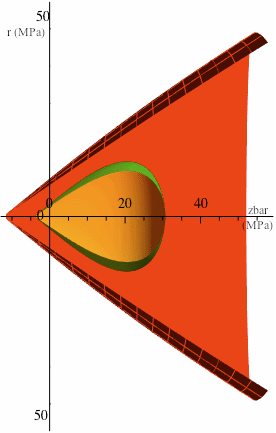
Initial teardrop yield and third-invariant limit surfaces in the Kayenta model

Four classical damage models for concrete (three of which are available in commercial codes) have been compared and critiqued, showing that they all share the notions of a “teardrop” yield surface that can harden and (for some models) translate until reaching a three-invariant fracture limit surface that then collapses to account for softening (i.e., permanent loss of strength).   Practical engineering models for rock and ceramics are similar.  The common drawbacks of these models (primarily severe mesh dependence) can be mitigated, though not eliminated, by seeding their material properties in the simulation with spatial variability (aleatory uncertainty) and by using appropriate scale effects for the strength and failure progression properties. Continue reading

Powder metal jet penetration into stressed rock

The Uintah computational framework (UCF) has been adopted for simulation of shaped charge jet penetration and subsequent damage to geological formations.  The Kayenta geomechanics model, as well as a simplified model for shakedown simulations has been  incorporated within the UCF and is undergoing extensive development to enhance it to account for fluid in pore space.

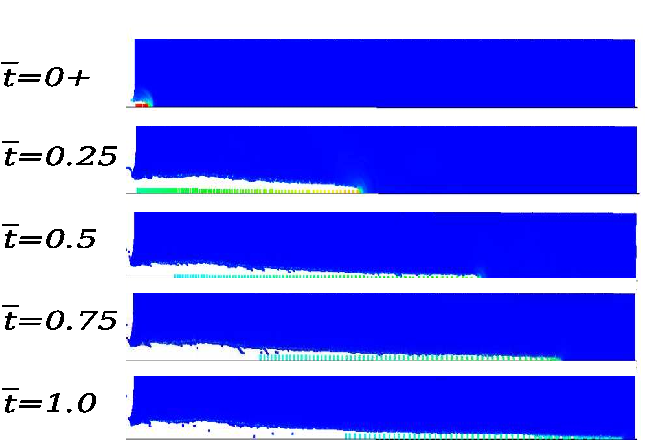
A generic penetration simulation using Uintah

The host code (Uintah) itself has been enhanced to accommodate  material variability and scale effects. Simulations have been performed that import flash X-ray data for the velocity and geometry of a particulated metallic jet so that uncertainty about the jet can be reduced to develop predictive models for target response.  Uintah’s analytical polar decomposition has been replaced with an iterative algorithm to dramatically improve accuracy under large deformations. Continue reading

Accelerated hip implant wear testing

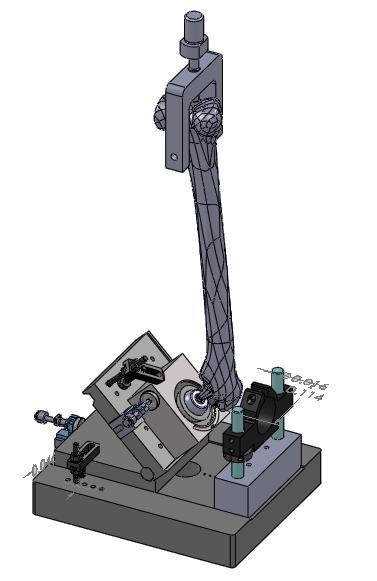
3D model Experimental Setup

Rim cracking of polyethylene acetabular liners and squeaking in ceramic components are two important potential failure modes of hip implants, but the loads and stresses that cause such failures are not well understood. Contact stresses in hip implants are analyzed under worst case load conditions to develop new wear testing methods to improve the pre-clinical evaluation of next-generation hip implants and their materials. Complicated full-scale hip implant simulator tests are expensive and take months to complete. A primary goal of this work is to find inexpensive surrogate specimen shapes and loading modes that can, in inexpensive lab tests taking only a few hours, produce the same wear patterns as seen in full-scale prototype testing. Continue reading

Nonclassical plasticity validation

Analysis and computations have been performed by the Utah CSM group to support experimental investigations of unvalidated assumptions in plasticity theory. The primary untested assumption is that of a regular flow rule in which it is often assumed that the direction of the inelastic strain increment is unaffected by the total strain increment itself. To support laboratory testing of this hypothesis, the general equations of classical plasticity theory were simplified for the case of axisymmetric loading to provide experimentalists with two-parameter control of the axial and lateral stress increments corresponding to a specified loading trajectory in stress space. Loading programs involving changes in loading directions were designed. New methods for analyzing the data via a moving least squares fit to tensor-valued input-output data were used to quantitatively infer the apparent plastic tangent modulus matrix and thereby detect violations of the regular flow rule. Loading programs were designed for validating isotropic cap hardening models by directly measuring the effect of shear loading on the hydrostatic elastic limit.

UofU Contributors/collaborators:
Michael Braginski (postdoc, Mech. Engr., UofU)
Jeff Burghardt (PhD student, Mech. Engr., UofU)

External collaborators/mentors:
Stephen Bauer (Manager, Sandia National Labs geomechanics testing lab)
David Bronowski (Sandia geomechanics lab technician)
Erik Strack (Manager, Sandia Labs Computational Physics)