
The Kayenta geological material model has been enhanced to span a broader range of pressures and loading rates. Temperature dependence of yield strength has been added along with nonlinear thermoelasticity that can accommodate pressure dependence of the shear modulus and entropy dependence of the bulk modulus in a thermodynamically consistent manner. Continue reading
Author Archives: Rebecca Brannon
Merits and shortcomings of conventional smeared damage models
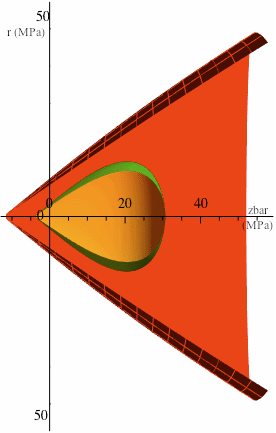
Initial teardrop yield and third-invariant limit surfaces in the Kayenta model
Four classical damage models for concrete (three of which are available in commercial codes) have been compared and critiqued, showing that they all share the notions of a “teardrop” yield surface that can harden and (for some models) translate until reaching a three-invariant fracture limit surface that then collapses to account for softening (i.e., permanent loss of strength). Practical engineering models for rock and ceramics are similar. The common drawbacks of these models (primarily severe mesh dependence) can be mitigated, though not eliminated, by seeding their material properties in the simulation with spatial variability (aleatory uncertainty) and by using appropriate scale effects for the strength and failure progression properties. Continue reading
Engineered microstructures for optimal energy absorbtion: design, validation, and verification
Breaking from conventional monolithic, layered, or woven designs for protective structures (bumpers, armor, etc.), micromanufacturing technology is now maturing to the point where precisely engineered microstructures may soon be possible. In anticipation of such advances, novel microstructures are being here designed to optimize the ability of protective structures to thwart impact loadings. Preliminary work shows that a variety of specially designed microstructures can distribute structural damage away from an impact site rather than allowing damage to be concentrated at the impact zone. The merits of these design concept are investigated numerically and experimentally in the scope of safety net design.
UofU contributors/collaborators:
S. Leelavanichkul (Research fellow, Mechanical Engineering, UofU)
A. Cherkaev (Prof. of Mathematics, UofU)
Publication: On a viscoplastic model for rocks with mechanism-dependent characteristic times
A.F. Fossum and R.M. Brannon (2006)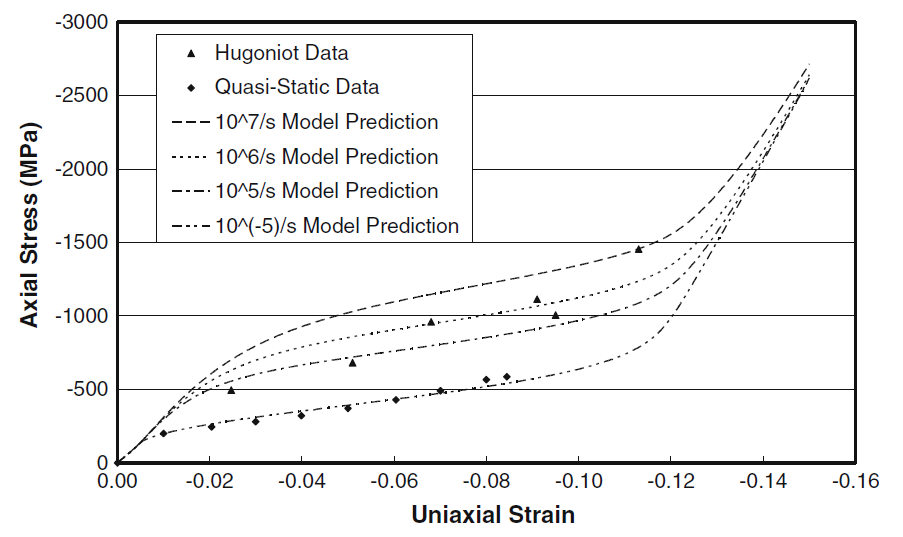
This paper summarizes the results of a theoretical and experimental program at Sandia National Laboratories aimed at identifying and modeling key physical features of rocks and rock-like materials at the laboratory scale over a broad range of strain rates. The mathematical development of a constitutive model is discussed and model predictions versus experimental data are given for a suite of laboratory tests. Concurrent pore collapse and cracking at the microscale are seen as competitive micromechanisms that give rise to the well-known macroscale phenomenon of a transition from volumetric compaction to dilatation under quasistatic triaxial compression. For high-rate loading, this competition between pore collapse and microcracking also seems to account for recently identified differences in strain-rate sensitivity between uniaxial-strain ‘‘plate slap’’ data compared to uniaxial-stress Kolsky bar data. A description is given of how this work supports ongoing efforts to develop a predictive capability in simulating deformation and failure of natural geological materials, including those that contain structural features such as joints and other spatial heterogeneities.
Available online:
http://dx.doi.org/10.1007/s11440-006-0010-z
http://www.mech.utah.edu/~brannon/pubs/7-2006FossumBrannonMechanismDependentViscoplasticity.pdf
Tutorial: Introduction to Mohr’s circle

Controlling frame rate in animated gif
Step 1: create a collection of single frames named sequentially, such as mymovie001.gif, mymovie002.gif, …
Step 2: In unix, execute the following (changing the value of “delay” to control frame rate)
convert -verbose -delay 20 -loop 0 -density 100 mymovie*.gif output.gif
Verification Research: The method of manufactured solutions (MMS)

MMS stands for “Method of Manufactured Solutions,” which is a rather sleazy sounding name for what is actually a respected and rigorous method of verifying that a finite element (or other) code is correctly solving the governing equations.
A simple introduction to MMS may be found on page 11 of The ASME guide for verification and validation in solid mechanics. The basic idea is to analytically determine forcing functions that would lead to a specific, presumably nontrivial, solution (of your choice) for the dependent variable of a differential equation. Then you would verify a numerical solver for that differential equation by running it using your analytically determined forcing function. The difference between the code’s prediction and your selected manufactured solution provides a quantitative measure of error.
Publication: Conjugate stress and strain caveats /w distortion and deformation distinction
The publication, “Caveats concerning conjugate stress and strain measures (click to download)” contains an analytical solution for the stress in a fiber reinforced composite in the limit as the matrix material goes to zero stiffness. Because the solution is exact for arbitrarily large deformations, it is a great test case for verification of anisotropic elasticity codes, and it nicely illustrates several subtle concepts in large-deformation continuum mechanics.
Also see related viewgraphs entitled “The distinction between large distortion and large deformation.”
Tutorial: Radial Return
A tutorial on the underlying theory of projecting a stress state back to the plastic yield surface.
You may download the document here, or view just view the graph.
Tutorial: Curvilinear coordinates
A self-study introduction to the general theory applied to 3-D Euclidean space. (It helps to read the “Elementary Vector and Tensor Analysis” document before attempting this one).
You may download the document here.
 University of Utah CSM Group