
The Kayenta geological material model has been enhanced to span a broader range of pressures and loading rates. Temperature dependence of yield strength has been added along with nonlinear thermoelasticity that can accommodate pressure dependence of the shear modulus and entropy dependence of the bulk modulus in a thermodynamically consistent manner. Continue reading
Tag Archives: strain
Research: Instability of *ANY* nonassociative plasticity model
The CSM group has independently confirmed a case study demonstrating the truth of a claim in the literature that any non-associative rate-independent model admits a non-physical dynamic achronistity instability. By stimulating a non-associative material in the “Sandler-Rubin wedge” (above yield but below the flow surface), plastic waves are generated that travel faster than elastic waves, thus introducing a negative net work in a closed strain cycle that essentially feeds energy into a propagating wave to produce unbounded increases in displacement with time.

Sandler-Rubin instability: an infinitesimal pulse grows as it propagates
Powder metal jet penetration into stressed rock
The Uintah computational framework (UCF) has been adopted for simulation of shaped charge jet penetration and subsequent damage to geological formations. The Kayenta geomechanics model, as well as a simplified model for shakedown simulations has been incorporated within the UCF and is undergoing extensive development to enhance it to account for fluid in pore space.
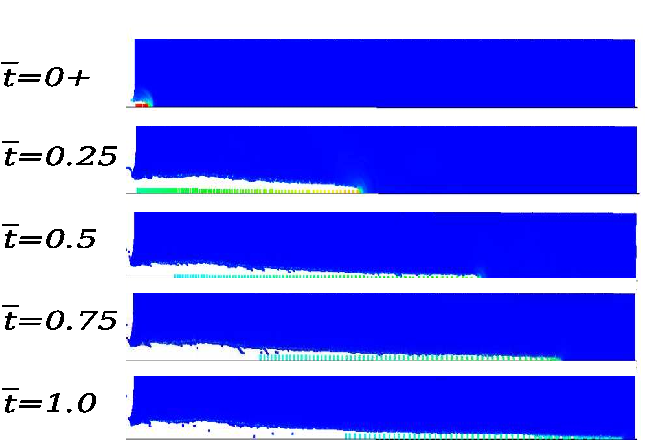
A generic penetration simulation using Uintah
The host code (Uintah) itself has been enhanced to accommodate material variability and scale effects. Simulations have been performed that import flash X-ray data for the velocity and geometry of a particulated metallic jet so that uncertainty about the jet can be reduced to develop predictive models for target response. Uintah’s analytical polar decomposition has been replaced with an iterative algorithm to dramatically improve accuracy under large deformations. Continue reading
Nonclassical plasticity validation
Analysis and computations have been performed by the Utah CSM group to support experimental investigations of unvalidated assumptions in plasticity theory. The primary untested assumption is that of a regular flow rule in which it is often assumed that the direction of the inelastic strain increment is unaffected by the total strain increment itself. To support laboratory testing of this hypothesis, the general equations of classical plasticity theory were simplified for the case of axisymmetric loading to provide experimentalists with two-parameter control of the axial and lateral stress increments corresponding to a specified loading trajectory in stress space. Loading programs involving changes in loading directions were designed. New methods for analyzing the data via a moving least squares fit to tensor-valued input-output data were used to quantitatively infer the apparent plastic tangent modulus matrix and thereby detect violations of the regular flow rule. Loading programs were designed for validating isotropic cap hardening models by directly measuring the effect of shear loading on the hydrostatic elastic limit.
UofU Contributors/collaborators:
Michael Braginski (postdoc, Mech. Engr., UofU)
Jeff Burghardt (PhD student, Mech. Engr., UofU)
External collaborators/mentors:
Stephen Bauer (Manager, Sandia National Labs geomechanics testing lab)
David Bronowski (Sandia geomechanics lab technician)
Erik Strack (Manager, Sandia Labs Computational Physics)
Publication: On a viscoplastic model for rocks with mechanism-dependent characteristic times
A.F. Fossum and R.M. Brannon (2006)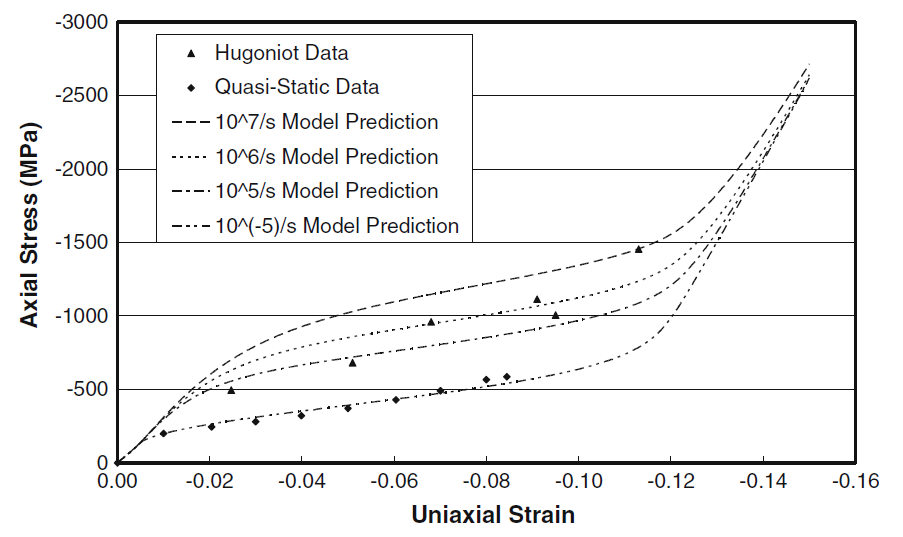
This paper summarizes the results of a theoretical and experimental program at Sandia National Laboratories aimed at identifying and modeling key physical features of rocks and rock-like materials at the laboratory scale over a broad range of strain rates. The mathematical development of a constitutive model is discussed and model predictions versus experimental data are given for a suite of laboratory tests. Concurrent pore collapse and cracking at the microscale are seen as competitive micromechanisms that give rise to the well-known macroscale phenomenon of a transition from volumetric compaction to dilatation under quasistatic triaxial compression. For high-rate loading, this competition between pore collapse and microcracking also seems to account for recently identified differences in strain-rate sensitivity between uniaxial-strain ‘‘plate slap’’ data compared to uniaxial-stress Kolsky bar data. A description is given of how this work supports ongoing efforts to develop a predictive capability in simulating deformation and failure of natural geological materials, including those that contain structural features such as joints and other spatial heterogeneities.
Available online:
http://dx.doi.org/10.1007/s11440-006-0010-z
http://www.mech.utah.edu/~brannon/pubs/7-2006FossumBrannonMechanismDependentViscoplasticity.pdf
Verification Research: The method of manufactured solutions (MMS)

MMS stands for “Method of Manufactured Solutions,” which is a rather sleazy sounding name for what is actually a respected and rigorous method of verifying that a finite element (or other) code is correctly solving the governing equations.
A simple introduction to MMS may be found on page 11 of The ASME guide for verification and validation in solid mechanics. The basic idea is to analytically determine forcing functions that would lead to a specific, presumably nontrivial, solution (of your choice) for the dependent variable of a differential equation. Then you would verify a numerical solver for that differential equation by running it using your analytically determined forcing function. The difference between the code’s prediction and your selected manufactured solution provides a quantitative measure of error.
Publication: Conjugate stress and strain caveats /w distortion and deformation distinction
The publication, “Caveats concerning conjugate stress and strain measures (click to download)” contains an analytical solution for the stress in a fiber reinforced composite in the limit as the matrix material goes to zero stiffness. Because the solution is exact for arbitrarily large deformations, it is a great test case for verification of anisotropic elasticity codes, and it nicely illustrates several subtle concepts in large-deformation continuum mechanics.
Also see related viewgraphs entitled “The distinction between large distortion and large deformation.”
Tutorial: Define Your Strain!
This single-page document emphasizes the need for experimentalists and theorists alike to ALWAYS define their strain measure. For every percent increase in strain, the most popular measures of strain will disagree by as much as 1.5%. This might not sound like much, but try running a simple shear Von Mises strain cycle using log strain and engineering strain. You will find that the engineering strain calculation produces anomalous PRESSURES because volumetric strain does NOT equal the trace of strain EXCEPT for logarithmic strain.
You may download the rest of the document here.
Publication: Experimental Assessment of Unvalidated Assumptions in Classical Plasticity Theory
Abstract: This report investigates the validity of several key assumptions in classical plasticity theory regarding material response to changes in the loading direction. Three metals, two rock types, and one ceramic were subjected to non-standard loading directions, and the resulting strain response increments were displayed in Gudehus diagrams to illustrate the approximation error of classical plasticity theories. A rigorous mathematical framework for fitting classical theories to the data, thus quantifying the error, is provided. Further data analysis techniques are presented that allow testing for the effect of changes in loading direction without having to use a new sample and for inferring the yield normal and flow directions without having to measure the yield surface. Though the data are inconclusive, there is indication that classical, incrementally linear, plasticity theory may be inadequate over a certain range of loading directions. This range of loading directions also coincides with loading directions that are known to produce a physically inadmissible instability for any nonassociative plasticity model.
You may download the full report here.
 University of Utah CSM Group