
I’ve been doing a lot of writing lately. I’ve come to believe that writing well is at least as important for engineers as calculus. This past semester I took a dissertation writing class from the writing department here at the University of Utah. It was very interesting to read dissertations from fields as diverse as literature, material science, nursing and nuclear engineering. I think that it’s safe to say it was beneficial for everyone involved. One nice resource that another student suggested, is a book title “The Elements of Style” by William Strunk and E.B. White. Yes that’s E.B. White of “Charlotte’s Web” fame. I picked up a copy of the book at the library and have found it an excellent, and readable, resource for writing well. I’ve also discovered that nearly everyone else on the planet knew about it and I was somehow left in the dark. So for any of you who might still be in the dark about this wonderful resource I highly recommend it.
Tag Archives: material
Verification Research: The method of manufactured solutions (MMS)
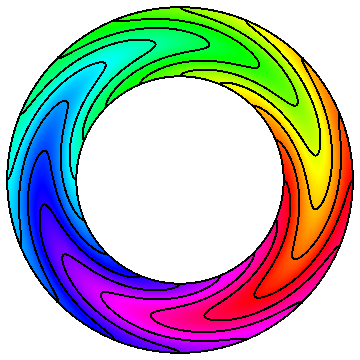
MMS stands for “Method of Manufactured Solutions,” which is a rather sleazy sounding name for what is actually a respected and rigorous method of verifying that a finite element (or other) code is correctly solving the governing equations.
A simple introduction to MMS may be found on page 11 of The ASME guide for verification and validation in solid mechanics. The basic idea is to analytically determine forcing functions that would lead to a specific, presumably nontrivial, solution (of your choice) for the dependent variable of a differential equation. Then you would verify a numerical solver for that differential equation by running it using your analytically determined forcing function. The difference between the code’s prediction and your selected manufactured solution provides a quantitative measure of error.
Publication: Conjugate stress and strain caveats /w distortion and deformation distinction
The publication, “Caveats concerning conjugate stress and strain measures (click to download)” contains an analytical solution for the stress in a fiber reinforced composite in the limit as the matrix material goes to zero stiffness. Because the solution is exact for arbitrarily large deformations, it is a great test case for verification of anisotropic elasticity codes, and it nicely illustrates several subtle concepts in large-deformation continuum mechanics.
Also see related viewgraphs entitled “The distinction between large distortion and large deformation.”
Tutorial: Radial Return
A tutorial on the underlying theory of projecting a stress state back to the plastic yield surface.
You may download the document here, or view just view the graph.
Tutorial: Classical constitutive material models for engineering materials
An overview book chapter of classical constitutive material models by Kaspar Willam.
You may download the rest of the document here.
Resource and Tutorial: thermostatics derivative simplification tables
When studying thermodynamics, do you feel lost in an alphabet soup of too many derivatives? Do you take a “random walk” through various identities hoping to stumble upon the right answer? If so, then this document will help! It describes a systematic way to express any thermostatics derivative in terms of fundamental thermodynamic state variables (pressure, temperature, entropy, and specific volume) and basic material properties such as specific heat, bulk modulus, thermal expansion coefficient, Gruneisen’s parameter, etc.
You may download the rest of the document here.
Tutorial: Functional and Structured Tensor Analysis for Engineers
A step-by-step introduction to tensor analysis that assumes you know nothing but basic calculus. Considerable emphasis is placed on a notation style that works well for applications in materials modeling, but other notation styles are also reviewed to help you better decipher the literature. Topics include: matrix and vector analysis, properties of tensors (such as “orthogonal”, “diagonalizable”, etc.), dyads and outer products, axial vectors, axial tensors, scalar invariants and spectral analysis (eigenvalues/eigenvectors), geometry (e.g., the equations for planes, ellipsoids, etc.), material symmetry such as transverse isotropy, polar decomposition, and vector/tensor calculus theorems such as the divergence theorem and Stokes theorem. (A draft of this document was last released publically on Aug. 3, 2003. The non-public version is significantly expanded in anticipation of formal publication.)
You may download the rest of the document here.
Publication: Experimental Assessment of Unvalidated Assumptions in Classical Plasticity Theory
Abstract: This report investigates the validity of several key assumptions in classical plasticity theory regarding material response to changes in the loading direction. Three metals, two rock types, and one ceramic were subjected to non-standard loading directions, and the resulting strain response increments were displayed in Gudehus diagrams to illustrate the approximation error of classical plasticity theories. A rigorous mathematical framework for fitting classical theories to the data, thus quantifying the error, is provided. Further data analysis techniques are presented that allow testing for the effect of changes in loading direction without having to use a new sample and for inferring the yield normal and flow directions without having to measure the yield surface. Though the data are inconclusive, there is indication that classical, incrementally linear, plasticity theory may be inadequate over a certain range of loading directions. This range of loading directions also coincides with loading directions that are known to produce a physically inadmissible instability for any nonassociative plasticity model.
You may download the full report here.
 University of Utah CSM Group